





Ten-minute workouts get written off as too short to matter, yet the real question, whether short workouts are effective, has a clearer answer than most people assume. For years the standard advice was thirty minutes minimum, ideally in one unbroken block. That number stuck in everyone's head. It also quietly convinced a lot of people that ten minutes is not worth starting, so they did nothing at all.
Here is what changed. In 2018 the United States rewrote its national physical activity guidelines and removed the old rule that exercise had to come in bouts of at least ten minutes to count toward your weekly total. The guidance now states plainly that any amount of movement adds up. Around the same time, exercise scientists kept publishing results that made the thirty-minute assumption look shaky. One widely reported study found that a session built around a single minute of genuinely hard effort produced fitness changes comparable to forty-five minutes of steady cardio, tracked over twelve weeks.
So does a 10-minute workout actually do anything. The short version is yes, more than you would expect, but only once you understand the single variable that decides whether those ten minutes are wasted or well spent. This guide walks through the evidence, the catch, and how to build ten minutes that hold up.
What you will learn
Why the thirty-minute minimum was never as solid as it sounded
What the research actually says about short and high-intensity workouts
The one factor that separates a useful ten minutes from a pointless one
How ten minutes of jump rope stacks up against other common cardio
Why the workout you repeat beats the longer one you keep skipping
A simple ten-minute structure you can start today
Where the "thirty minutes or it doesn't count" idea came from
The thirty-minute rule was not invented to discourage anyone. It came from the first edition of the Physical Activity Guidelines for Americans in 2008, which recommended adults get at least 150 minutes of moderate activity a week and added that, to count, activity should be accumulated in bouts of ten minutes or longer. That bout rule was a reasonable call at the time, based on the evidence then available. The problem was how people heard it. A minimum meant to set a floor turned into a mental wall. If you could not carve out a clean half hour, the message felt like there was no point bothering.
The 2018 update quietly removed the wall
When the guidelines were revised in 2018, a 17-member advisory committee reviewed a much larger body of research and reached a different conclusion. The second edition eliminated the requirement that activity occur in bouts of at least ten minutes. The reasoning, summarised in the American Heart Association's journal, was direct: the total amount of activity is what matters, and there is no lower limit to the point where movement starts helping your heart. A few flights of stairs count. A brisk ten minutes counts.
This was not a small tweak buried in a footnote. It reversed the one belief that had given people permission to skip. A 2020 analysis in the CDC's Preventing Chronic Disease confirmed that, in practice, counting short bursts barely changed national activity estimates, because most people who move at all were already moving in longer stretches. The point of the change was psychological as much as statistical. It told the person who only had ten minutes that those ten minutes were never the problem.

What the research says about short workouts
Once the bout rule fell, the more interesting question became how much a short, focused workout can deliver. The answer keeps surprising researchers, and it pushes hard against the idea that more time always means more results.
The one-minute finding
The most cited example comes from McMaster University, where kinesiology professor Martin Gibala has spent years studying brief, intense training. In one twelve-week study, his team compared a group doing sprint interval training, three twenty-second all-out efforts inside a ten-minute session, against a group doing forty-five minutes of continuous moderate cycling. After three months, the two groups showed remarkably similar gains in cardiorespiratory fitness and how their bodies handled blood sugar. The second group exercised roughly five times as long. As Gibala put it, the interval approach can deliver comparable benefit in far less time.
Even non-exercise bursts move the needle
The evidence is not limited to structured training. A 2022 study in Nature Medicine tracked tens of thousands of adults using wrist monitors and looked at what the researchers called vigorous intermittent lifestyle physical activity, brief everyday bursts like rushing up stairs or walking fast to catch a bus. They found that a median of about 4.4 minutes of these bursts per day was linked to meaningfully lower mortality risk, with reductions in the range of a quarter to a third for all-cause, cancer, and cardiovascular death. These were people who did no formal exercise at all. The takeaway is not that four minutes replaces a training plan. It is that the body responds to short, intense effort far more readily than the old thirty-minute framing ever suggested.
Short answer: Yes, short workouts are effective. A focused ten-minute session, especially one with bursts of real effort, can improve cardio fitness and metabolic health in ways research now backs.
Why it matters: The thirty-minute minimum kept a lot of people on the sidelines who could have been training all along. Ten minutes is no longer a compromise. It is a legitimate dose.
Best next step: Stop measuring a workout by the clock and start measuring it by effort. The next section explains exactly what that means.
Intensity is the variable that makes ten minutes count
Here is the catch, and it is the part most "ten-minute workout" articles skip. Ten minutes only does something if those ten minutes ask something of you. A gentle ten-minute stroll and ten minutes of hard skipping are both ten minutes. They are not the same workout. The variable that matters is intensity, and the cleanest way to compare activities by intensity is the metabolic equivalent, or MET, used in the Compendium of Physical Activities. Higher METs mean harder effort per minute, which means more work done in the same window of time.
How ten minutes of jump rope compares
Jump rope sits near the top of the everyday-cardio range. At a steady moderate pace it lands around 11 to 12 METs, well above a brisk walk and comfortably above a steady jog. That intensity is why a speed rope packs so much into a short session, and it is the physical basis for the long-standing observation that jump rope can deliver cardiovascular benefit in a fraction of the time of jogging. The table below shows roughly what ten minutes of each activity delivers for a 70 kg adult. Treat the calorie figures as planning estimates, since they scale with bodyweight and pace.
| Activity (10 minutes) | Typical intensity (METs) | Rough calories, 70 kg adult | What it mainly trains |
| Brisk walk (5 to 6 km/h) | 3.5 to 4.3 | ~45 to 55 | Light aerobic base, recovery |
| Steady cycling (moderate) | ~7.5 | ~90 | Aerobic endurance, low impact |
| Jogging (~8 km/h) | ~8.3 | ~100 | Aerobic endurance |
| Jump rope (moderate pace) | 11 to 12 | ~135 to 150 | Cardio, coordination, full-body conditioning |
Intensity values based on the Compendium of Physical Activities. Calorie figures are estimates derived from MET values and a 70 kg bodyweight.
The pattern is hard to miss. Because jump rope runs at a higher intensity than most steady cardio, ten focused minutes of it does roughly what a longer session of walking or jogging would. You are not getting something for nothing. You are trading duration for effort, which is exactly the trade the McMaster research showed your body rewards. This is also why the rope you use matters. A consistent spin lets you keep effort up instead of stopping every few seconds to untangle, which is the difference between ten real minutes and ten frustrating ones.
Short answer: A ten-minute workout works when the effort is high. Intensity, not duration, is what turns a short session into a real one.
Why it matters: It reframes the whole problem. You do not need more time. You need ten minutes that actually push you, which most people can find.
Best next step: Pick an activity with built-in intensity. Jump rope is one of the few that reaches vigorous effort almost immediately, no warm-up jog required.
The real advantage: a ten-minute workout is the one you will actually repeat
There is a second reason short workouts win, and it has nothing to do with physiology. A ten-minute workout is the one you keep doing. The most effective training plan is not the one that looks best on paper. It is the one that survives a bad week, a sick kid, and a packed calendar. Thirty or sixty minutes is fragile. Ten minutes is durable.
Why this matters more than the calorie math
Ask a busy parent how their workout went and you hear the same theme on repeat. One mother described how an hour of exercise could stretch to two and a half hours once interruptions were counted, and how she felt lucky to get ten minutes to herself. For someone in that reality, a workout that demands an hour is not ambitious. It is impossible, so it gets skipped, and the skipping becomes the habit. The same logic hits the lapsed gym member, who knows the guilt of a membership that quietly bills every month while the trainers go unseen.
Ten minutes solves the math because it is small enough to keep a promise around. You stop being someone who is always about to get back into it and start being someone who trained today. That shift, from intention to evidence, is what actually rebuilds the belief that you follow through. The fitness is a side effect. The identity is the point. A short session you finish does more for that than a long one you abandon, every single time.
Short answer: The biggest advantage of a ten-minute workout is consistency. A modest session you repeat beats an ambitious one you skip.
Why it matters: Most people do not fail at fitness because their workout was too easy. They fail because it was too big to fit their life, so it stopped happening.
Best next step: Choose a format you can do at home in the time you actually have. Removing the commute, the crowd, and the setup is half the battle.

How to make ten minutes count
A useful ten-minute workout is not random effort for ten minutes. It is a short structure that warms you up, pushes you in bursts, and lets you recover enough to keep moving. Jump rope suits this format almost perfectly, because you can dial intensity up and down in seconds just by changing pace. Here is a simple beginner version you can run with one rope and about a square metre of floor.
- Minutes 0 to 2, warm-up: easy bounce on the spot or slow skipping, just enough to raise your heart rate and find your rhythm.
- Minutes 2 to 8, intervals: 30 seconds of brisk skipping, then 30 seconds of light marching or slow bounce to recover. Repeat six times. The work intervals should feel genuinely hard by the last few rounds.
- Minutes 8 to 10, cool-down: slow skipping or walking on the spot, then a short calf and shoulder stretch.
That is one session. Done three or four times a week, it lines up well with what the interval research suggests is enough to build fitness, while staying small enough to actually keep. If you are brand new to skipping and worried about tripping or coordination, that is normal and fixable. A heavier, slower beaded rope gives more feedback and forgives mistakes while you learn, which is why most beginners are better off starting there rather than with a fast rope. Our full jump rope for beginners guide covers technique, sizing, and the first few weeks step by step.
Frequently Asked Questions
Are 10-minute workouts enough to lose weight?
They can contribute, but weight change depends mostly on your overall energy balance across the week, not a single session. A daily ten-minute high-intensity workout adds up to real activity over a month and supports fat loss alongside how you eat. For honest numbers on what jumping rope burns, see our guide on calories burned jumping rope.
Is a 10-minute workout better than nothing?
Considerably. Since 2018, national guidelines have confirmed that any amount of activity counts toward your health, with no minimum bout length required. Ten consistent minutes beats a perfect hour you never start.
Can you actually get fit in 10 minutes a day?
You can build meaningful cardiorespiratory fitness with short daily sessions if the intensity is high enough. Interval research has shown ten-minute formats producing gains similar to much longer moderate workouts. The limiting factor is effort, not duration.
Is it better to do one long workout or several short ones?
For general health, the total adds up the same way, so several short sessions are a valid and often more sustainable choice. Short sessions also fit around a busy day and are easier to repeat, which is what drives long-term results.
How long until a 10-minute daily workout shows results?
Most people notice better energy and rhythm within the first week or two, with measurable fitness changes building over roughly six to twelve weeks of consistent training, which mirrors the timelines used in interval studies.
Why does jump rope work so well for short workouts?
Jump rope reaches vigorous intensity almost immediately, so you are not spending the first ten minutes warming up to the real effort. That high effort per minute is what lets a short session do the work of a longer one. To check whether it suits you, read is jump rope a good workout for adults.
Where to start
If the ten-minute idea finally makes fitness feel possible again, the next move is small on purpose. Do not buy a programme or sign up for anything with a monthly fee. Pick a rope, learn the basic bounce, and run the ten-minute structure above a few times this week. The goal for the first fortnight is not results. It is simply becoming someone who shows up for ten minutes, because that is the foundation everything else is built on.
For a complete beginner, the most forgiving starting point is a beaded rope, which gives you the feedback and rhythm to learn without constant tripping. The Ascent Bundle pairs a beaded rope for learning with a speed rope for once you have the basics, along with a guide to get going. If you already jump and want pure cardio speed, browse the Speed Rope range. And if you would rather have every option from day one, the Ascent MAX Bundle adds a heavy rope for strength work as you progress.
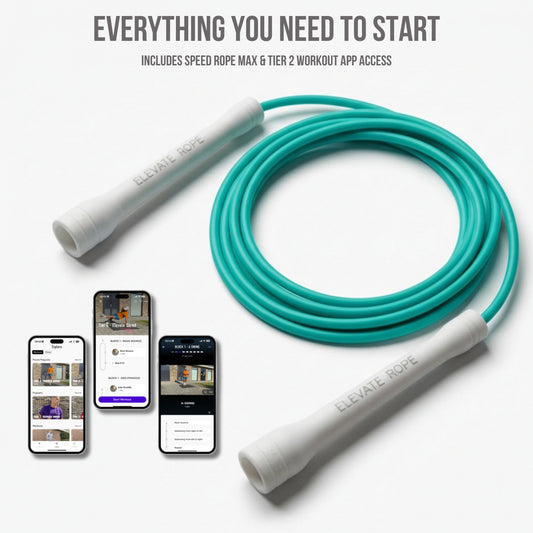
Every Elevate rope comes with free access to our app, with 100+ guided workouts and a built-in timer, so you are never guessing what to do with your ten minutes, and there is no subscription waiting after the purchase. The rope is yours. More than 1,200 verified reviews from the Elevate Family back the approach. Pick one, give it ten minutes, and let the evidence stack up.
Sources
- U.S. Department of Health and Human Services. Physical Activity Guidelines for Americans, 2nd edition (2018).
- American Heart Association. Physical Activity Guidelines for Americans From the US Department of Health and Human Services. Circulation: Cardiovascular Quality and Outcomes.
- Ussery EN, Watson KB, Carlson SA. The Influence of Removing the Ten-Minute Bout Requirement on National Physical Activity Estimates. Preventing Chronic Disease, CDC (2020).
- McMaster University / Gillen et al. No time to get fit? Think again (sprint interval training study). ScienceDaily, PLOS One (2016).
- Stamatakis E, et al. Association of wearable device-measured vigorous intermittent lifestyle physical activity with mortality. Nature Medicine (2022).
- O'Donovan G, et al. The 2018 Physical Activity Guidelines for Americans: What's New? Journal of Orthopaedic & Sports Physical Therapy (2019).
- Compendium of Physical Activities (2024 Adult Compendium), for MET intensity values.
You may also like
→ The Real Reason You Can't Stick to a Workout Routine
→ Why 67% of Gym Memberships Go Unused (and What Quietly Works Instead)
→ Is Jump Rope a Good Workout for Adults? What the Evidence Says