





By Geraldo Alken, founder and CEO of Elevate Rope. Published 1 September 2026.
To jump rope without hurting your ankles, land on the front of your foot with a soft knee, keep the hop low enough to clear a 5mm cable and no higher, jump on a surface with some give, and add minutes in small steps. Sore ankles after skipping are usually a load problem rather than a form problem you can fix in one session.
What the ankle is actually doing
Every landing asks the ankle to take your body weight, absorb it, and hand it back for the next hop. Done well, most of that is soaked up by the calf and the arch of the foot before the joint sees it. Done badly, the heel hits first and the joint takes the load directly.
That is why ankle pain and calf soreness usually show up together. They are the same problem seen from two ends.
The landing
Land on the ball of the foot with the heel hovering just off the floor. The heel can kiss the ground, it should not slam into it. Keep a small bend in the knee. A locked knee has nowhere to send the force except up.
Keep the hop small. The rope is five millimetres thick, so you need about two centimetres of clearance. Most people jump ten or fifteen. Cutting the hop height is the single change that takes the most load off the ankle, and it costs nothing.
The surface you jump on
Concrete is the hardest surface most people have access to and it is the one most people use, because it is the garage or the patio. It gives you nothing back. Wood, rubber, a gym floor or a mat all return some of the landing instead of sending it up your leg.
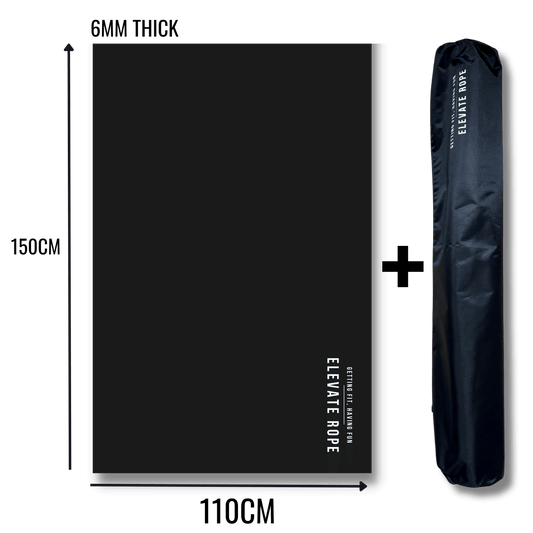
A mat also saves your rope. This is the most common thing we hear from people who jump every day on a hard floor: the beads wear flat, or the PVC coating scuffs through. If you are jumping on concrete regularly, a mat from accessories pays for itself in cable life alone. There is more on surfaces and joints in is jump rope bad for your knees.
Volume, and the mistake almost everyone makes
Skipping is easy to do too much of, because it does not feel hard until the next morning. Fifteen minutes a day sounds modest and it is roughly 1,800 landings.
If you are coming back to it, or starting from nothing, work in short sets with real rest. Thirty seconds on and thirty off for five rounds is a session. Add a round a week rather than adding five minutes at once. That is unglamorous advice and it is the reason most ankle complaints never happen in the first place.
Shoes
Jump in something with a bit of cushioning under the forefoot and a sole that is not too soft sideways. Running shoes with a big heel stack are not ideal, because the heel gets in the way of landing where you want to land. Barefoot has its own arguments, and its own risks on a hard floor, which is covered in jumping rope barefoot.
Mobility work that helps
Stiff ankles land worse. If you cannot get much forward bend at the ankle with your heel down, your calf and your foot pick up the difference. Ten minutes of ankle and calf work a few times a week changes how the landing feels within a fortnight. We wrote the routine up separately in jump rope ankle and shin mobility, and the related shin problem in shin splints from jumping rope.

Where the rope comes into it
Less than people think, but not nothing.
A rope that is too long makes you jump higher to clear it, and a higher hop is a harder landing. Size it properly. Stand on the middle of the cable and the handles should reach between your armpit and the top of your shoulder. Our cables have no metal in them, so you trim to length with household scissors and lock it off, on the speed ropes with a snaplock and on the beaded ropes with a washer.
The second thing is pace. A beaded rope turns slower than a thin speed cable and tells you where it is, which tends to produce a calmer, lower hop while you are still learning. That is not a medical claim, it is what the rhythm does to your jumping.
When to stop
Soreness that eases as you warm up and settles within a day or two is normal training soreness. Sharp pain, pain in one ankle only, swelling, or anything that is still there after a week of rest is worth showing to a physiotherapist or a doctor before you jump on it again. The same goes if it followed a specific moment where something felt wrong.
If the ankles are one of several things bothering you, the overview is in jump rope problems and how to fix them.
About the author
Geraldo Alken is the founder and CEO of Elevate Rope. He designs jump ropes and works with jumpers every day, from people picking up a rope for the first time to professionals.
Frequently asked questions
Why do my ankles hurt after jumping rope?
Most often because you added minutes faster than your calves and ankles adapted, and because a hard floor gives nothing back on landing. Heel-first landings and a hop higher than the rope needs both send more force through the joint.
What surface is best for jumping rope?
Something with a little give. Wood, rubber, a gym floor or a mat all absorb part of the landing. Concrete absorbs none of it and it also wears through cables and flattens beads faster than any other surface.
How high should you jump when skipping?
About two centimetres. A speed cable is five millimetres thick, so that is all the clearance you need. Most people jump several times higher than that, and every extra centimetre is a harder landing.