





If you keep tripping on your jump rope, the cause is almost always one of six things: the rope is too long, the cable is too light or too fast for your level, your arms are too far from your body, your surface is wrong, you are jumping too high, or you cannot feel where the rope is. Only the last two are about you. The first four are setup.
By Geraldo Alken, founder and CEO of Elevate Rope. Published 24 August 2026.
1. The rope is too long
This is the big one. A rope that is too long lands in front of your feet instead of under them, and the extra slack drags on the floor and slows one side of the arc. You feel it as a rope that catches at random.
Stand on the middle of the cable with one foot. The handle tops should reach somewhere between your armpit and the middle of your chest, depending on how experienced you are. Longer for beginners, shorter as your form tightens. Our sizing guide has the full method.
Because there is no metal in our cables, you can cut a rope to length with household scissors and lock it with the snaplock in the handle. Take 5cm off, jump for two minutes, take another 5cm if you need it. That is the whole job.
2. The cable is faster than your timing
A very thin, very stiff cable moves through the air quickly and gives you almost nothing back. If your timing is a fraction out, the first thing that tells you is your shins. That is a fine trade for a competitive speed jumper and a hard one for anybody still learning the rhythm.
The same applies to handles with bearings. A bearing lets the cable keep turning faster than your arms are actually moving, so the rope arrives slightly ahead of where your body expects it. We build our handles without bearings for exactly that reason, and the full argument is in bearing vs bearing-free jump ropes.
3. You cannot feel where the rope is
Most beginners are not badly coordinated. They are jumping blind. A light, fast cable passes without you sensing it, so you time the jump off sound and hope.
This is what beads solve. The 2.5cm beads on a Dignity Beaded Rope catch air, hold the arc of the rope, and click when they hit the floor. You stop guessing. Customers tell us the sound is what makes the timing click, and one wrote that it makes it easy to jump on the beat with music. We run the beads on 3.5mm polycord rather than the 3mm you usually see, because the thicker cord holds its shape better in the air.
If you want the background on that rope type, read what are beaded jump ropes.
4. Your arms are drifting away from your body
Every centimetre your hands move away from your hips shortens the working length of the rope. Start with your elbows near your ribs and your hands slightly in front of the hip line. If your hands creep out as you get tired, the rope starts clipping your toes even though nothing about the rope changed.
Handle length changes how obvious this is. A 13cm handle keeps your hands close. A 20cm handle on our long handle ropes puts them further from the axis on purpose, which is useful for tricks and less useful when you are still fighting for a clean hundred singles. More on that in jump rope handles explained.
5. The surface is working against you
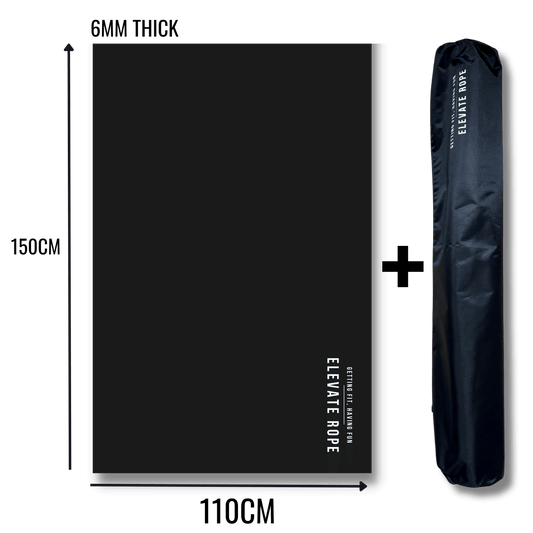
Concrete gives you no bounce and chews the underside of the cable. Thick carpet swallows the rope. Deep grass grabs it. If you are jumping outdoors on stone, a mat is the cheapest fix on the list and it also keeps the cable alive longer. We sell them in accessories, but any firm mat will do.

6. You are jumping too high
Two or three centimetres is enough. Most people jump ten, which leaves them landing while the rope is still coming through. Try jumping so low it feels silly. If you stop tripping, that was it.
A quick order to work through
- Size the rope first. Nothing else matters until that is right.
- Then drop your jump height and pull your hands in.
- Then look at the surface.
- Only then change the rope itself.
Most people do that list backwards and buy a new rope on day two.
Common questions
How long does it take to stop tripping?
It varies more than anyone selling you something will admit. What we see is that people who fix the length first get to a clean set much sooner than people who keep changing their technique on a rope that was never the right size.
Does a heavier rope help beginners?
It often does, because slower is easier to time. A beaded rope or a heavy rope both slow the arc down, they just do it for different reasons. Beaded for feedback, heavy for load.
Is it the rope or is it me?
Test it in one minute. Have somebody film you from the side. If the rope is hitting the floor well in front of your toes, it is length. If it is hitting your heels, your hands are too far back or you are leaning forward.
About the author
Geraldo Alken is the founder and CEO of Elevate Rope. He designs jump ropes and works every day with jumpers, from complete beginners to professionals.