





The best jump rope mat alternative is a horse stall mat or a sheet of dense rubber, cut to size. Plywood works if you seal the edges. Interlocking foam tiles and a doubled yoga mat both fail for the same reason: they are too soft and too narrow.
We sell a mat, so treat this with the scepticism it deserves. But there is no point writing a page that pretends the only answer is the one with our name on it. Some of these work fine.
Two rules decide all of it.
Width beats everything. A rope arc is about a metre and a half across for most adults. If the surface is narrower than that, the cable lands on the floor either side and you have solved nothing.
Firm beats soft. Your hop comes from pushing into the ground and getting something back. Anything that swallows the push slows your turn and flattens your rhythm.
Horse stall mat
The best of the lot, by a distance.
Dense recycled rubber, usually 12 to 19 millimetres thick, sold in large sheets at agricultural suppliers. It is heavy, it does not slide, it kills noise, and it is smooth enough that the cable does not catch.
Two catches. It is genuinely heavy, so it lives where you put it. And it smells of rubber for the first few weeks, which matters in a bedroom and not in a garage.
If you have a garage or a shed and no plans to move the setup, this is the answer.
Plywood over concrete
Cheap, and better than it sounds.
A sheet of 18mm plywood laid over concrete gives you a small amount of flex, which is more than the concrete gives you on its own. It is smooth, so cable wear drops a lot.
Seal or tape the edges. A raw plywood edge splinters, and a cable that catches a splinter frays in one session. It also does nothing for noise, so this is a garage solution and not a flat solution.
Interlocking foam tiles
The most common mistake.
They are cheap, they cover a big area, and they feel protective underfoot. That is exactly the problem. Foam absorbs the push-off, so you work harder for a slower turn. The seams also lift, and a lifted seam catches a cable.

They are fine as a floor protector under something else. They are poor as the surface you actually jump on.
A doubled yoga mat
Too narrow, too soft, and now twice as soft.
A yoga mat is around 60cm wide. Your arc is around 150cm. Doubling it does not make it wider. All you get is more softness in the one place you did not want it.
The one thing it does do is protect the floor directly under your feet, so if your only worry is a scuff mark under the landing, it half works.
An old rug or carpet offcut
Quiet, cheap, and slow.
A dense low-pile rug on a hard floor is a reasonable compromise. It kills most of the noise and stops the cable striking bare concrete. Thick pile does the same thing carpet does and drags on the turn.
Tape the edges down. A rug that slides under a landing is a real way to turn an ankle.
Nothing, and a cheaper rope
The honest option nobody lists.
If you jump on concrete twice a week for ten minutes, the maths might not favour a mat at all. A cable is a consumable on hard ground. Buying two spare cables and accepting the wear is a legitimate choice, and for a light user it can be the cheaper one.
Where it stops working is noise and joints. Neither of those is solved by a spare cable.
What a jump rope mat alternative has to beat
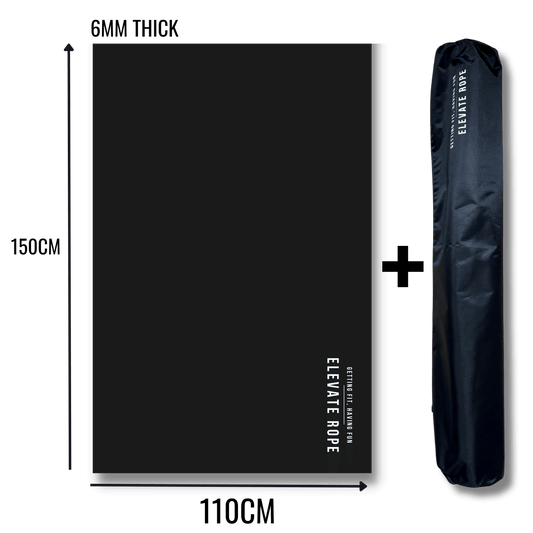
We sized ours at 150 by 110 centimetres, against the arc of a rope rather than the width of a person. That number is the whole reason the product exists, and it is the one thing most of the alternatives above get wrong.
The rest of it is the same brief you would give yourself. Dense rather than thick. Smooth enough that a cable does not catch. Heavy enough to stay put, and able to roll up so it goes back in a cupboard.
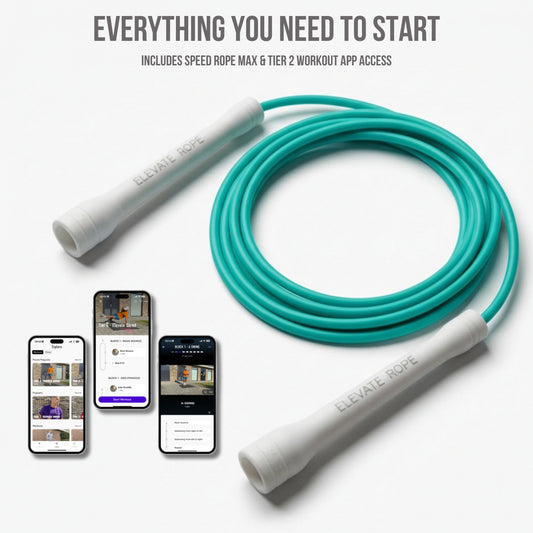
On the rope side, our cables are 5mm PVC over a nylon core with no metal in them. The PVC is the wear layer, so a cable that has lived on a rough surface thins before it kinks and gives you warning. That is worth knowing whichever surface you land on, because it means the wear is visible before it becomes a failure.
The short version
- If you have a garage: horse stall mat.
- If you have a garage and no budget: sealed plywood.
- If you have a flat and neighbours: dense low-pile rug, or a proper mat.
- If you jump twice a week and nothing hurts: nothing, and keep a spare cable.
- If you are about to buy foam tiles: do not.
Geraldo Alken is the founder and CEO of Elevate Rope. He designs jump ropes and works daily with jumpers from beginner to professional.