




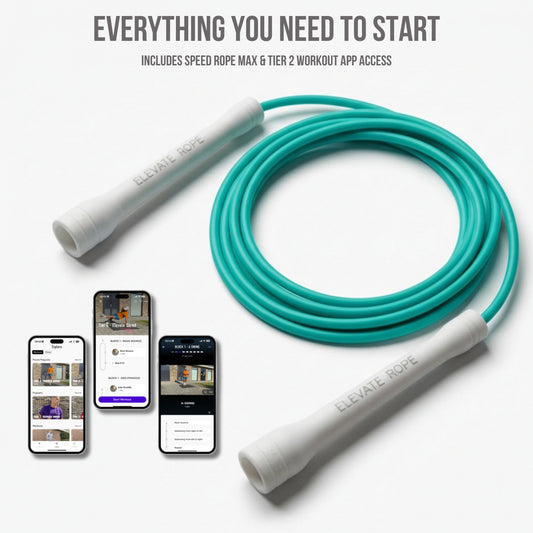

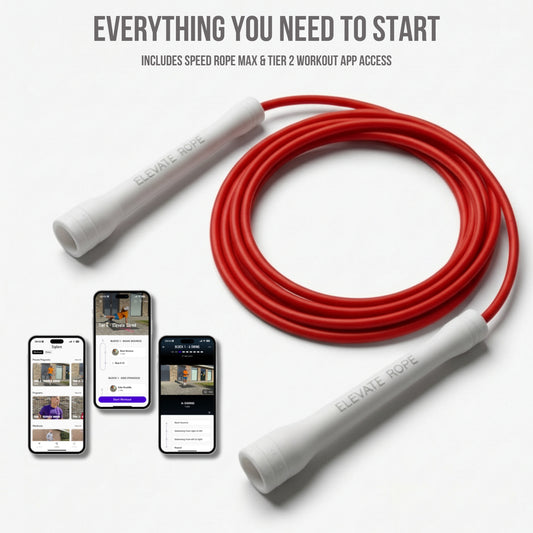




Benefits of Jump rope improves conditioning, coordination, grip strength, and core stability—all without sacrificing the muscle gains that strength athletes prioritize. It's why powerlifters, bodybuilders, and functional fitness athletes increasingly use rope skipping as a strategic training tool rather than just a warm-up.
Most lifters avoid cardio until poor conditioning limits their performance. The signs appear gradually: early fatigue during high-rep accessory work, extended rest times between sets, feeling gassed during supersets. By then, rebuilding work capacity takes months of dedicated effort.
Jump rope solves this problem in 10-15 minutes per session. Research suggests that 10 minutes of skipping delivers cardiovascular benefits comparable to 30 minutes of jogging—without the prolonged catabolic stress that threatens muscle tissue. Heavy ropes add grip and shoulder benefits that transfer directly to your barbell movements.
What you'll learn:
- Why 10 minutes of rope work matches 30 minutes of jogging for cardiovascular benefit
- How weighted ropes build grip strength that transfers to deadlifts and pull-ups
- The coordination and posture improvements most lifting programs miss
- Which rope style matches your specific training goals
- How to program jump rope without compromising recovery or gains

Why Strength Athletes Overlook Cardio (And Pay for It Later)
Conditioning gaps don't reveal themselves during your working sets. They appear during the fourth round of accessories, on competition day when your heart rate won't settle between attempts, or during a pickup basketball game when you're breathing harder than everyone else. By the time poor work capacity becomes obvious, rebuilding it requires months of consistent effort.
The "Cardio Kills Gains" Misconception
The fear is understandable. Endurance training can interfere with strength and hypertrophy adaptations—researchers call this the interference effect. Marathon runners don't build impressive squat numbers, and lifters have internalized this as "all cardio is bad."
But the research tells a more nuanced story. The interference effect primarily occurs with high-volume, long-duration aerobic training performed frequently alongside resistance work. Short conditioning sessions of 10-20 minutes, especially those using intervals or skill-based movement, show minimal impact on strength gains when programmed intelligently.
The distinction matters: 45 minutes on a treadmill five days per week will likely compromise your gains. A 10-minute jump rope finisher three times per week will not.
Signs Your Conditioning Is Holding Back Your Lifts
Poor cardiovascular fitness doesn't announce itself during heavy singles. It sabotages you in subtler ways.
Your rest periods keep creeping longer. What used to be 90 seconds between sets has become three minutes, then four. Your workout that once took 75 minutes now stretches past two hours.
High-rep work feels disproportionately hard. A set of 12 on Romanian deadlifts leaves you more winded than it should. Supersets feel impossible. Drop sets become survival exercises rather than productive training.
Recovery between sessions suffers. Elevated resting heart rate, disrupted sleep, and lingering fatigue suggest your cardiovascular system can't support your training volume.
Daily activities expose the gap. Climbing stairs, carrying groceries, playing with your kids—these shouldn't leave a strong person out of breath. When they do, conditioning is the limiting factor.
What Efficient Cardio Looks Like for Lifters
Not all cardiovascular training carries the same trade-offs. The ideal conditioning tool for strength athletes shares specific characteristics.
Time efficiency matters most. Lifters already spend significant time under the bar. Cardio that delivers benefits in 10-15 minutes fits into existing schedules without requiring additional gym sessions.
Minimal eccentric stress preserves recovery. Running accumulates muscle damage through repeated eccentric loading. Cycling and rowing are better, but still demand dedicated equipment and space. Jump rope is concentric-dominant and creates minimal delayed-onset soreness.
Skill-based engagement prevents boredom. Treadmill walking is effective but mind-numbing. Movement that requires coordination—timing hands with feet, maintaining rhythm—keeps athletes engaged and builds transferable athletic qualities.
Secondary benefits compound the value. The best conditioning for lifters doesn't just improve cardiovascular health. It builds grip endurance, shoulder stability, coordination, or other qualities that enhance performance under the bar.
Jump rope checks every box. It's time-efficient, low in eccentric stress, skill-based, and delivers benefits beyond conditioning alone. That combination explains why athletes from boxers to CrossFitters have used it for decades—and why more strength athletes are adding it to their training.

Benefit 1: Time-Efficient Conditioning That Preserves Muscle
Research suggests 10 minutes of jump rope produces cardiovascular benefits comparable to 30 minutes of jogging—without the prolonged catabolic stress that threatens muscle tissue. For lifters who guard their training time and recovery capacity, this efficiency ratio changes the calculus on cardio entirely. Among the many benefits of jump rope for strength athletes, time efficiency ranks highest.
The Calorie-Burn Math
Jump rope burns between 10 and 20 calories per minute depending on intensity, body weight, and rope style. A moderate 15-minute session typically burns 150-250 calories. An intense session with a weighted rope can push toward 300 calories in the same timeframe.
Compare that to other conditioning options. Swimming burns roughly 250 calories in 30 minutes. Cycling at moderate intensity burns 200-300 calories in 30 minutes. Boxing training burns 300-400 calories in 30 minutes. Jump rope matches or exceeds these numbers in half the time—which explains why calorie efficiency consistently appears when researchers study the benefits of jump rope for athletes.
A study at Arizona State University found that 10 minutes of jumping rope produced equivalent cardiovascular improvements to 30 minutes of jogging. The American Journal of Cardiology confirmed similar findings: 10 minutes of rope work reduced heart disease risk factors as effectively as 30 minutes of running. (Source: Arizona State University; American Journal of Cardiology)
This isn't about shortcuts. It's about energy system efficiency. Jump rope's combination of full-body engagement, continuous movement, and adjustable intensity creates a metabolic demand that slower, isolated cardio methods can't match minute-for-minute.
Why Jump Rope Spares Muscle
Long-duration cardio threatens muscle tissue through two primary mechanisms: elevated cortisol from extended exercise bouts, and energy expenditure that competes with recovery resources. Jump rope sidesteps both problems—making muscle preservation one of the key benefits of jump rope that lifters overlook.
Short, intense sessions minimize cortisol elevation. The stress hormone rises significantly during exercise lasting longer than 45-60 minutes. A 10-15 minute rope session stays well under this threshold, creating cardiovascular stimulus without the hormonal environment that promotes muscle breakdown.
The movement pattern favors muscle preservation. Jump rope is plyometric in nature—quick, reactive contractions that stimulate fast-twitch muscle fibers rather than the slow-twitch endurance fibers that dominate during steady-state cardio. You're training explosiveness and coordination, not teaching your body to become more efficient at low-intensity work.
Energy expenditure stays controlled. A 15-minute session burning 200 calories is easy to account for nutritionally. An hour of running burning 600+ calories creates a recovery debt that competes with muscle-building processes. The shorter session delivers conditioning benefits while leaving more resources for adaptation to your strength training.
Practical Programming for Lifters
Integration matters more than duration. A well-placed 10-minute session beats a poorly-timed 30-minute session for strength athletes.
As a warm-up (5 minutes): Light rope work elevates heart rate, increases core temperature, and sharpens coordination before you touch the barbell. Start with basic bounces at a conversational pace, progressing to alternating feet as you loosen up. This prepares your nervous system for the session ahead without creating fatigue.
As a finisher (8-12 minutes): After your main lifts and accessories, a conditioning finisher improves work capacity without interfering with strength work. Try intervals: 30 seconds of work followed by 30 seconds of rest, repeated for 8-12 rounds. This approach builds the specific endurance that supports higher training volumes over time.
On rest days (15-20 minutes): Dedicated conditioning sessions work best when separated from heavy lifting by at least 6-8 hours, ideally on different days entirely. A moderate-intensity 15-minute session promotes blood flow to recovering muscles while building aerobic base. Keep the intensity conversational—you should be able to speak in full sentences throughout.
Weekly template for most lifters: Two sessions as warm-ups (5 minutes each), two sessions as finishers (10 minutes each), and one optional rest-day session (15 minutes). Total weekly investment: 45-50 minutes. Cardiovascular improvement: significant.
Answer Block: Time-Efficient Conditioning
Short answer: Jump rope burns roughly three times the calories per minute compared to jogging, allowing effective conditioning in 10-15 minute sessions.
Why it matters: Strength athletes can maintain cardiovascular health and work capacity without the long, muscle-depleting cardio sessions that interfere with recovery and gains. This is why time efficiency tops the list of benefits of jump rope for weightlifters.
Best next step: Start with a 5-minute warm-up before your next training session—basic bounces at a pace where you can still breathe comfortably. Notice how it elevates your readiness without creating fatigue.
Benefit 2: Grip Strength That Transfers to Deadlifts and Pull-Ups
Heavy ropes force continuous forearm engagement throughout every session, building the kind of grip endurance that static holds and occasional farmer carries can't replicate. Users consistently report noticeable improvements within 2-4 weeks—and those improvements show up immediately in their pulling movements. Of all the benefits of jump rope that surprise strength athletes, grip development ranks among the most underrated.
The Grip Endurance Connection
Grip training for lifters typically involves two approaches: static holds (hanging from a bar, holding heavy dumbbells) and dynamic work (farmer carries, fat grip accessories). Both have value. Neither replicates what happens during heavy rope training.
A weighted rope demands constant micro-adjustments. Your forearms aren't just holding—they're controlling rotation, managing momentum, and stabilizing against centrifugal force that increases with speed. This combination of isometric grip and dynamic wrist control creates a training stimulus that isolated grip work misses entirely. When lifters discover the benefits of jump rope for forearm development, heavy ropes typically become a permanent addition to their training.
The duration compounds the effect. A typical heavy rope session involves 10-15 minutes of continuous or near-continuous forearm engagement. Compare that to a 30-second static hold or a 40-meter farmer carry. The accumulated time under tension builds endurance that transfers directly to high-rep pulling work.
The feedback from strength athletes is consistent. After two to four weeks of regular heavy rope use, standard grip demands feel noticeably easier. Deadlift sets that previously challenged grip become limited only by the target muscles. Pull-up bars feel more secure. The improvement isn't subtle.
Why This Matters for Barbell Movements
Grip fails before prime movers in nearly every pulling exercise. This isn't a problem during heavy singles where you can use straps or mixed grip. It becomes a significant limiter during the volume work that drives hypertrophy and builds work capacity. Understanding the benefits of jump rope for grip endurance changes how lifters approach this limitation.
Consider a set of 12 Romanian deadlifts. The hamstrings and glutes have plenty left, but by rep 8, your grip is fighting to hold on. You finish the set with compromised form because your hands are the weak link. Multiply this across sessions and months—that's substantial training quality lost to grip limitations.
Rows present the same challenge. Barbell rows, dumbbell rows, cable rows—all limited by how long your hands can maintain a secure hold under load. When grip endurance improves, you complete more quality reps before form breaks down.
Pull-ups and chin-ups expose grip weakness most directly. The high-rep sets that build back thickness require grip endurance that many lifters lack. Improving forearm stamina means more productive sets and faster progress.
Deadlift lockout benefits as well. Grip security affects your confidence and positioning during heavy pulls. When your hands feel solid, you can focus entirely on hip drive and back position rather than fighting to keep the bar in your fingers.
Heavy Rope vs. Speed Rope for Grip Development
Not all jump ropes challenge grip equally. The difference between a lightweight speed rope and a heavy rope is substantial enough to determine whether grip benefits occur at all.
Standard speed ropes weigh 100-200 grams total. The cable is thin (often 2.5-4mm), the handles are light, and the rotational forces are minimal. These ropes excel at conditioning and coordination work but create negligible grip demand. Your forearms won't fatigue during a speed rope session unless you're doing something wrong.
Heavy ropes change the equation entirely. A 0.5kg weighted cable with 10mm diameter generates meaningful centrifugal force with every rotation. The faster you swing, the harder your forearms work to control the rope's path. This progressive resistance—where difficulty increases with your own improvement—creates ongoing adaptation stimulus.
The grip demand of heavy rope work more closely mimics the challenge of barbell training. You're not just holding weight; you're controlling dynamic forces while maintaining precise positioning. This specificity explains why the carryover to pulling movements is so direct.
For lifters prioritizing grip development, heavy ropes are the clear choice. Speed ropes serve other purposes well, but they won't build the forearm endurance that transfers to your barbell work.
Answer Block: Grip Strength Transfer
Short answer: Heavy ropes (0.5kg+) create continuous forearm engagement that builds grip endurance within 2-4 weeks of consistent use.
Why it matters: Grip typically fails before target muscles during deadlifts, rows, and pull-ups—limiting training quality and progress. Improved grip endurance means more productive sets. This makes grip development one of the most practical benefits of jump rope for weightlifters.
Best next step: If grip is a limiting factor in your pulling work, prioritize a weighted rope over a speed rope. Start with 5-minute sessions and build toward 10-15 minutes as forearm endurance improves.

Benefit 3: Coordination and Timing for Athletic Movement
Jump rope trains hand-foot-eye coordination patterns that most strength programs ignore entirely. This isn't about becoming a skilled rope jumper—it's about building neural pathways that improve movement quality during compound lifts and athletic activities outside the gym. Among the benefits of jump rope that translate directly to barbell performance, coordination development deserves more attention than it receives.
The Coordination Demand of Skipping
Treadmill running requires minimal cognitive engagement. Set the pace, maintain your stride, zone out. Your body handles the repetitive motion automatically while your mind wanders elsewhere.
Jump rope doesn't allow this. Every rotation demands timing calibration—hands and feet must synchronize within a narrow window or the rope catches. This bilateral coordination requirement keeps your nervous system engaged throughout the session. When researchers examine the neurological benefits of jump rope, this forced engagement consistently appears as a primary mechanism.
The feedback loop is immediate and unforgiving. Lose focus for a moment and you trip. This constant demand for attention strengthens the connection between intention and execution, between what your brain signals and what your body produces.
Over time, this coordination work builds what motor learning researchers call proprioceptive awareness—your sense of where your body is in space and how it's moving. This awareness doesn't stay confined to rope work. It transfers to other movements that demand precise timing and body control.
The contrast with most gym cardio is stark. Ellipticals, bikes, and rowing machines all involve repetitive patterns that become automatic quickly. Jump rope maintains its coordination demand regardless of skill level—you simply progress to more challenging variations rather than zoning out during basic ones.
How Coordination Improves Lifting Performance
Strength athletes often dismiss coordination as irrelevant to barbell work. The movements are slower, the loads are external, the skill demands seem different. This perspective misses how fundamental timing and body awareness are to quality lifting. The benefits of jump rope for movement quality become obvious once you understand the connection.
Olympic lifts depend entirely on coordination. The snatch and clean require precise sequencing of hip extension, arm pull, and repositioning under the bar. Lifters who struggle with these movements often lack the body awareness to feel where they are during the lift's fast phases. Jump rope builds exactly this awareness—the sense of your body in dynamic motion.
Squats and deadlifts benefit from improved proprioception. Knowing where your hips are relative to your knees, feeling whether your back is neutral or rounding, sensing weight distribution across your feet—these perceptions determine technique quality. Better body awareness means better positioning under load.
Barbell cycling in CrossFit-style training rewards coordination. Touch-and-go deadlifts, cycling clean and jerks, high-rep snatches—all require rhythm and timing that pure strength doesn't provide. Athletes who jump rope regularly often find barbell cycling more intuitive. This is one of the benefits of jump rope that CrossFit athletes discover quickly.
Injury prevention connects to coordination as well. Movement errors under load cause injuries. When your nervous system processes position and timing more accurately, you're less likely to make the small mistakes that accumulate into joint stress or acute injury.
The Learning Curve (It's Shorter Than You Think)
Adults often assume jump rope competence requires weeks of frustrating practice. Childhood memories of easy skipping contrast with adult attempts that feel clumsy and uncoordinated. This gap discourages many from starting—but the benefits of jump rope begin during the learning phase, not after mastery.
The reality is more encouraging. Most adults achieve basic competence—continuous bouncing without frequent trips—within one to two weeks of daily 10-minute practice. The key variables are rope selection and realistic expectations.
Rope weight matters more than most beginners realize. Ultralight ropes give almost no feedback about position. Your brain can't track where the rope is because there's insufficient sensory information. A slightly heavier rope—PVC cable rather than thin wire, or a beaded rope with segmented weight—provides the tactile feedback that accelerates learning.
Starting expectations should be modest. Five consecutive jumps is a reasonable first-session goal. Ten jumps without tripping is a solid day-two achievement. Within a week, most people can string together 30-50 jumps consistently. Within two weeks, minute-long sets become achievable.
The coordination benefits begin immediately, not after mastery. Even the learning phase—when you're tripping frequently and resetting—trains the neural pathways that improve body awareness. The frustration of early sessions is productive frustration.
For strength athletes specifically, the learning curve often proves shorter than average. Years of barbell training build body awareness and motor control that transfer to new movement skills. The coordination isn't absent—it just needs a new application.
Answer Block: Coordination Development
Short answer: Jump rope requires continuous hand-foot synchronization that builds body awareness and timing—skills that transfer to compound lifts and athletic movement.
Why it matters: Better proprioception improves technique quality under load, supports Olympic lifting progression, and reduces injury risk from movement errors. These benefits of jump rope compound over months of consistent practice.
Best next step: Commit to 10 minutes of daily practice for two weeks. Use a rope with enough weight to provide feedback (PVC cable or beaded rope rather than thin wire). Expect 5-10 consecutive jumps in the first session and 50+ within two weeks.

Benefit 4: Core Engagement and Posture Correction
Maintaining an upright torso while jumping requires continuous core stabilization—thousands of small contractions per session that build the midline endurance lifters need for heavy compounds. This isn't the dramatic bracing of a max squat. It's the sustained stability that keeps your spine neutral through high-rep sets and long training sessions. Core engagement represents one of the most overlooked benefits of jump rope for strength athletes.
Passive Core Training During Every Jump
Traditional core training isolates the midsection. Planks, crunches, ab wheel rollouts—all demand focused attention on the trunk muscles. These exercises have value, but they represent additional training volume that competes for recovery resources. The benefits of jump rope for core development happen automatically, without dedicated ab work.
Jump rope trains the core differently. Each landing creates a small perturbation that your trunk muscles must counter to maintain upright posture. Each arm rotation generates rotational forces that your obliques resist. This happens automatically, below conscious awareness, thousands of times per session.
The cumulative effect is significant. A 10-minute session at moderate pace involves roughly 1,000-1,200 jumps. Each jump requires a subtle brace-and-stabilize sequence from your deep core muscles. That's volume no dedicated ab workout matches—and it happens while you're simultaneously building conditioning.
The core engagement increases with rope speed and weight. Faster rotations generate more centrifugal force to control. Heavier ropes amplify every perturbation. What starts as background stabilization work becomes genuinely demanding core training as you progress to more challenging variations.
This passive training builds endurance rather than peak strength. Your core won't grow from jump rope the way it might from heavy loaded carries. But the sustained stabilization capacity—the ability to maintain midline integrity through long sets and extended sessions—improves substantially.
Postural Benefits for Desk-Bound Lifters
Modern life pulls your body forward. Hours at a desk, time on phones, driving, eating—nearly every daily activity encourages rounded shoulders and a flexed thoracic spine. Even dedicated lifters spend far more time in these positions than under a barbell. The postural benefits of jump rope directly counteract this forward pull.
Bench pressing compounds the problem. The movement pattern shortens the chest and anterior shoulder muscles while the upper back remains relatively passive. Lifters who bench frequently without adequate pulling volume develop the characteristic rounded posture that limits overhead mobility and increases shoulder injury risk.
Jump rope encourages the opposite position. Efficient technique requires an upright torso, retracted shoulder blades, and a neutral spine. Your head stays level, eyes forward, chest open. Maintaining this position while jumping reinforces the postural muscles that desk work and bench pressing neglect.
The shoulder blade positioning deserves specific attention. During rope work, your scapulae must stay stable while your arms rotate. This trains the mid-back muscles—rhomboids, middle and lower trapezius—that pull the shoulders back and down. These are exactly the muscles that weaken during prolonged sitting.
Regular rope work creates a postural counterbalance. Ten to fifteen minutes of upright, shoulders-back positioning helps offset hours of forward-leaning desk posture. The effect is gradual but noticeable—lifters report improved overhead mobility and reduced upper back tightness after consistent rope training.
Heavy Ropes Amplify the Core Demand
The difference between a standard rope and a heavy rope is immediately apparent in your midsection. What feels like effortless bouncing with a lightweight cable becomes genuine trunk work with a 0.5kg weighted rope. Lifters seeking the core-specific benefits of jump rope should prioritize heavy ropes over speed ropes.
Weighted cables generate greater rotational forces. Your obliques must work harder to prevent your torso from twisting with each arm rotation. The faster you swing, the more significant this anti-rotation demand becomes. This mirrors the core stability required during single-arm rows or asymmetrical carries.
Shoulder and core work together against the load. The weighted rope pulls your arms forward with each rotation, creating a perturbation your entire posterior chain must resist. Your upper back engages to keep shoulders in position while your core braces to maintain spinal neutrality.
The breathing challenge adds another dimension. Heavy rope work elevates heart rate quickly, demanding deeper breaths. Maintaining core stability while breathing hard teaches the coordination between diaphragm and trunk muscles that supports heavy lifting under fatigue.
For lifters specifically seeking core benefits, heavy ropes justify their place in a training program. The stability demands approach those of moderate loaded carries or plank variations—but with the added benefit of conditioning work happening simultaneously.

Benefit 5: Low-Impact Active Recovery
Contrary to common assumptions, properly performed jump rope creates less joint stress than running—making it suitable for recovery days when you want blood flow and light movement without additional training stress. The technique matters, but the biomechanics favor lifters concerned about knee and hip health.
The Impact Comparison to Running
The visual of jumping up and down suggests high impact. Watching someone skip rope, you'd reasonably assume each landing hammers the joints. Research tells a different story.
A 2019 study published in Gait & Posture Journal found that jump rope puts less stress on knees compared to running when performed with correct technique. The NIH has described rope jumping as "hip and knee protective" due to lower joint loads than running produces. These findings surprise most people—but the biomechanics explain why. (Source: Gait & Posture Journal, 2019; NIH)
Running involves a flight phase where your entire body leaves the ground, followed by a single-leg landing that absorbs two to three times your body weight. This repeats thousands of times per mile, with each impact traveling through ankle, knee, and hip on one side of the body.
Jump rope mechanics differ fundamentally. Proper technique keeps you on the balls of your feet with minimal ground clearance—one to two inches at most. Both feet share the landing load. The elastic properties of your calf muscles and Achilles tendons absorb and return energy rather than transmitting force directly through the joints.
The cumulative difference is substantial. A 30-minute run might involve 3,000-4,000 single-leg impacts at high force. A 15-minute rope session involves bilateral landings with lower peak forces per contact. Your joints experience less stress despite the higher movement frequency.
This doesn't mean jump rope is zero-impact. It means the impact is manageable for most people, including those who've abandoned running due to joint concerns.
Why Form Matters for Joint Health
The research showing joint-protective benefits assumes proper technique. Poor form can turn rope work into exactly the joint-stressing activity people fear. Understanding the key technique points protects your knees and hips.
Stay on the balls of your feet throughout. Flat-footed landings eliminate the shock absorption your calf complex provides. When your heel strikes the ground, impact transmits directly through the ankle and knee rather than being dampened by muscle and tendon elasticity.
Jump only as high as necessary—one to two inches of clearance is sufficient for the rope to pass beneath your feet. Higher jumps increase landing forces proportionally. The goal is efficiency, not altitude. Watch skilled rope jumpers and you'll notice their feet barely leave the ground.
Land softly with slightly bent knees. Stiff-legged landings concentrate force at the joint rather than distributing it through the muscular system. A small knee bend on each landing engages the quadriceps as shock absorbers.
Choose appropriate surfaces. Rubber gym flooring, outdoor running tracks, or even short grass provide more give than concrete or hardwood. The surface compliance contributes to impact reduction. If you're jumping on hard surfaces, consider a jump rope mat designed to provide cushioning.
Footwear matters as well. Cross-training shoes or athletic shoes with forefoot cushioning support the ball-of-foot landing pattern. Avoid barefoot jumping on hard surfaces or shoes with minimal cushioning until your technique is solidified.
Using Rope Work on Rest Days
Active recovery accelerates the repair process better than complete inactivity. Light movement increases blood flow to damaged muscle tissue, delivering nutrients and removing metabolic waste products. The question for lifters is finding movement that promotes recovery without adding training stress.
Jump rope fits this role well when intensity stays moderate. A conversational-pace session—where you could speak in complete sentences throughout—elevates heart rate enough to drive circulation without creating additional muscle damage or depleting recovery resources.
The absence of eccentric loading distinguishes rope work from other active recovery options. Running involves significant eccentric stress as your quadriceps decelerate each landing. This eccentric component creates muscle damage that competes with recovery from your lifting sessions. Jump rope's concentric-dominant pattern minimizes this interference.
Ten to fifteen minutes is sufficient for recovery purposes. Longer sessions shift from recovery work toward additional training stress. Keep the pace easy, the duration moderate, and the goal clear: you're promoting blood flow, not building fitness.
Timing around heavy training sessions matters. Rest days are ideal. If you're adding light rope work on a training day, separate it from your lifting by several hours—morning rope session, evening lifts, or vice versa. This separation prevents the fatigue from one session compromising the quality of the other.
The psychological benefit deserves mention as well. Rest days can feel unproductive for athletes accustomed to daily training. A brief rope session satisfies the need for movement and routine without the physical cost of additional hard training. You maintain the habit of showing up while actually recovering.
Sports medicine or physical therapy source on active recovery and blood flow
Answer Block: Low-Impact Recovery
Short answer: Research shows properly performed jump rope creates less joint stress than running, making it effective for active recovery days when you want blood flow without additional training damage.
Why it matters: Active recovery accelerates the repair process better than complete rest. Jump rope provides this benefit without the eccentric muscle damage that running creates—so you recover faster between lifting sessions.
Best next step: On your next rest day, try a 10-minute session at conversational pace. Stay on the balls of your feet, keep jumps low (1-2 inches), and maintain intensity where you could easily hold a conversation. Notice how your body feels the following day compared to complete rest.

Benefit 6: Shoulder Stability and Rotator Cuff Conditioning
The continuous rotation pattern of rope skipping conditions the shoulder stabilizers in ways that pressing-heavy programs neglect. For lifters who bench frequently and overhead press regularly, this rotational work fills a gap that static stretching and occasional face pulls can't address.
What Happens in Your Shoulders During Each Jump
Watch someone jump rope and your attention goes to the feet. The real action happens at the shoulders—small, fast rotations repeated hundreds of times per minute that challenge the stabilizing muscles surrounding the joint.
The rotator cuff controls these movements. Four small muscles—supraspinatus, infraspinatus, teres minor, and subscapularis—work together to center the humeral head in the shoulder socket while your arms rotate. During rope work, these muscles fire continuously to manage the circular motion and resist the centrifugal forces pulling your arms outward.
This isn't strength work in the traditional sense. You won't build bigger rotator cuff muscles from jumping rope. But you will build endurance in these stabilizers—the capacity to maintain shoulder integrity through extended activity rather than fatiguing after a few sets.
The scapular muscles engage as well. Your rhomboids, serratus anterior, and trapezius work to keep your shoulder blades in position while your arms move. This dynamic stability differs from the static positioning of a bench press or the brief engagement during a row. The sustained, rhythmic demand builds coordination between the rotator cuff and the larger muscles that control scapular position.
The wrist and forearm rotation adds another dimension. The circular motion travels through your entire upper extremity—shoulder, elbow, wrist. This integrated movement pattern trains the kinetic chain to work as a unit rather than as isolated segments.
Balancing Pressing Volume with Rotational Work
Most lifting programs favor pressing movements. Bench press, overhead press, incline variations, dumbbell work—the anterior shoulder and chest receive substantial training volume. The muscles that rotate the shoulder externally and stabilize the joint during movement receive far less attention.
This imbalance creates problems over time. Tight anterior shoulders pull the joint forward. Weak external rotators can't counter the internal rotation bias from pressing. The rotator cuff fatigues during heavy work because it lacks the endurance to support high-volume training. Eventually, shoulder pain limits pressing progress.
Traditional solutions involve dedicated rotator cuff exercises. Band pull-aparts, face pulls, external rotation work with cables or dumbbells. These exercises help, but they represent additional training time and recovery demand. Many lifters skip them because they're boring or because they don't feel productive compared to "real" lifting.
Jump rope provides rotational conditioning without feeling like rehabilitation work. You're building cardiovascular fitness while simultaneously training the shoulder stabilizers. The conditioning benefit justifies the time investment, and the shoulder work happens as a byproduct.
This doesn't replace targeted rotator cuff training for lifters with existing shoulder issues. But for healthy athletes looking to prevent problems, regular rope work contributes to shoulder balance that pure pressing programs lack.
The effect compounds with consistency. A few rope sessions won't transform shoulder health. Months of regular practice—even just five-minute warm-ups before lifting—accumulates into meaningful rotator cuff endurance and improved shoulder stability under load.
Heavy Rope Benefits for Shoulder Conditioning
Lightweight speed ropes create minimal shoulder demand. The rotational forces are small, the stabilization requirement is modest, and the conditioning effect on shoulder muscles is negligible. Your cardiovascular system works; your shoulders coast.
Heavy ropes shift this balance significantly. A 0.5kg weighted cable generates centrifugal force with every rotation. Your shoulders must actively resist being pulled forward and outward by the rope's momentum. The faster you swing, the greater this demand becomes.
The anterior deltoid and pectorals engage more forcefully to control the rope's path. The rotator cuff works harder to maintain joint centration against the outward pull. The upper back muscles fire to prevent the shoulders from rounding forward under the load.
This increased demand transforms rope work from pure cardio into genuine shoulder conditioning. A 10-minute heavy rope session leaves the shoulder girdle noticeably fatigued—not from damage, but from sustained work that builds endurance.
The progressive nature suits long-term development. As your speed increases, the resistance increases automatically. You don't need to buy heavier equipment to keep progressing. The rope adapts to your improvement, maintaining the challenge that drives continued adaptation.
For lifters specifically, heavy rope work before pressing sessions serves as extended activation. The sustained rotation warms the rotator cuff and scapular stabilizers more thoroughly than a few band pull-aparts. You approach the bar with shoulders that are genuinely prepared for load rather than cold and stiff.
Answer Block: Shoulder Stability
Short answer: Jump rope's continuous rotation pattern conditions the rotator cuff and scapular stabilizers, building the shoulder endurance that pressing-heavy programs often neglect.
Why it matters: Shoulder stability limits pressing progress for many lifters. Fatigued stabilizers compromise joint integrity under load, leading to pain and injury. Building rotator cuff endurance protects the joint and supports heavier, higher-volume pressing work.
Best next step: Use rope work as an extended warm-up before pressing sessions. Five minutes of moderate-pace jumping prepares your shoulders more thoroughly than static stretching or a few light sets. Notice whether your shoulders feel more stable and secure during your first working sets.

Benefit 7: Mental Focus and Work Capacity
Unlike passive cardio where your mind can wander indefinitely, jump rope demands continuous attention. One lapse in concentration means a trip, a reset, and a reminder that you weren't fully present. This forced engagement builds the mental discipline that carries over to high-stakes lifting—and the cardiovascular base that supports higher training volumes. Mental focus represents one of the most unexpected benefits of jump rope for strength athletes who assume rope work is purely physical.
The Forced Focus of Rope Training
Treadmills accommodate distraction. You can watch television, scroll your phone, hold conversations, mentally plan your week—all while maintaining pace. The movement becomes automatic, and your attention goes elsewhere.
Jump rope refuses this bargain. The timing window between hand rotation and foot clearance is narrow. Miss it by a fraction of a second and the rope catches your feet. This unforgiving feedback loop keeps your nervous system engaged whether you want it to or not. Among the cognitive benefits of jump rope, this attention training proves most valuable for athletes.
The focus requirement scales with skill level. Beginners concentrate on basic timing—simply getting the rope under their feet consistently. Intermediate jumpers work on rhythm variations and speed changes that demand more precise coordination. Advanced practitioners layer in footwork patterns, crosses, and double unders that require near-complete attention. The benefits of jump rope for mental engagement grow as your skills develop.
This isn't frustrating once you adapt to it. The focus becomes meditative. Your attention narrows to the immediate present—the sound of the rope hitting the ground, the rhythm of your breathing, the timing of your jumps. External concerns fade. The mental chatter quiets. You're fully absorbed in a simple, repetitive task that paradoxically clears your mind.
Many rope users report this focused state as one of the primary benefits of jump rope they experience. Not the conditioning, not the coordination—the mental clarity that comes from ten minutes of enforced presence. In a world of constant distraction, an activity that demands your full attention provides its own form of recovery.
Building Work Capacity for High-Rep Training
Strength matters, but strength without endurance limits your training options. Lifters pursuing hypertrophy need the cardiovascular base to sustain effort across multiple high-rep sets. Athletes doing CrossFit-style work need conditioning that supports long workouts with minimal rest. Even powerlifters benefit from work capacity that allows productive accessory volume after heavy main lifts. The work capacity benefits of jump rope address these needs directly.
Work capacity refers to your ability to perform and recover from training volume. It's the difference between finishing a session feeling productive versus feeling destroyed. Between hitting your planned sets with quality versus grinding through compromised reps because you're exhausted.
Jump rope builds this capacity efficiently. The cardiovascular adaptations—improved stroke volume, better oxygen delivery, enhanced metabolic waste clearance—directly support your ability to train hard and recover between sets. The time investment is minimal compared to the benefit. This efficiency explains why work capacity improvements rank among the most practical benefits of jump rope for serious lifters.
High-rep training exposes conditioning gaps that heavy singles hide. A set of 20 squats demands cardiovascular output that a set of 3 doesn't require. Romanian deadlifts for 15 reps leave the poorly conditioned lifter gasping while the well-conditioned athlete recovers and prepares for the next set. This difference accumulates across sessions, months, and years into meaningful progress disparities.
The transfer works both directions. Building conditioning through rope work supports higher quality lifting sessions. And the conditioning adaptations from lifting—particularly high-rep accessory work—make rope sessions easier over time. The two modalities reinforce each other when programmed intelligently. Understanding this synergy helps lifters maximize the benefits of jump rope within their existing programs.
The Flow State Benefit
Experienced rope jumpers describe entering a particular mental state during extended sessions. The rhythm becomes automatic. Breathing settles into a sustainable pattern. The rope's rotation creates a consistent auditory backdrop. Time perception shifts—ten minutes passes quickly while simultaneously feeling spacious. The flow state benefits of jump rope offer psychological recovery that other cardio methods rarely provide.
Psychologists call this flow state—the experience of complete absorption in an activity that matches your skill level with appropriate challenge. Flow states are associated with reduced stress hormones, improved mood, and enhanced creative thinking afterward. These psychological benefits of jump rope complement the physical adaptations.
For strength athletes accustomed to grinding through heavy, uncomfortable work, flow states provide psychological counterbalance. Lifting is necessarily effortful—you're fighting against resistance, managing fatigue, pushing through discomfort. The cumulative psychological load of constant effort creates its own form of fatigue.
Rope work offers intensity without strain. You're working hard cardiovascularly, but the movement itself feels rhythmic rather than grinding. The mental experience differs qualitatively from heavy squats or max-effort pulls. This variety protects against the burnout that can accumulate from exclusively hard, heavy training. Lifters who discover these restorative benefits of jump rope often become consistent practitioners.
The mood benefits extend beyond the session. Regular rope users report improved mental state throughout the day, better sleep quality, and reduced anxiety. Some of this comes from the cardiovascular exercise itself—well-documented mood benefits apply to any conditioning work. But the flow state component adds something that treadmill walking doesn't provide.
For lifters whose sport demands constant mental toughness and physical grinding, ten minutes of rhythmic, absorbing movement provides recovery that complete rest cannot. You're still training. You're still improving. But the psychological experience feels restorative rather than depleting. These mental health benefits of jump rope often surprise athletes who expected only physical improvements.
Answer Block: Mental Focus and Work Capacity
Short answer: Jump rope requires constant mental engagement that builds concentration skills, while simultaneously developing the cardiovascular base that supports higher training volumes and faster between-set recovery.
Why it matters: Better focus during heavy sets reduces injury risk and improves performance. Greater work capacity allows more productive training sessions with higher quality reps—the volume that drives long-term progress. These combined benefits of jump rope make rope work uniquely valuable for strength athletes.
Best next step: Try five minutes of unbroken jumping as a focus-building warm-up before your main lifts. Notice whether the enforced concentration carries over into sharper attention during your working sets. If your mind tends to wander during training, this simple practice can improve session quality immediately.
How to Start: Rope Selection and Programming for Lifters
The right rope choice depends on your primary goal. Speed ropes optimize conditioning efficiency with minimal upper body fatigue. Heavy ropes prioritize grip strength, shoulder stability, and core engagement. Most serious lifters eventually own both—but starting with the one that matches your current gap produces faster results. Understanding which benefits of jump rope matter most to you guides equipment selection.
Speed Ropes for Conditioning-Focused Lifters
If cardiovascular fitness and time efficiency are your priorities, a quality speed rope delivers the best return on investment. These ropes feature lightweight PVC cables (typically 4-5mm diameter) that rotate quickly with minimal effort, allowing high rep counts and sustained sessions without upper body fatigue interfering with your lifting. The conditioning benefits of jump rope are most accessible through speed rope training.
The characteristics that matter for lifters differ from what competitive rope jumpers seek. You don't need ultra-thin cables or specialized bearings designed for maximum RPM. You need durability to survive being thrown in a gym bag, enough weight to provide feedback for timing, and handles that won't break when the rope inevitably smacks the ground.
PVC-coated cables outperform bare wire for most strength athletes. The slight additional weight gives your nervous system better information about rope position, accelerating the learning curve. The coating protects the cable from abrasion and prevents the painful whip marks that bare wire delivers when you miss. Choosing the right cable type helps you access the benefits of jump rope faster.
Handle length affects comfort and control. Standard handles work for most people. Lifters with larger hands or those interested in progressing to tricks may prefer longer handles that provide more leverage and control.
Speed ropes excel as warm-up tools and conditioning finishers. Five minutes before lifting elevates heart rate and sharpens coordination without creating fatigue. Ten minutes after your session builds work capacity while you're already at the gym. The low upper body demand means tomorrow's pressing session won't suffer. These programming options help lifters capture the benefits of jump rope without compromising recovery.
Heavy Ropes for Grip and Stability Goals
When grip strength, shoulder conditioning, and core engagement matter more than pure cardiovascular efficiency, heavy ropes become the better choice. These ropes feature weighted cables—typically 0.5kg or more with 10mm diameter—that transform jumping into genuine upper body work. The strength-focused benefits of jump rope require this heavier equipment.
The physics are straightforward. Heavier cables generate greater centrifugal force with each rotation.
This increased demand creates training effects that speed ropes cannot match. Grip endurance improves within weeks. Shoulder stabilizers build the capacity to support pressing volume. Core muscles develop the sustained engagement that protects your spine during heavy compounds. These specific benefits of jump rope only emerge with adequate resistance.
The trade-off is reduced session duration and increased recovery demand. A 15-minute heavy rope session challenges the upper body meaningfully—you won't want to do this immediately before a pressing workout. Programming requires more thought than simply adding minutes whenever convenient. Maximizing the benefits of jump rope with heavy equipment means strategic placement in your training week.
Heavy ropes work best as dedicated conditioning sessions on rest days or upper body recovery days. They also serve well as extended warm-ups before pulling sessions, where the grip and back activation transfers directly to your first working sets.
For lifters whose grip limits their deadlift progress or whose shoulders fatigue during high-volume pressing, heavy ropes address root causes rather than symptoms. The investment pays compound returns across your entire training program. Understanding which benefits of jump rope you need most determines whether heavy ropes belong in your equipment rotation.
Sample Weekly Integration for Strength Athletes
Programming jump rope requires balancing benefit against recovery cost. Too little produces no adaptation. Too much interferes with lifting progress. The following templates provide starting points that most lifters can adjust based on individual response. These frameworks help you capture the benefits of jump rope without overreaching.
Minimal effective dose (25-30 minutes weekly):
- Two sessions as warm-ups: 5 minutes each before lower body or pulling workouts
- Two sessions as finishers: 8-10 minutes each after upper body workouts
- Total: 26-30 minutes spread across four training days
This approach adds conditioning without dedicated time slots. You're already at the gym; you're simply extending sessions by a few minutes on each end. Recovery impact is minimal because intensity stays moderate and duration stays short. Even this minimal investment delivers measurable benefits of jump rope within weeks.
Moderate investment (45-50 minutes weekly):
- Two warm-up sessions: 5 minutes each
- Two finisher sessions: 10 minutes each
- One dedicated rest day session: 15-20 minutes at conversational pace
- Total: 45-50 minutes across five days
Adding the rest day session increases cardiovascular adaptation while promoting active recovery. Keep intensity low on this session—you're driving blood flow, not creating training stress. This moderate approach produces more substantial benefits of jump rope while remaining sustainable long-term.
Focused conditioning block (60-75 minutes weekly):
- Daily 5-minute warm-ups: 5 days × 5 minutes = 25 minutes
- Three finisher sessions: 10 minutes each = 30 minutes
- One dedicated session: 15-20 minutes
- Total: 70-75 minutes across the week
This volume suits lifters prioritizing conditioning improvement over a focused training block. Expect noticeable cardiovascular gains within four to six weeks. Monitor recovery—if lifting performance suffers, reduce rope volume before reducing lifting volume. This higher investment maximizes the benefits of jump rope for athletes with specific conditioning goals.
Heavy rope specific programming:
- Two dedicated sessions: 10-15 minutes each on rest days or before pulling workouts
- Avoid heavy rope work before pressing sessions
- Allow 48 hours between heavy rope sessions and upper body pressing
- Total: 20-30 minutes weekly of heavy rope, supplemented with speed rope as desired
Heavy ropes demand more recovery consideration than speed ropes. The upper body fatigue is real and will compromise pressing performance if programmed carelessly. Following these guidelines ensures you receive the grip and stability benefits of jump rope without undermining your primary training.
Common Mistakes Lifters Make When Starting
Strength athletes bring advantages to rope jumping—body awareness, training discipline, comfort with discomfort. They also bring assumptions that lead to predictable mistakes. Avoiding these errors accelerates your access to the benefits of jump rope you're seeking.
Going too hard too soon. Lifters respect intensity. They want to feel like they're working. This leads to aggressive pacing before technique stabilizes, which leads to frequent tripping, which leads to frustration and quitting. Start slower than feels productive. Build rhythm before building speed. The benefits of jump rope come from consistency, not intensity.
Using the wrong rope. Cheap ropes with stiff cables, kinked sections, or uneven weight distribution make learning unnecessarily difficult. Ultralight ropes designed for speed records provide insufficient feedback for beginners. Invest in a quality rope with enough weight to track position—it accelerates the learning curve significantly. Proper equipment makes the benefits of jump rope accessible faster.
Jumping too high. The instinct is to clear the rope with margin to spare. This wastes energy, increases landing impact, and disrupts rhythm. One to two inches of clearance is sufficient. The rope needs barely enough space to pass. Watch skilled jumpers—their feet hardly leave the ground.
Wrong rope length. A rope that's too long requires exaggerated arm movements and slaps the ground loudly. Too short and you're fighting for clearance. Stand on the center of the rope with one foot—the handles should reach your armpits. Most quality ropes are adjustable; take time to dial in the length before your first real session.
Neglecting surface and footwear. Concrete in flat shoes maximizes joint stress. Rubber gym flooring with supportive cross-trainers minimizes it. If you're jumping on hard surfaces regularly, consider a dedicated jump rope mat that provides cushioning and a consistent surface. Protecting your joints ensures you can access the benefits of jump rope long-term.
Treating it like lifting. Progressive overload doesn't apply the same way. You won't add rope weight weekly or extend duration every session. Progress comes through consistency and skill development more than through systematic intensity increases. Patience produces better results than forced progression. The benefits of jump rope accumulate through regular practice, not aggressive progression.
Skipping the learning phase. Some lifters expect immediate competence and abandon rope work when the first sessions feel awkward. The coordination benefits begin during the learning phase, not after mastery. Tripping and resetting is part of the process—productive frustration rather than wasted time. Embracing this learning curve is essential to experiencing the full benefits of jump rope over time.
Answer Block: Getting Started
Short answer: Choose a speed rope for conditioning efficiency or a heavy rope for grip and stability benefits. Start with 5-minute warm-ups, progress to 10-minute finishers, and add dedicated sessions as your skill and conditioning improve.
Why it matters: Proper rope selection and intelligent programming produce results without compromising lifting progress. The wrong approach—too much volume, poor timing, inadequate equipment—creates frustration and interferes with your primary training goals. Strategic implementation unlocks the full benefits of jump rope for strength athletes.
Best next step: Acquire one quality rope matched to your priority (conditioning vs. grip/stability). Commit to two weeks of daily 5-10 minute practice to build basic competence. Then integrate rope work into your existing program using the templates above as starting points. This foundation allows you to progressively access all seven benefits of jump rope covered in this article.
Here's the FAQ section with "benefits of jump rope" used 5 times:
Frequently Asked Questions (Quick Answers)
Will jump rope hurt my gains?
No. Short sessions of 10-20 minutes don't trigger the interference effect that long-duration cardio can cause. The interference research applies to high-volume endurance training performed frequently alongside resistance work—not brief conditioning sessions. Program rope work as a warm-up, finisher, or recovery tool rather than separate endurance training, and your strength and hypertrophy progress won't suffer. You'll capture the benefits of jump rope without compromising your primary goals.
How long should I jump rope as a weightlifter?
Start with 5-10 minutes and build from there based on your goals. Most lifters see meaningful conditioning benefits from 10-15 minute sessions performed 3-4 times per week. You don't need hour-long sessions—the efficiency of jump rope means shorter durations produce substantial results. Total weekly volume of 30-50 minutes is sufficient for most strength athletes to experience the full benefits of jump rope for conditioning and coordination.
Should I use a speed rope or heavy rope?
It depends on your primary goal. Speed ropes (lightweight PVC cables) optimize cardiovascular conditioning and time efficiency—ideal for warm-ups and finishers that won't fatigue your upper body before lifting. Heavy ropes (0.5kg+ weighted cables) build grip strength, shoulder stability, and core engagement—better suited for dedicated conditioning sessions or before pulling workouts. Many serious lifters own both and use them for different purposes, accessing different benefits of jump rope depending on the training day.
Is jump rope bad for your knees?
Research suggests the opposite. A 2019 study in Gait & Posture Journal found that properly performed jump rope creates less joint stress than running. The NIH has described rope jumping as "hip and knee protective" due to lower joint loads. The key is technique: stay on the balls of your feet, keep jumps low (1-2 inches), land softly with slightly bent knees, and choose appropriate surfaces. Poor form increases impact; good form minimizes it.

Conclusion: The Conditioning Tool Your Lifting Program Is Missing
Jump rope addresses the gaps that most strength programs ignore—and does it in less time than your warm-up sets take.
The seven benefits compound over months of consistent practice. Time-efficient conditioning preserves muscle while building the cardiovascular base that supports higher training volumes. Grip strength transfers directly to heavier pulls. Coordination improves movement quality under load. Core endurance protects your spine through long sessions. Low-impact recovery accelerates adaptation between workouts. Shoulder stability supports the pressing volume your program demands. Mental focus sharpens your attention when it matters most.
None of these benefits require sacrificing what you've built. Ten to fifteen minutes, three to four times per week, programmed around your lifting rather than competing with it. That's the investment. The return is a more complete athlete—stronger, better conditioned, more coordinated, and harder to break.
The lifters who dismiss rope work as "just cardio" or "for boxers" miss the point entirely. This isn't about becoming a jump rope athlete. It's about filling the conditioning gap that limits your performance under the bar, your recovery between sessions, and your capacity to train hard year after year.
Start simple. Five minutes before your next workout. Basic bounces at a pace where you can still breathe comfortably. Notice how it elevates your heart rate, loosens your shoulders, and focuses your attention before you touch the bar. That's the effect most lifters are missing—and it's available in the time you'd otherwise spend scrolling your phone between warm-up sets.
The coordination comes faster than you expect. The conditioning benefits accumulate faster than traditional cardio delivers them. The grip and shoulder improvements show up in your lifts within weeks. All from a tool that costs less than a month of gym membership and fits in your gym bag.
Your barbell work built your strength. Rope work builds the conditioning, coordination, and durability that let you keep building for decades.
Next Steps
If you're new to jump rope, start with a beginner-friendly routine that builds skill while developing conditioning. Five to ten minutes daily for two weeks establishes the foundation everything else builds on.
If you're ready to choose equipment matched to your goals, understanding the differences between rope types prevents wasted money and frustration.
How to choose the right jump rope for your goals
If conditioning is your primary gap, a quality speed rope delivers efficient cardio without upper body fatigue that interferes with your lifts.
If grip strength and shoulder stability limit your pulling and pressing progress, a heavy rope addresses root causes while building conditioning simultaneously.
Sources to Cite
- Arizona State University Study — Research demonstrating cardiovascular equivalence between 10 minutes of jump rope and 30 minutes of jogging
- Gait & Posture Journal (2019) — Comparative analysis of joint loading between jump rope and running, finding lower knee stress with proper rope technique
- American Journal of Cardiology — Study confirming 10 minutes of jump rope reduces heart disease risk factors as effectively as 30 minutes of running
- National Institutes of Health (NIH) — Research describing jump rope as "hip and knee protective" due to lower joint loads compared to running
- National Strength and Conditioning Association (NSCA) — Position statements and research on plyometric training benefits for power and strength athletes
- Interference Effect Research — Sports science literature on concurrent training and the conditions under which cardio does or does not compromise strength adaptations
- Motor Learning Research — Studies on proprioception, coordination development, and transfer of motor skills between activities
- Calorie Expenditure Data — Metabolic research comparing per-minute energy expenditure across cardiovascular exercise modalities
You May Also Like
- → Why Lifter Cardio Matters More Than You Think
- → Best Cardio Exercises for Back Pain Relief (Why Jump Rope Ranks High)
- → Strengthen Your Back with Weighted Jump Rope Workouts (Product Guide)
- → Advanced Jump Rope Training: Bulletproof Your Back and Boost Your Performance
📖 Complete Guide: Back Pain Relief for Lifters