





The best jump rope workouts for core strength go far beyond basic bouncing. If your sessions feel repetitive, your progress has stalled, or your lower back tightens up after longer training days, this guide was built for you. Below you will find everything needed to break through plateaus and protect your spine for the long haul.
We are covering progressive overload strategies, a type rotation system that prevents adaptation, back health protocols for high-volume jumpers, and seven complete jump rope workouts for core development you can start this week. Whether the goal is athletic performance, visible abs, or a body that moves as well as it looks, these principles will elevate your practice.

Why Your Current Routine Stopped Working
Every body adapts to repeated stimuli. That basic bounce which challenged your cardiovascular system three months ago is now a warm-up. Calves have strengthened, wrist endurance has improved, and heart rate barely climbs during sets that once left you breathless. Adaptation is a sign of fitness, but it is also why results plateau.
The American College of Sports Medicine defines progressive overload as the systematic increase of training demands to drive continued adaptation. Effective jump rope workouts for core require more than just going faster or longer. They demand new movement patterns, varied resistance through different weights, shifting work-to-rest ratios, and structured periodization across weeks and months.
Without progression, two outcomes become likely: performance stagnation and overuse injuries. The lower back is especially vulnerable because a single bounce pattern loads the lumbar spine in the same plane thousands of times per session. Routine variation is not optional for advanced jumpers — it is a prerequisite for longevity.
Building Jump Rope Workouts for Core: Progressive Overload
Progression follows a clear hierarchy. Once a movement feels consistent for three or more sessions, it is time to level up. Here is how progressive overload works across skill complexity, resistance, and session structure.
Skill Complexity Progression
Move to the next tier only when the current one feels automatic:
- Basic bounce and alternate foot step (mastered)
- High knees, butt kicks, and boxer shuffle (transition phase)
- Side swings and crossovers (intermediate-advanced)
- Double-unders and combination sequences (advanced)
- Multi-skill freestyle sets (performance level)
Each new skill challenges the midsection differently. Crossovers create asymmetric loading that fires the obliques and transverse abdominis far more than a standard bounce. Double-unders demand explosive hip extension and rapid bracing. These are not just tricks — they are what transform basic skipping into targeted jump rope workouts for core power and stability.
Session Structure Progression
Volume and intensity should increase gradually. A reliable eight-week framework for structuring your jump rope workouts for core gains:
- Weeks 1–2: 3 sessions per week, 15–20 minutes each, with 60-second work and 30-second rest intervals.
- Weeks 3–4: 4 sessions per week, 20–25 minutes, introducing 90-second work intervals with mixed skills.
- Weeks 5–6: 4–5 sessions per week, 25–30 minutes, adding EMOM (every minute on the minute) formats and heavy finishers.
- Weeks 7–8: Deload week — reduce volume by 40%, maintain skill practice, and focus on mobility and recovery.
This cycle repeats indefinitely with new skill targets and equipment types introduced each round. The deload phase is critical because it allows connective tissues to recover and prevents the cumulative spinal loading that leads to chronic lower back fatigue.
Type Rotation: The Secret to Continued Progress
Rotating between different equipment types is one of the most overlooked strategies in advanced training. Each variant delivers a distinct stimulus, and cycling through them prevents adaptation while building a well-rounded skill set.
Speed Cables for Cardiovascular Conditioning
A lightweight PVC or wire speed cable spins faster and demands precise wrist mechanics. It excels for cardiovascular intervals, double-under practice, and high-tempo footwork drills. Minimal feedback forces reliance on timing rather than feel, sharpening neural coordination over time.
Best for: HIIT sessions, double-under progressions, timed fitness tests, and active recovery days when volume matters more than load.
Beaded Options for Timing and Feedback
Beaded options offer auditory and tactile feedback that speed cables lack. Weight distribution along the cord creates a consistent arc, making them ideal for learning crossovers and side swings. The audible click on ground contact provides real-time rhythm feedback that accelerates motor learning.
Best for: Skill acquisition sessions, freestyle practice, and outdoor training. Beaded cords handle wind and rough surfaces better than PVC cables. If you are developing advanced combinations, a quality set like the ones in the Ascent Bundle gives you the control needed to refine complex patterns.

Heavy Variants for Strength and Overload
A weighted heavy option (typically 0.5 kg or more) transforms a cardio session into genuine strength-endurance training. Centrifugal force from the weighted cable demands significantly more stabilization — obliques resist torso rotation, deep stabilizers maintain spinal neutrality, and shoulders fatigue rapidly. The added weight makes standard sessions feel like an entirely different exercise.
Use them for short, intense sets of 30–60 seconds as finishers or on dedicated strength days. The Ascent MAX Bundle includes a speed, beaded, and heavy variant in a single kit — ideal for implementing the rotation strategy outlined here.
Sample Weekly Rotation Schedule
| Day | Type | Focus | Duration |
| Monday | Speed | HIIT intervals, double-under practice | 25 min |
| Tuesday | Rest / Mobility | Hip and thoracic spine drills | 15 min |
| Wednesday | Beaded | Skill work: crossovers, side swings, combos | 20 min |
| Thursday | Speed | Steady-state cardio, footwork variations | 20 min |
| Friday | Heavy | Strength finishers, EMOM sets | 15 min |
| Saturday | Beaded | Freestyle practice, new skill attempts | 20 min |
| Sunday | Rest | Full rest or light walking | — |
Back Health Protocols for Jump Rope Workouts for Core
Thousands of low-impact compression cycles hit your spine during a typical session. For most people, this loading is perfectly safe and even beneficial for bone density. However, as volume and intensity increase, proactive back care becomes non-negotiable.
Pre-Session Mobility (5–10 Minutes)
A proper warm-up primes the joints and muscles that absorb impact and control rotation. Three areas deserve focused attention:
- Thoracic spine rotation: Sit cross-legged and rotate your upper body left and right, reaching one hand behind you. Complete 10 rotations per side to prevent compensatory lumbar rotation during crossovers and side swings.
- Hip flexor openers: Half-kneeling hip flexor stretches with an overhead reach, held for 30 seconds per side. Tight hip flexors pull the pelvis forward, increasing lumbar stress during jumping.
- Cat-cow sequences: 10–15 slow cycles to mobilize each vertebral segment and warm up the spinal extensors and flexors before loading.
For a deeper dive into mobility drills designed for athletes, our guide on mobility and injury prevention covers ankle, knee, hip, and shoulder preparation in detail.
Mid-Session Recovery Techniques
During longer sessions (20+ minutes), insert active recovery micro-breaks every 8–10 minutes:
- Standing spinal decompression: Reach both arms overhead, interlace your fingers, and gently stretch upward for 10 seconds to offset cumulative compression.
- Side-to-side swings (ropeless): Swing your arms and rotate your torso gently left to right for 20 seconds. This resets spinal position and maintains thoracic mobility mid-workout.
- Deep breathing reset: 5 slow diaphragmatic breaths with hands on your ribcage to re-engage the deep stabilizers that fatigue during extended sets.
Post-Session Spinal Care (10 Minutes)
Cool-down should directly address the areas loaded during your jump rope workouts for core training:
- Child’s pose with lateral reach: Hold 60 seconds, then walk your hands to each side for 30 seconds to decompress the lumbar spine and stretch the lats.
- Supine spinal twist: Lie on your back and let your knees drop to one side. Hold 45 seconds per side to restore rotational balance after asymmetric skill work.
- 90/90 hip stretch: Addresses the hip tightness that accumulates from repeated jumping and prevents load from transferring to the lower back.
For additional recovery stretches using your equipment as a mobility tool, check out 8 Stretch Exercises for Enhanced Flexibility and Strength.
7 Jump Rope Workouts for Core You Can Start This Week
Each routine below targets abdominal strength and stability from a different angle. Rotate through these jump rope workouts for core across your training week, matching each to the right equipment type.
Workout 1: The Double-Under Ladder (Speed)
Start with 1 double-under, then 10 basic bounces. Next, perform 2 double-unders followed by 10 bounces. Keep adding 1 double-under per round until you reach 10 (or failure). Rest 60 seconds between rounds. Explosive hip extension and rapid bracing during double-unders builds reactive power unlike any floor exercise.
Workout 2: Crossover Circuit (Beaded)
Alternate 30 seconds of crossovers with 30 seconds of basic bounce for 10 rounds (10 minutes total). Asymmetric arm positioning generates rotational forces that your obliques must resist, creating anti-rotation training with every rep. This is one of the most effective routines for midsection development because it challenges stabilization from a completely different plane.
Workout 3: Heavy EMOM
Set a timer for 10 minutes. At the top of each minute, jump with the heavy cable at maximum sustainable pace for 30 seconds. Use the remaining 30 seconds to rest. The weighted resistance amplifies every rotational perturbation, demanding constant midline control under fatigue.
Workout 4: Freestyle Flow (Beaded)
Pick 4 skills you are developing (e.g., side swing, crossover, double bounce, high knees). Flow between them for 3-minute rounds without stopping. Rest 90 seconds between rounds and complete 4 total. Constant skill transitions challenge the midsection to stabilize through unpredictable movement patterns.
Workout 5: Tabata Sprint Intervals (Speed)
Classic Tabata protocol: 20 seconds of maximum speed jumping, 10 seconds rest, repeated for 8 rounds (4 minutes). Take a 2-minute break, then repeat the entire set. This ranks among the most intense conditioning formats available, building deep stabilizer endurance faster than any other interval structure.
Workout 6: Alternating Superset (Speed + Heavy)
Complete 60 seconds of speed high knees, then immediately switch to 30 seconds of heavy basic bounce. Rest 45 seconds and repeat 8 times. Contrasting light and heavy resistance trains the body to modulate bracing intensity, building adaptable stabilization capacity.
Workout 7: The Skill Pyramid (Beaded)
Build up through 30 seconds each of: basic bounce, alternate foot, boxer shuffle, high knees, side swings, and crossovers. Then reverse back down. Rest 2 minutes and repeat 3 times. Progressively increasing skill complexity creates a natural engagement wave through the set.
Periodization: Planning Jump Rope Workouts for Core Across Months
Smart athletes do not just train hard — they train strategically. Periodization means organizing sessions into phases that each serve a distinct purpose. A three-phase model works well for planning jump rope workouts for core development over longer timelines:
Phase 1 — Skill Acquisition (Weeks 1–4): Focus on learning new movements with a beaded setup. Volume is moderate, intensity stays low-to-moderate. The goal is neural adaptation and motor pattern development.
Phase 2 — Conditioning (Weeks 5–8): Shift emphasis to cardiovascular and muscular endurance using speed intervals. Volume increases while intensity rises to moderate-to-high.
Phase 3 — Power and Strength (Weeks 9–12): Introduce heavy finishers, double-under challenges, and max-effort intervals. Volume decreases as intensity peaks. Abdominal demands are highest in this phase.
After completing each 12-week cycle, take a full deload week before starting again with new skill targets. This cyclical approach keeps progress moving while preventing overuse injuries and mental staleness.
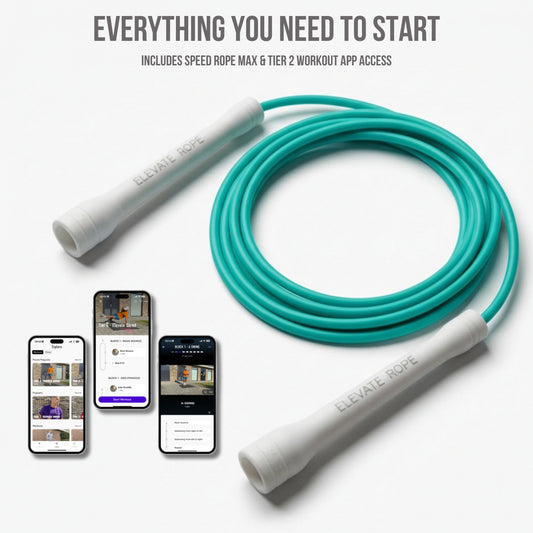
Structured programs like Elevate 14 and Elevate Shred provide built-in periodization with guided training plans. They complement self-directed practice with community accountability and expert programming. Explore available programs at elevaterope.com.

Common Mistakes That Stall Advanced Jumpers
Skipping the deload: More is not always better. Connective tissues adapt more slowly than muscles. Accumulated micro-stress in the lower back and Achilles tendon catches up without scheduled deload weeks every 4–8 weeks.
Not varying your equipment: Each type serves a specific purpose. Learning crossovers on a wire speed cable is frustrating and inefficient — a beaded option provides the feedback needed. Conditioning intervals are more effective with a speed cable. Rotating equipment keeps your jump rope workouts for core challenging and productive.
Ignoring supplemental training: Sessions build excellent midsection endurance, but they do not develop peak strength. Planks, dead bugs, progressively loaded exercises, Pallof presses, and loaded carries fill that gap and support better performance.
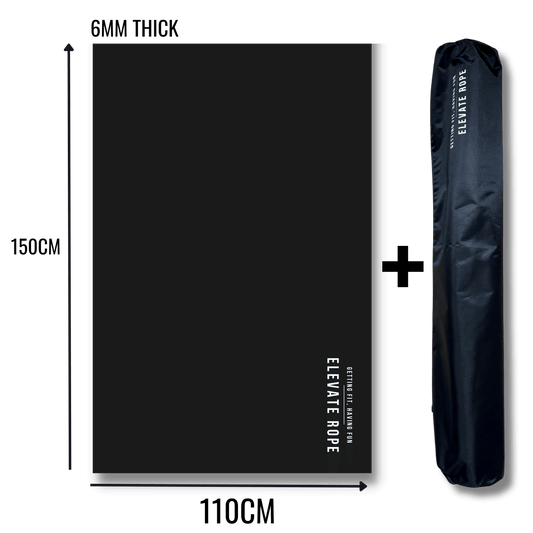
Training on the wrong surface: Concrete amplifies impact forces significantly. Whenever possible, use rubber gym mats, wooden floors, or purpose-built exercise flooring. Over thousands of reps, the right surface protects both your lower back and joints.
Building a Sustainable Long-Term Practice
The real goal is not surviving sessions — it is building a practice that lasts for years. The jump rope workouts for core outlined above are designed for exactly that: structured progression that keeps the body healthy, the mind motivated, and results compounding over time.
Rotate your equipment. Vary your movements. Respect recovery. Take care of your spine. A jumper who follows these habits consistently for two years will always outperform someone who trains recklessly for six months and burns out.
Treat every session like a skill practice, not just a workout, and it will reward you with decades of athletic capacity and resilience. These jump rope workouts for core strength are the starting point — where you take them is up to you.