





Quick feet drills with a jump rope help you practise foot speed, coordination, and timing without needing a large training space. Whether you're learning your first footwork patterns or adding variety to your workouts, five simple drills can give you a clear place to start.
But faster feet don't begin with jumping as quickly as possible.
They begin with control.
If you regularly trip over your rope, jump higher to compensate, or lose your rhythm when switching steps, the answer isn't always more speed. Often, you need to simplify the movement, adjust your rope length, and build a rhythm you can repeat.
In this guide, you'll learn five quick feet drills, how to combine them into a ten-minute workout, and how to choose a rope that suits your current skill level.
What Do Quick Feet Drills Actually Train?
Quick feet drills practise repeated stepping movements while challenging your coordination and rhythm.
A jump rope adds another task: your feet must clear the rope at the right moment on every rotation.
This provides immediate feedback. When your feet and rope fall out of sync, the rope catches. You can then slow down, identify what went wrong, and try again.
Foot Speed vs. Agility: What's the Difference?
Although the terms are often used together, foot speed and agility are not identical.
Foot speed describes how quickly you perform a stepping pattern. Coordination describes how effectively you organise different movements. Agility in sport also involves responding to changing situations, such as an opponent moving unexpectedly.
A scientific review of agility training and testing by Sheppard and Young explains why planned changes of direction and reactive agility are different skills. PubMed
For example, practising lateral hops with a rope helps you learn a planned side-to-side movement. Reacting to an opponent in boxing or changing direction during football involves additional skills.
Jump rope drills can support your footwork practice, but they shouldn't replace sport-specific training.
If your goal includes faster changes of direction, explore our 10 best agility exercises for explosive speed alongside your jump rope routine.
5 Jump Rope Drills for Quick Feet

Start with the basic bounce and move through these drills gradually. You don't need to master all five in one workout.
Focus on keeping your jumps low, your shoulders relaxed, and your movements controlled.
1. Basic Bounce: Build Your Rhythm
The basic bounce is the foundation of jump rope footwork.
Stand upright with your elbows close to your sides and your hands slightly forward. Use small wrist movements to rotate the rope.
Make one low jump for every complete rope rotation.
How to practise:
- Start with five relaxed jumps.
- Pause and reset your position.
- Build towards ten consecutive jumps.
- Repeat until the rhythm feels comfortable.
Don't worry about speed yet. Your first goal is to complete a short sequence without unnecessary movements.
If the rope repeatedly catches your shoes, check your timing, hand position, and rope length before jumping higher.
2. Alternate-Foot Step: Learn to Switch Feet
The alternate-foot step resembles jogging lightly in place while jumping rope.
Instead of landing with both feet together, alternate which foot contacts the floor on each rotation.
How to practise:
- Begin with three basic bounces.
- Switch to one foot per rope rotation.
- Alternate between your left and right foot.
- Keep the movement small and controlled.
Avoid lifting your knees unnecessarily high.
The objective is to coordinate your feet with the rope, not turn every repetition into a high-knee sprint.
If your timing breaks down, return to the basic bounce before trying again.
3. Boxer Step: Practise Weight Transfer
The boxer step introduces a subtle transfer of weight from one foot to the other.
It is commonly associated with boxing-style jump rope training, but anyone learning footwork can practise it.
Unlike a wide lateral jump, the movement stays compact.
How to practise:
- Stand without your rope and gently shift your weight between your feet.
- Add small hops while maintaining the same movement.
- Pick up your rope and complete several basic bounces.
- Introduce the weight transfer without changing your hand position.
Think of the movement as a relaxed shift rather than a forceful jump.
For more boxing-specific variations, read our jump rope footwork patterns for boxing.
4. Lateral Hops: Move Side to Side
Lateral hops challenge you to maintain rope timing while changing your landing position.
Start with very small movements.
How to practise:
- Complete three basic bounces.
- Move slightly to your left on the next rotation.
- Move slightly to your right on the following rotation.
- Repeat while staying within the rope's path.
You don't need to cover a large distance.
A few centimetres can be enough to practise the pattern.
If you begin jumping dramatically higher or swinging your arms outward, reduce the distance and slow down.
5. Rhythm Changes: Control Your Speed
Once you can repeat the first four drills, experiment with controlled changes in tempo.
This teaches you to maintain your movement pattern as the rope rotates at different speeds.
How to practise:
- Complete five slow basic bounces.
- Increase your rotation speed slightly for five jumps.
- Return to your original pace.
- Repeat without stopping between the two rhythms.
The challenge isn't reaching your maximum speed.
It's moving between rhythms without losing your technique.
If you repeatedly trip during the faster section, reduce the speed difference until the transition becomes manageable.
How to Build a 10-Minute Quick Feet Workout

You don't need a long workout to practise jump rope footwork.
A short session gives you enough time to repeat individual movements while leaving room for breaks and adjustments.
Try this beginner-friendly structure:
| Time | Exercise | Main Focus |
| 0:00–2:00 | Gentle warm-up and no-rope steps | Comfortable movement |
| 2:00–4:00 | Basic bounce | One turn, one jump |
| 4:00–6:00 | Alternate-foot step | Switching feet |
| 6:00–8:00 | Boxer step or lateral hops | Controlled footwork |
| 8:00–10:00 | Your most comfortable drill | Finishing with control |
The times include rest when needed. You don't have to jump continuously for ten minutes.
If you're completely new to skipping, start with shorter jumping periods and gradually build your tolerance.
The CDC recommends starting physical activity slowly and working towards longer or more challenging activities over time. CDC
How Often Should You Practise?
Your training frequency depends on your fitness level, current exercise routine, and recovery.
Beginners can start with short sessions separated by rest or other activities.
Cleveland Clinic recommends gradually increasing jump rope intensity and duration rather than attempting long or demanding sessions immediately. Cleveland Clinic
Rather than increasing both speed and duration at once, focus on improving one element at a time.
For example, you could aim to complete more controlled alternate-foot steps before introducing faster rotations.
Track the quality of your movement, not only the total number of jumps.
Which Jump Rope Is Best for Quick Feet Drills?
Different jump ropes provide different sensations during training.
The most useful option is the one that allows you to practise your current movements comfortably and consistently.
Beaded Rope: Learn Timing and Rope Control
A Beaded Rope uses individual PVC beads threaded onto a cord.
The beads create tactile feedback as the rope rotates, helping you notice its movement through your hands and arms.
This can be useful when learning the basic bounce, alternate-foot step, or boxer step.
If you regularly lose track of where the rope is during a rotation, a beaded design may make the timing easier to recognise.
Explore Elevate Rope's Beaded Ropes if you're looking for a rope that provides noticeable rotation feedback while learning footwork.
Speed Rope: Practise a Different Rotation Feel
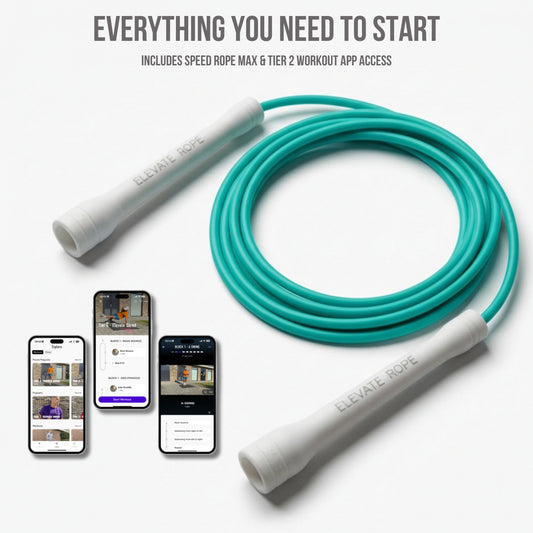
Elevate's Speed Rope MAX uses a flexible PVC cable.
It provides a different sensation from a beaded rope and can suit jumpers who already feel comfortable maintaining their rhythm.
A speed rope won't automatically correct your technique, however.
If you regularly trip during the basic bounce, focus on control before attempting faster combinations.
Do You Need Both Rope Types?
Not necessarily.
You can learn all five drills with one suitable rope.
Some jumpers prefer a Beaded Rope for technique practice and a Speed Rope for other conditioning sessions. Others continue using one rope for most of their training.
If you want both types, Elevate's Ascent Bundle combines a Beaded Rope and Speed Rope MAX.
Choose based on the type of practice you enjoy rather than assuming you need multiple ropes to improve.
4 Common Mistakes That Slow Down Your Footwork
1. Moving Too Fast Before You Have Control
If you can't consistently complete ten basic bounces, adding fast alternate-foot steps introduces another challenge.
Return to the last pattern you could repeat comfortably.
Build consistency first, then increase the difficulty.
2. Jumping Higher Than Necessary
Higher jumps can make timing harder because your feet spend longer in the air.
Aim for enough clearance to let the rope pass beneath your shoes.
Keep your movements relaxed rather than trying to generate more height with every rotation.
3. Ignoring Your Rope Length
An incorrectly sized rope can make even simple drills frustrating.
A rope that's too long may drag excessively, while one that's too short can catch your feet.
Before cutting or permanently adjusting your rope, follow our complete jump rope sizing guide.
4. Treating Jump Rope Footwork as Complete Agility Training
Practising a predictable rope pattern can help with movement timing and coordination.
However, sport-specific agility also involves reacting to changing situations.
If you're training for boxing, football, tennis, or another sport, combine jump rope practice with appropriate acceleration, deceleration, direction-change, and reaction drills.
Frequently Asked Questions About Quick Feet Drills
What Are Quick Feet Drills?
Quick feet drills are repeated stepping patterns used to practise movement timing, coordination, and foot speed. They can involve a jump rope, agility ladder, floor markings, or simple bodyweight movements.
Can Jump Rope Improve Foot Speed?
Jump rope provides a way to practise repeated foot movements and timing. Improving these patterns doesn't automatically guarantee faster sprint times or quicker reactions in sport, so include training that matches your specific goal.
What's the Easiest Jump Rope Footwork Drill?
The basic bounce is the simplest starting point.
Learn to complete one low jump per rope rotation before introducing alternate-foot steps or more complicated patterns.
How Long Should a Beginner Practise?
Start with a manageable session and take breaks when needed.
A ten-minute practice structure can be useful, but the jumping periods should match your current fitness and comfort with impact.
Can I Practise Quick Feet Drills at Home?
Yes, provided you have enough floor space, overhead clearance, and a suitable surface.
Remove nearby objects and check that your rope can rotate freely.
Should I Use a Beaded Rope or Speed Rope?
Some beginners prefer the tactile feedback of a Beaded Rope. A Speed Rope provides a different rotation feel and can also be used for footwork practice.
Choose according to your current control, comfort, and training preferences.
When Should I Try More Advanced Footwork?
Move on when you can repeat your current movement without regularly losing balance or rope timing.
Add one new element at a time rather than combining faster rotations, bigger movements, and new steps in the same session.
Start With One Drill and Build From There
You don't need five perfect footwork patterns to start improving your jump rope practice.
Begin with ten controlled basic bounces.
When those feel comfortable, introduce alternate-foot steps. Then experiment with the boxer step, lateral hops, and rhythm changes.
The goal is to make each new movement repeatable before increasing speed.
If your rope keeps catching, check your timing and sizing rather than assuming you're uncoordinated.
Your next step: Pick one quick feet drill, practise it at a comfortable pace, and notice what happens when you make your movements smaller and more controlled.