






You've heard that jump rope HIIT burns fat faster than traditional cardio. You've also heard that jump rope is one of the most efficient exercises available. Put them together and you get something special.You've also heard that jump rope is one of the most efficient exercises available. Put them together and you get something special.
Jump rope HIIT combines the time efficiency of interval training with the full-body engagement of rope jumping. The result: workouts that torch calories, elevate metabolism for hours afterward, and finish before you've had time to get bored.
This isn't theoretical. Research consistently shows that HIIT protocols produce superior fat loss compared to steady-state cardio, even when total exercise time is shorter. And jump rope's continuous muscular demand makes it an ideal HIIT tool—there's no coasting, no momentum carrying you through easy phases.
This article provides five complete jump rope workouts ranging from beginner-friendly to brutally advanced. Pick the one that matches your current fitness level and watch what happens to your body composition.
What you'll learn:
- Why jump rope HIIT outperforms steady cardio for fat loss
- The science of EPOC and how intervals keep burning calories post-workout
- Five complete workouts with exact timing and structure
- How to progress from beginner to advanced protocols
- Recovery requirements to avoid overtraining
Why Jump Rope HIIT Burns More Fat
Before diving into workouts, understanding why jump rope works helps you train smarter and stay motivated when intervals get uncomfortable.
The EPOC effect
EPOC stands for Excess Post-Exercise Oxygen Consumption—the elevated calorie burn that continues after your workout ends. High-intensity exercise creates an oxygen debt that your body must repay, and repaying that debt requires energy.
Steady-state cardio produces minimal EPOC. You burn calories while exercising, then metabolism returns to baseline quickly. It creates substantial EPOC—research shows elevated metabolism for 12-24 hours post-workout. Those extra calories burned at rest add up significantly over weeks and months.
Muscle preservation
Traditional cardio, especially long-duration running, can break down muscle tissue for fuel. This reduces your metabolic rate over time, making fat loss progressively harder.
Jump rope is brief and intense. The short duration limits muscle breakdown while the intensity provides sufficient stimulus to preserve (and sometimes build) lean tissue. More muscle means higher resting metabolism, which means easier fat loss long-term.
Time efficiency
A 20-minute session can produce equivalent or superior fat loss results to 45-60 minutes of steady jogging. For busy people, this efficiency isn't just convenient—it's the difference between exercising consistently and not exercising at all.
Full-body engagement
Unlike cycling or elliptical HIIT, jump rope HIIT engages your entire body. Calves, quads, core, shoulders, forearms—everything works. This maximises calorie expenditure per minute and creates systemic metabolic demand that isolated exercises can't match.
Answer Block: Why Is Jump Rope Effective for Fat Loss?
Short answer: Jump rope creates significant EPOC (excess post-exercise oxygen consumption), keeping metabolism elevated for 12-24 hours post-workout. The high intensity preserves muscle mass while burning calories, and the full-body nature of jump rope maximises energy expenditure per minute.
Key insight: A 15-20 minute session can burn equivalent calories to 40-60 minutes of steady-state cardio when accounting for both during-exercise and post-exercise calorie expenditure.
Best application: 2-4 sessions per week, with adequate recovery between sessions to prevent overtraining and allow metabolic adaptations.

Workout 1: The Beginner Protocol
If you're new to jump rope , this workout builds your foundation without overwhelming your system. Master this before progressing.
Total time: 12 minutes Work intervals: 20 seconds Rest intervals: 40 seconds Rounds: 12
The workout:
Warm-up: 2 minutes of easy jumping at conversational pace
Main set:
- Jump at moderate-high intensity for 20 seconds
- Rest completely (no jumping) for 40 seconds
- Repeat 12 times
Cool-down: 2 minutes of easy jumping, then stretching
Intensity guidance:
During the 20-second work intervals, jump at a pace that feels challenging but sustainable. You should be breathing hard by the end of each interval but not gasping. On a 1-10 effort scale, aim for 7-8.
The 40-second rest periods allow full recovery. Your heart rate should drop noticeably before the next interval begins.
Why this works for beginners:
The 1:2 work-to-rest ratio provides ample recovery, preventing the overwhelming fatigue that causes beginners to quit. Twelve rounds builds total volume (4 minutes of actual jumping) while keeping individual efforts short enough to maintain form.
Progression:
Once you can complete this workout feeling strong on the final rounds, you're ready for Workout 2. This typically takes 2-3 weeks of consistent practice.
Workout 2: The Standard Fat Burner
This is the jump rope workout most people should use as their baseline. It balances intensity and volume for optimal fat loss without excessive recovery demands.
Total time: 16 minutes Work intervals: 30 seconds Rest intervals: 30 seconds Rounds: 12
The workout:
Warm-up: 2 minutes easy jumping
Main set:
- Jump at high intensity for 30 seconds
- Rest for 30 seconds
- Repeat 12 times
Cool-down: 2 minutes easy jumping
Intensity guidance:
Work intervals should feel hard—8 out of 10 effort. You should be unable to hold a conversation during work periods. The 30-second rest will feel short; your heart rate won't fully recover before the next interval. This is intentional.
Variations to prevent boredom:
Round 1-4: Basic bounce Round 5-8: Alternating feet (running in place) Round 9-12: High knees
Changing techniques every four rounds maintains engagement while training slightly different movement patterns.
Expected results:
Performing this workout 3-4 times per week, combined with reasonable nutrition, typically produces visible fat loss within 3-4 weeks. Calorie burn during the session is approximately 150-200 calories, with an additional 50-100 calories burned through EPOC over the following 12-24 hours.
Workout 3: The Tabata Protocol
Tabata is a specific jump rope format backed by research: 20 seconds of maximum effort followed by 10 seconds of rest, repeated 8 times. It's brutally effective and brutally hard.
Total time: 10 minutes Work intervals: 20 seconds (maximum effort) Rest intervals: 10 seconds Rounds: 8 (one Tabata = 4 minutes)
The workout:
Warm-up: 3 minutes easy jumping (essential—don't skip this)
Tabata block 1:
- 20 seconds MAXIMUM effort
- 10 seconds rest
- Repeat 8 times (4 minutes total)
Recovery: 2 minutes very easy jumping or walking
Optional Tabata block 2: Repeat the above for advanced practitioners
Cool-down: 1-2 minutes easy movement
Intensity guidance:
"Maximum effort" means exactly that. Sprint pace. Every work interval should feel like you're giving everything you have. By round 5-6, you'll be questioning your life choices. By round 8, you'll understand why Tabata has a reputation.
The 10-second rest periods are not enough to recover. You'll start each subsequent round more fatigued than the last. This cumulative fatigue is what makes Tabata so effective—and so difficult.
Warning:
This jump rope format is not for beginners. Attempting Tabata without a solid fitness base risks injury, excessive soreness, and mental burnout. Complete Workouts 1 and 2 for at least a month before attempting this protocol.
Why it works:
Research by Dr. Izumi Tabata found this protocol improved both aerobic and anaerobic capacity simultaneously—something steady cardio doesn't achieve. The extreme intensity creates massive EPOC, and the short duration makes it achievable even on the busiest days.

Workout 4: The Pyramid
This structure varies interval length, creating different physiological demands throughout the workout. The changing structure also maintains mental engagement better than fixed intervals.
Total time: 20 minutes Structure: Ascending then descending interval lengths
The workout:
Warm-up: 3 minutes easy jumping
Ascending pyramid:
- 10 seconds work / 20 seconds rest
- 20 seconds work / 20 seconds rest
- 30 seconds work / 20 seconds rest
- 40 seconds work / 20 seconds rest
- 50 seconds work / 20 seconds rest
- 60 seconds work / 20 seconds rest
Recovery: 60 seconds easy jumping
Descending pyramid:
- 60 seconds work / 20 seconds rest
- 50 seconds work / 20 seconds rest
- 40 seconds work / 20 seconds rest
- 30 seconds work / 20 seconds rest
- 20 seconds work / 20 seconds rest
- 10 seconds work / 20 seconds rest
Cool-down: 2 minutes easy jumping
Intensity guidance:
Adjust effort based on interval length. Shorter intervals (10-20 seconds) should be near-maximum intensity. Longer intervals (50-60 seconds) require moderating pace to complete them—aim for 80% effort.
The pyramid structure naturally teaches pacing. You'll learn what intensity you can sustain for different durations, which improves your overall jump rope capacity.
Why it works:
Variable intervals train multiple energy systems. Short bursts develop explosive power and anaerobic capacity. Longer intervals build aerobic endurance. The combination creates comprehensive cardiovascular fitness while maximising fat-burning potential.
Workout 5: The Advanced Incinerator
This jump rope HIIT workout is for experienced jumpers who have completed the previous protocols and need a new challenge. It's the most demanding workout in this article.
Total time: 25 minutes Structure: Mixed intervals with minimal rest
The workout:
Warm-up: 3 minutes easy jumping, 1 minute building intensity
Block 1 - Speed focus (6 minutes):
- 15 seconds maximum speed / 15 seconds moderate pace
- Repeat 12 times (no standing rest—active recovery only)
Recovery: 60 seconds easy jumping
Block 2 - Endurance focus (8 minutes):
- 45 seconds high intensity / 15 seconds easy
- Repeat 8 times
Recovery: 60 seconds easy jumping
Block 3 - Finisher (4 minutes):
- 20 seconds MAXIMUM effort / 10 seconds rest (Tabata format)
- Repeat 8 times
Cool-down: 2 minutes easy jumping, stretching
Intensity guidance:
Block 1: The "rest" periods are active—you keep jumping at moderate pace. This eliminates standing recovery and maintains elevated heart rate throughout.
Block 2: High intensity means 85-90% effort. You should be breathing very hard but able to maintain form.
Block 3: Everything you have left. This is the finisher—leave nothing in the tank.
Who should attempt this:
Only attempt this jump rope HIIT workout if you can comfortably complete Workout 3 (Tabata) and Workout 4 (Pyramid). You should be able to jump continuously for 5+ minutes without tripping and have at least 2-3 months of consistent jump rope experience.
Expected response:
You will be exhausted. Drenched in sweat. Possibly questioning why you thought this was a good idea. Calorie burn approaches 300-400 during the session, with significant EPOC continuing for 24+ hours.

Programming Your Jump Rope HIIT Week
Individual workouts matter less than consistent weekly programming. Here's how to structure jump rope HIIT for optimal fat loss without overtraining.
Beginner (first month):
- 2-3 sessions per week
- Use Workout 1 exclusively
- At least one rest day between sessions
Intermediate (months 2-3):
- 3-4 sessions per week
- Rotate between Workouts 2 and 3
- Can do back-to-back days occasionally, but not regularly
Advanced (month 4+):
- 3-4 sessions per week
- Rotate through all workouts
- Include one easier session (Workout 1 or 2) for every two harder sessions
Recovery requirements:
Jump rope HIIT creates significant systemic stress. Unlike steady cardio, you cannot do intense intervals daily without consequences. Overtraining symptoms include persistent fatigue, decreased performance, disrupted sleep, and increased injury risk.
If you're also doing strength training, count it as a training stress. Three days of lifting plus four days of intense HIIT is likely too much for most people. Balance is essential.
Nutrition considerations:
Jump rope HIIT depletes glycogen (stored carbohydrates). Attempting these workouts in a severely carb-depleted state reduces performance and increases injury risk. Moderate carbohydrate intake supports HIIT performance while still allowing fat loss through the overall calorie deficit.
Common Mistakes That Limit Fat Loss
Even well-designed workouts fail when execution goes wrong. Avoid these errors.
Going too hard on "easy" intervals
Rest and recovery periods exist for a reason. If you maintain high intensity during rest intervals, you'll burn out before completing the workout and reduce total training volume. Easy means easy.
Not going hard enough on work intervals
Conversely, if work intervals don't challenge you, EPOC won't materialise and fat loss benefits diminish. The discomfort of true high-intensity effort is the price of admission for HIIT benefits.
Doing HIIT every day
More is not better. Daily jump rope HIIT leads to overtraining, injury, and plateaus. Three to four sessions per week with recovery days between produces better long-term results than daily sessions that degrade in quality over time.
Ignoring technique when fatigued
Form breakdown during late intervals increases injury risk and reduces effectiveness. If your technique degrades significantly, reduce intensity slightly rather than continuing with poor form.
Expecting immediate results
Fat loss takes time regardless of training method. Jump rope HIIT accelerates the process but doesn't eliminate it. Expect visible changes after 4-6 weeks of consistent training combined with appropriate nutrition.

Frequently Asked Questions
How many calories does a jump rope HIIT workout burn?
A 15-20 minute session burns approximately 150-250 calories during exercise, depending on intensity and body weight. The EPOC effect adds an additional 50-150 calories over the following 12-24 hours. Total calorie impact is often 200-400 calories per session when accounting for both immediate and post-exercise burn.
Can I do jump rope HIIT every day?
Not recommended. High-intensity training creates systemic stress requiring recovery. Three to four sessions per week with rest days between produces better results than daily sessions. If you want to jump rope daily, alternate between HIIT days and easy steady-state days.
Should I do jump rope HIIT fasted?
Some research suggests fasted cardio may slightly enhance fat oxidation during exercise. However, performance typically suffers without pre-workout fuel. For most people, a small meal 1-2 hours before training supports better workout quality, which matters more than any minor fasted benefit. Experiment to find what works for your body.
How long before I see fat loss results?
With consistent (3-4 sessions weekly) combined with a moderate calorie deficit, most people notice visible changes within 4-6 weeks. Scale weight may change faster due to water fluctuations, but actual fat loss follows a slower timeline. Take progress photos monthly rather than relying solely on the scale.
Is jump rope HIIT better than running for fat loss?
For time efficiency, yes. A 20-minute session typically produces comparable or superior fat loss to a 45-60 minute moderate run. It also preserves more muscle mass. However, "better" depends on what you'll actually do consistently—a running routine you follow beats a jump rope program you abandon.
Can beginners do jump rope HIIT ?
Yes, starting with appropriate protocols. Workout 1 in this article is designed for beginners. The key is matching intensity and duration to your current fitness level, then progressing gradually. Attempting advanced protocols without building a base leads to frustration, excessive soreness, and potential injury.
The Bottom Line: Jump Rope HIIT Works
If your goal is fat loss with maximum time efficiency, jump rope HIIT delivers. The combination of high-intensity intervals with full-body jump rope movement creates metabolic effects that steady cardio can't match.
The workouts in this article provide a progression from beginner to advanced. Start where your current fitness allows, master that level, then progress. Consistency over weeks and months matters more than intensity on any single day.
A rope, some floor space, and 15-20 minutes. That's all jump rope HIIT requires to transform your body composition.
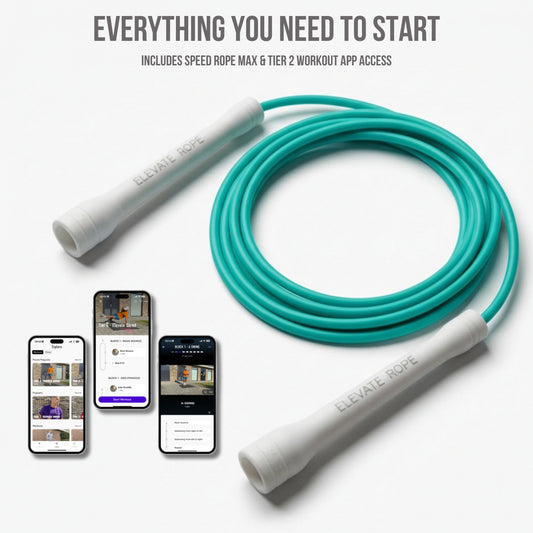
If you're ready to start, our complete guide to jump rope for home cardio covers technique fundamentals that make HIIT training safer and more effective. For high-intensity work, the Elevate Speed Rope MAX handles fast rotations without tangling, while the Elevate Gravity Heavy Rope adds resistance that amplifies calorie burn.
The intervals are waiting. The fat loss is waiting. The only question is whether you'll start.
Sources
EPOC research references studies on excess post-exercise oxygen consumption following high-intensity interval training, including meta-analyses published in the Journal of Sports Sciences. The Tabata protocol references original research by Dr. Izumi Tabata published in Medicine & Science in Sports & Exercise. Calorie expenditure estimates reference metabolic equivalent (MET) values from the Compendium of Physical Activities combined with HIIT-specific research on post-exercise metabolism. Muscle preservation during HIIT versus steady-state cardio references comparative studies on body composition changes across different training modalities.