






For many strength athletes, jump rope benefits still feel reserved for boxers, fighters, or warm-ups—not serious lifting. Cardio is often treated as separate from performance, and anything that doesn’t add weight to the bar gets pushed aside.
But strength isn’t just about how much force you can produce. It’s about how well your body can sustain that force under fatigue, recover between sessions, and stay coordinated as training demands increase.
That’s where jump rope quietly earns its place—and where its benefits start to matter.
Used correctly, jump rope doesn’t compete with strength training—it supports it. The real jump rope benefits show up through improved conditioning without excessive joint stress, reinforced posture and coordination, and the ability to stay sharp deeper into workouts. For lifters who want to train hard without feeling run down, these qualities matter more than most realize.
In this article, we’ll break down seven key benefits of jump rope for strength athletes, and why incorporating it strategically can enhance performance, resilience, and long-term training consistency—without sacrificing strength or size.

Why Strength Athletes Should Care About Conditioning
Most strength athletes don’t avoid conditioning because they think it’s useless.
They avoid it because they think it’s separate.
Lifting builds strength.
Cardio builds endurance.
Each lives in its own lane.
But in real training, those lines blur quickly.
Conditioning determines how well you can express strength after the first few sets, how fast you recover between efforts, and how clean your movement stays when fatigue starts to creep in. Without it, even strong athletes begin to lose posture, rush reps, and compensate through joints and connective tissue instead of moving efficiently.
This is where many lifters get tripped up.
They associate conditioning with long, exhausting sessions that interfere with recovery or muscle growth. But effective conditioning for strength athletes isn’t about distance, duration, or burning calories. It’s about teaching the body to stay organized as heart rate rises and breathing becomes heavy.
When conditioning is neglected:
- Fatigue arrives earlier than expected
- Coordination breaks down before strength does
- Recovery between sessions slows
- Small aches and tightness linger longer
On the other hand, when conditioning supports strength training, it acts like a buffer. It helps athletes tolerate volume, maintain form deeper into workouts, and recover more predictably from week to week.
This is where the jump rope benefits begin to stand out. Jump rope challenges conditioning without competing with strength, improving rhythm, posture, and fatigue resistance in a way that complements heavy lifting rather than undermining it.
Before we break down the specific benefits, it’s important to understand this shift: conditioning isn’t something strength athletes add on later. It’s part of what allows strength to show up consistently, session after session.
Next, we’ll look at the first major benefit—how jump rope improves conditioning without killing strength or recovery.
Benefit #1 — Improves Conditioning Without Killing Strength
One of the biggest reasons strength athletes avoid conditioning is fear of interference.
More cardio usually means less energy for lifting, slower recovery, or compromised muscle growth.
Jump rope doesn’t rely on long-duration, steady-state effort. When used properly, it creates short bursts of elevated heart rate that challenge the cardiovascular system without draining muscular output. The total workload stays low, but the quality of the stimulus stays high.
This is important because strength athletes don’t need more volume—they need better tolerance to the work they’re already doing.
One of the key jump rope benefits is how it improves conditioning without the usual trade-offs. It does this by:
- Raising heart rate quickly, then allowing fast recovery
- Training breathing control under movement
- Improving circulation without excessive muscle damage
Because sessions are brief, jump rope doesn’t compete with strength training for recovery resources. Instead, it helps athletes recover faster between sets and between workouts by improving overall work capacity.
Another key distinction is impact management. Compared to running or high-volume machine cardio, jump rope places less repetitive stress on joints when performed with good rhythm and low jump height. This allows strength athletes to improve conditioning without adding unnecessary wear to knees, hips, or the lower back.
The result isn’t exhaustion—it’s resilience.
Athletes often notice they feel less winded during heavy sets, recover faster between efforts, and maintain better composure deeper into training sessions. Strength output stays intact, but the system supporting it becomes more efficient.
Next, we’ll look at how jump rope improves coordination and movement control—especially when fatigue starts to interfere with technique.
That concern makes sense—but it comes from a narrow view of what conditioning actually is.
Benefit #2 — Enhances Coordination Under Fatigue
Strength often holds up longer than coordination.
Most lifters don’t lose power first—they lose timing. Reps get rushed. Setups become sloppy. Breathing and bracing fall out of sync. These changes are subtle, but they’re where many training issues begin.
This is one of the areas where jump rope benefits become immediately obvious.
Jump rope exposes coordination breakdown quickly. Every jump requires precise timing between the hands, feet, and core. As fatigue increases, that timing becomes harder to maintain. Miss the rhythm, and the rope tells you immediately—there’s no hiding poor coordination or drifting posture.
One of the key jump rope benefits is that it trains the body to stay organized while tired, not just when everything feels fresh. Instead of allowing compensations to build quietly, it forces constant feedback and adjustment in real time.
Jump rope improves coordination under fatigue by:
- Forcing consistent timing between upper and lower body
- Reinforcing posture as heart rate rises
- Teaching the nervous system to adapt without excess tension
Unlike isolated drills, jump rope doesn’t allow athletes to compartmentalize movement. Everything has to work together at once. As fatigue builds, the body learns to make small corrections instead of collapsing into compensations—which is why the jump rope benefits translate so well to heavy training.
For strength athletes, this carryover is significant.
Better coordination under fatigue leads to cleaner setups on later sets, more consistent bar paths, and less reliance on last-second bracing to “muscle through” reps. Movement stays smoother even as training intensity increases.
Jump rope doesn’t replace technical lifting practice. But one of the most practical jump rope benefits is how it supports the system that holds technique together when fatigue starts to interfere.
Next, we’ll look at how jump rope supports posture and core engagement in a way that transfers directly to heavy lifting.

Benefit #3 — Supports Posture & Core Engagement
Good posture isn’t something you switch on at the start of a set.
It’s something your body maintains—or loses—under stress.
Many strength athletes have strong cores in controlled positions, but that strength doesn’t always carry over when breathing speeds up and fatigue sets in. This is where posture starts to drift and compensations creep in.
This is one of the more understated jump rope benefits.
Jump rope addresses this gap in a subtle but powerful way. To keep the rope moving smoothly, the body naturally stacks itself into efficient alignment. The head stays tall, the ribs stay over the hips, and the core engages reflexively instead of being forced. If posture slips, rhythm breaks.
One of the key jump rope benefits here is that it trains automatic posture, not conscious bracing.
Jump rope supports posture and core engagement by:
- Encouraging upright alignment under movement
- Linking core engagement to breathing rather than tension
- Reducing reliance on rigid bracing to maintain control
Over time, these jump rope benefits carry over into lifting. Athletes often notice they feel more stable at the start of sets and better supported as fatigue builds. The core doesn’t have to overreact to keep things together—it’s already engaged as part of the movement.
The result isn’t a tighter or stiffer midsection.
It’s a core that stays involved without dominating the movement—one of the most practical jump rope benefits for long-term strength training.
For strength athletes, this means less strain on the lower back, smoother transitions between reps, and posture that holds up deeper into training sessions.
Next, we’ll look at another reason jump rope fits so well into strength programs: how additional jump rope benefits come from improving conditioning while staying relatively low-impact on joints and connective tissue.
Benefit #4 — Low-Impact Conditioning That’s Easier on Joints
Not all conditioning stresses the body the same way.
Many strength athletes avoid cardio because of joint fatigue, impact-related aches, or the feeling that their lower body never fully recovers. Running, long sled pushes, or high-volume machines can add stress in places that are already working hard under the bar.
This is where the jump rope benefits start to separate it from other conditioning options.
Jump rope offers a different option. When performed with good rhythm and low jump height, it creates a light, elastic impact rather than repetitive pounding. Ground contact is brief, landings are controlled, and force is absorbed efficiently through the ankles, knees, and hips instead of being dumped into the joints.
One of the most practical jump rope benefits is that it’s easier to recover from compared to many traditional cardio choices.
Low-impact doesn’t mean low value.
It means the stress is distributed more intelligently.
Jump rope supports joint-friendly conditioning through several key jump rope benefits, including:
- Limiting excessive ground contact time
- Encouraging soft, controlled landings
- Avoiding long bouts of repetitive loading
For strength athletes, this matters because conditioning should support training—not compete with it. When joints feel beat up, performance suffers even if muscles feel strong.
By keeping impact manageable, the jump rope benefits allow athletes to improve cardiovascular fitness and movement quality without stacking unnecessary stress on top of heavy lifting.
This makes jump rope especially useful during high-volume training blocks or when athletes want to stay conditioned without compromising recovery—one of the most overlooked jump rope benefits for long-term progress.
Next, we’ll look at how jump rope helps strength athletes stay sharper deeper into workouts by improving fatigue resistance during demanding sessions.
Benefit #5 — Builds Fatigue Resistance for Heavy Sets
Most strength sessions don’t fall apart at the beginning.
They fall apart at the end.
Early sets feel crisp. Technique is clean. Breathing is controlled.
Then fatigue builds—and everything starts to drift.
Jump rope helps address this exact problem.
Because it elevates heart rate quickly and requires constant coordination, jump rope trains the body to stay composed as fatigue rises. Instead of panicking under stress, the nervous system learns to regulate breathing, posture, and timing at the same time.
This has a direct effect on heavy lifting.
Fatigue resistance isn’t about pushing through exhaustion. It’s about delaying the point where fatigue starts to interfere with execution. Jump rope improves this by:
- Teaching the body to recover faster between efforts
- Improving breathing efficiency under load
- Reinforcing movement control when energy levels drop
For strength athletes, this often shows up as better consistency on later sets. Bar speed stays more predictable. Setup doesn’t feel rushed. Bracing feels calmer instead of forced.
Over time, athletes notice they can handle more quality work without feeling overwhelmed by fatigue. Sessions feel demanding—but not chaotic.
This doesn’t mean jump rope replaces volume or intensity work. It supports it by strengthening the system that allows heavy sets to stay productive from start to finish.
Next, we’ll look at another practical advantage of jump rope for strength athletes: how little time it takes to get meaningful results.

Benefit #6 — Time-Efficient Conditioning for Busy Strength Athletes
One of the biggest barriers to conditioning isn’t motivation—it’s time.
Many strength athletes already spend long sessions in the gym. Adding extra conditioning often feels unrealistic, especially when recovery and scheduling are already tight. This is where jump rope stands out.
Jump rope delivers a meaningful conditioning stimulus in a very short window. Heart rate rises quickly, coordination is challenged immediately, and the body has to stay organized from the first jump. There’s no long ramp-up period and no need for extended sessions to make it effective.
Because time is limited for many strength athletes, efficient conditioning tools—like sleds, assault bikes, or jump rope—are often used to deliver a strong training stimulus in short sessions without disrupting recovery https://www.roguefitness.com/
For strength athletes, this efficiency matters.
Jump rope works well because:
- Five to ten minutes can be enough to create an adaptation
- It fits easily into warm-ups, finishers, or off-day movement
- There’s no setup time or equipment logistics
Because sessions are short, jump rope is easier to recover from and easier to stick with consistently. It becomes a habit rather than another drain on training resources.
This consistency is what makes the difference. Small, frequent exposures to conditioning build capacity over time without disrupting strength work. Instead of choosing between lifting and conditioning, athletes can support both.
Next, we’ll look at the final benefit—how jump rope helps balance the entire training system rather than acting as a standalone tool.
Benefit #7 — Helps Balance a Holistic Training System
Strength training doesn’t exist in isolation.
Performance is shaped by how well strength, conditioning, recovery, and movement quality work together. When one of those pieces is missing, the system becomes fragile—even if individual lifts keep improving.
Jump rope helps fill a common gap.
It doesn’t add more load.
It doesn’t demand long sessions.
And it doesn’t compete with recovery.
Instead, it connects multiple elements of training at once. Jump rope reinforces posture while conditioning the cardiovascular system. It challenges coordination while managing impact. It builds fatigue resistance without excessive stress.
This makes it a powerful support tool, not a replacement for lifting.
For strength athletes, this balance matters. When conditioning supports posture and recovery instead of draining them, training becomes more sustainable. Athletes stay consistent, technique holds up deeper into sessions, and small issues are less likely to compound over time.
A holistic system doesn’t mean doing more.
It means doing what supports everything else.
Jump rope fits into that role by strengthening the foundation underneath heavy training—quietly, efficiently, and without demanding center stage.
Next, we’ll move from theory to application and look at how strength athletes can start using jump rope in a simple, effective way without overthinking it.
How Strength Athletes Can Start Using Jump Rope
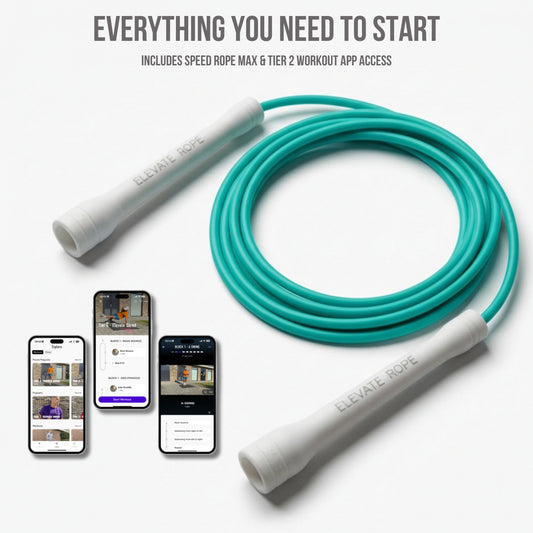
Getting value from jump rope doesn’t require complex programming or long sessions. For strength athletes, the goal isn’t to add another exhausting workout—it’s to support the training you’re already doing. With Elevate Rope
The easiest way to start is to treat jump rope as practice, not conditioning punishment.
Begin with short bouts. Five minutes total is enough in the beginning. This could be broken into rounds of 30–60 seconds with brief rest in between. The focus should be on smooth rhythm, upright posture, and relaxed movement—not speed or intensity.
Use jump rope where it fits naturally:
- As part of a warm-up to raise heart rate and reinforce coordination
- Between lighter sets as active recovery
- On rest days as low-stress movement to stay loose and conditioned
Pay attention to posture first. Keep jumps low, land softly, and stay tall through the torso. If breathing becomes chaotic or timing breaks down, stop the set. Quality matters more than volume.
Frequency matters more than duration. Two to four short sessions per week is enough to create adaptation without interfering with recovery. Over time, the body becomes more efficient at handling movement under fatigue, and the benefits start to show up in lifting sessions.
Jump rope works best when it stays subtle. It shouldn’t leave you exhausted or sore. It should leave you feeling more coordinated, more awake, and better prepared to train.
From there, the next step is avoiding common mistakes—things that cause many lifters to misuse jump rope or abandon it altogether. That’s what we’ll cover next.

Common Mistakes Strength Athletes Make With Jump Rope
Jump rope is simple—but it’s easy to misuse when it’s treated like traditional cardio.
Most problems don’t come from doing too little.
They come from doing the wrong things for the wrong reasons.
One common mistake is going too hard too soon. Speed, complex footwork, or long rounds often become the focus before rhythm and posture are established. When intensity outpaces control, jump rope stops supporting training and starts adding unnecessary fatigue.
Another mistake is treating jump rope like punishment. Using it only as a finisher or conditioning test turns it into something athletes dread. Jump rope works best when it’s consistent and controlled, not when it’s used to chase exhaustion.
Many strength athletes also jump too high. Excessive jump height increases impact and disrupts rhythm without providing additional benefit. Efficient jump rope is quiet, low to the ground, and elastic—not explosive.
Poor posture is another issue. Slouching, over-tensing the shoulders, or craning the neck forward breaks alignment and reduces carryover to lifting. If posture slips, the value of the movement drops quickly.
Finally, some athletes expect immediate results. Jump rope isn’t meant to overhaul conditioning in a week. Its benefits compound over time through regular, low-stress exposure.
Avoiding these mistakes keeps jump rope in its proper role: a tool that quietly improves conditioning, coordination, and resilience without competing with strength training.
In the final section, we’ll bring everything together and look at how jump rope fits into a long-term training approach that supports strength and consistency over time.
How Jump Rope Fits Into a Long-Term Strength Training Lifestyle
The goal of adding jump rope isn’t to replace lifting.
It’s to support it—quietly, consistently, and over time.
Strength training builds force.
Jump rope helps your body handle that force repeatedly, without breaking down.
When used correctly, jump rope becomes a background habit rather than a focal point. Short sessions. Clean movement. Minimal impact. Enough stimulus to improve conditioning and coordination without stealing recovery from heavy lifts.
This is what makes it sustainable.
Instead of relying on more volume, more intensity, or more accessories, jump rope improves the quality of your training days. You warm up faster. You feel more coordinated under load. Fatigue arrives later. Sessions feel smoother instead of chaotic.
For strength athletes, that matters more than chasing another conditioning metric.
Over weeks and months, this approach creates a quieter kind of progress:
- Better movement efficiency
- More consistent training weeks
- Fewer interruptions from nagging aches or stiffness
- Improved confidence under fatigue
Jump rope doesn’t demand attention.
It earns its place by making everything else work better.
When strength training is supported by rhythm, coordination, and low-impact conditioning, it becomes easier to train hard—and keep training.
That’s the difference between short bursts of progress and a system you can rely on long term.
A Smarter Way to Stay Strong Without Breaking Down
Most lifters don’t need more motivation.
They need better support.
Back discomfort, fatigue, and stiffness aren’t signs that lifting is wrong—they’re signals that the system around lifting needs attention. Conditioning, movement quality, and recovery determine whether strength holds up over time or slowly starts to leak.
When those pieces are in place, training feels different. More controlled. More repeatable. Less fragile.
You don’t need to do everything at once. Small additions—low-impact conditioning, better rhythm under fatigue, more intentional recovery—compound faster than drastic overhauls.
The strongest lifters aren’t the ones who avoid stress.
They’re the ones who organize it best.
And when your body can stay organized, strength becomes something you can keep—not something you’re constantly trying to protect.