





Bearing jump ropes are not better than bearing-free jump ropes, they are different. A bearing lets the cable keep turning faster than your arms are actually moving. A bearing-free handle keeps cable speed tied to your hands, so the rope arrives where you expect it. For most jumpers that predictability is worth more than raw spin speed.
By Geraldo Alken, founder and CEO of Elevate Rope. Published 24 August 2026.
What a bearing actually does
A bearing sits between the handle and the cable and lets the cable rotate on its own axis with very little friction. You spin the rope, and it keeps going for a moment after your hand has already slowed down. That is the whole mechanism. It takes friction out of the connection between cable and handle.
Bearing-free handles work the other way around. The cable is fixed in the handle and turns with it. Whatever your hands do, the cable does. There is a little more friction in that system, and that friction is exactly what gives you feedback.
Why our handles have no bearings
We left bearings out on purpose. A bearing makes the rope spin faster than your body is actually moving, and that breaks the rhythm you are trying to build. Your arms are doing one thing, the cable is doing another. In a beginner that shows up as tripping. In an experienced jumper it shows up as a rope that feels slightly disconnected from the hands.
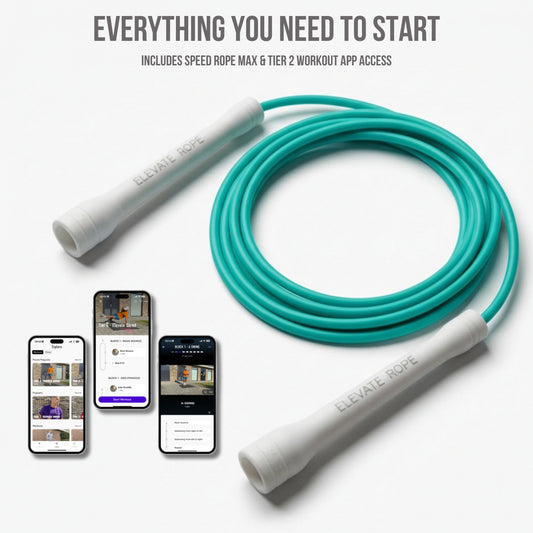
Our speed rope range is built around that one idea. A 5mm PVC cable wrapped around a nylon core, held in a lightweight handle, no metal anywhere in the cable. The PVC gives you speed with enough air resistance that you can feel where the rope is. The nylon core keeps it from kinking and stops it holding the shape of the coil it shipped in.
We looked at wire cable too and decided against it. Wire moves through the air very quickly and gives you almost nothing back. If your timing is a fraction out, you find out when it catches your shins. That is a fair trade for someone chasing a speed record. For most people it is not. The longer version of that comparison is in our jump rope material guide.
Spin speed and jump speed are not the same number
This is where the bearing argument usually goes wrong. A cable can be turning quicker than your arms without a single extra jump happening. What you want is the rope arriving under your feet at the same moment on every rep. That is timing, and timing comes from the cable being tied to your hands rather than running ahead of them.
It is also the reason most people trip. If your rope keeps catching your feet, the cause is usually one of six things and only one of them is you. We wrote that up separately in why you keep tripping on your jump rope.
Where a bearing does help
Being straight about it: there are cases for a bearing. Speed events, where the only thing that counts is how many times the rope passes in thirty seconds. Very long single-under sets where you want every bit of friction gone. And some jumpers simply prefer the feel and jump well on it. None of that is wrong.
What a bearing will not do is fix your setup. If the rope hits the floor in front of you, that is length or arm position. If your hands ache after ten minutes, that is grip and handle weight. Neither is a friction problem. We covered the second one in jump rope handles explained.
What actually sets how a rope feels
Four things, in roughly this order.
- Cable diameter and material. Thinner and stiffer means faster and less forgiving. Thicker means slower and easier to feel.
- Cable length. The single biggest cause of trips, and the easiest to fix. Our sizing guide walks through it.
- Handle length and weight. A 13cm handle and a 20cm handle put your hands in different positions and change what tricks are comfortable.
- Your hands. Wrists turn the rope. Arms hold position. Most rhythm problems live here.
Notice that the bearing is not on that list. It changes one variable, and it is not the one doing the work.
Sizing without tools, because there is no metal in it
Taking the metal out had a second effect we like. Because the cable is PVC over nylon, you can cut it to your own length with household scissors and lock it with the snaplock inside the handle. No crimping tool, no spare parts, no video tutorial. The beaded ropes use a washer system instead, same principle.
That matters more than it sounds. A rope that is 15cm too long is the most common reason a new jumper gives up in week one, and if sizing is a hassle nobody does it.

Maintenance is shorter without bearings
One of the review lines that stuck with us was somebody writing that there are no bearings to oil. That is the quiet upside. Nothing to service, nothing to grit up, nothing to replace when it seizes. Full routine here: do jump rope bearings need maintenance?
What jumpers actually tell us
We have over 1,200 verified reviews now, and the bearing question almost never comes up in them. What comes up is timing. People write that they can feel where the rope is, that the sound of a beaded rope helps them anticipate the turn, that crossovers and side swings got easier. One customer who came off a steel cable said it did not hold its shape as well when swinging. Another, who had tested around fifty ropes, said ours was one of the best they had used.
That is the pattern we design against. Nobody buys a rope because of what is inside the handle. They buy it because the rope does what they expect when they turn their hands, and they keep it because it still does that in month six.
It cuts the other way too. If you already jump well on a rope with bearings and you like the feel, there is no reason to switch. We are not saying a bearing is broken. We are saying that for most people, and for everything we build, keeping the cable tied to the hands is the better trade.
Which rope for which goal
| Rope | Cable | Built for |
| Speed Rope MAX | 5mm PVC, nylon core | Cardio, double unders, general training |
| Dignity Beaded Rope | 2.5cm beads on 3.5mm polycord | Learning rhythm, crosses, jumping to music |
| Elevation MAX Long Handle | 4mm PVC, 20cm handles | Freestyle and trick work |
| Gravity Heavy Rope | 10mm PVC | Strength and endurance sets |
The beaded polycord is 3.5mm rather than the 3mm most beaded ropes use. Half a millimetre sounds like nothing. In the hand it is the difference between a rope that holds its arc and one that folds when you swing it.
The rest of this series
- Why you keep tripping on your jump rope
- Do jump rope bearings need maintenance?
- What jump ropes do professional freestylers use?
- Speed rope without bearings: fast enough for double unders?
- Jump rope handles: weight, length and grip explained
Common questions
Are bearing jump ropes better than bearing-free ropes?
No, they are built for different things. A bearing removes friction so the cable can outrun your hands. A bearing-free handle keeps cable speed and hand speed together, which makes the timing repeatable. If you are chasing a speed record, friction matters. If you want the rope to land in the same place every rep, it does not.
Do bearing-free ropes tangle or kink more?
Tangling comes from the cable, not the handle. Our PVC cables run over a nylon core, which is there to stop kinking and keep the cable from holding the shape it was coiled in. Store it loosely coiled rather than folded and it stays straight.
Can you do double unders on a rope without bearings?
Yes. Double unders need the rope to pass twice per jump, which is a function of cable speed and your wrists, not of bearings. There is a full answer in this piece on double unders.
Does a bearing-free rope need oiling?
No. There is nothing in the handle to oil. Wipe the cable if you have been jumping outside and check it for nicks where it meets the handle.
About the author
Geraldo Alken is the founder and CEO of Elevate Rope. He designs jump ropes and works every day with jumpers, from complete beginners to professionals.