






Family fitness activities that work for all ages are surprisingly hard to find — not because the options don't exist, but because most families are searching in the wrong places. You don't need a gym membership, a schedule overhaul, or children who are naturally sporty. You need a handful of activities that blur the line between exercise and play so effectively that nobody notices they're getting fit.
Research from the World Health Organization shows that 80% of adolescents globally don't meet minimum weekly physical activity guidelines. Most parents already know this — and feel the guilt that comes with it. But the solution isn't stricter screen time rules or forcing reluctant kids onto a sports field. It's finding activities where movement is the side effect of having fun, not the point.
These seven activities have something important in common: they work across age gaps. A six-year-old, a forty-year-old, and a sixty-year-old grandmother can all participate at their own level without anyone sitting on the sidelines. That's the standard that actually matters for family fitness.
In this article
Why most "family fitness" ideas fail after the first attempt
The 7 activities that genuinely work for mixed ages and skill levels
How to make jump rope the anchor of your family fitness routine
What the research says about children who exercise with their parents
How to turn any of these into a weekly habit without it feeling like homework
The one piece of equipment that supports your whole household from age 5 upward
Why Most Family Fitness Attempts Fail
The typical family fitness attempt looks like this: parents decide everyone needs to be more active, they suggest a bike ride, the youngest child complains their legs hurt after 10 minutes, the oldest teenager puts in earphones, and the whole thing dissolves into resentment. Two weeks later, the bikes are back in the garage.
The problem isn't motivation. It's design. Most activities are designed for a single age group or fitness level. Bike rides favour those with endurance. Sports require similar skill levels to be competitive. Gym workouts are age-restricted. Any activity where one family member is clearly struggling while another is bored has a short lifespan.
Effective family fitness activities share three characteristics. First, the challenge is self-scaling — each person works at their own ceiling naturally. Second, success is defined individually, not comparatively. A five-year-old completing 10 jumps and a parent completing 100 are both winning. Third, there's an element of play or friendly competition baked in, because adults and children both engage harder when there's a game at stake.
The research case for exercising together
A 2019 study published in Pediatric Exercise Science found that children whose parents exercised with them were significantly more likely to maintain physical activity habits into adolescence than children whose parents simply encouraged them to exercise. The modeling effect is powerful. Children don't adopt habits because they're told to. They adopt habits because the adults they admire demonstrate them consistently.
There's also a secondary benefit for parents: when exercise becomes a shared family activity, the guilt of "choosing the gym over the kids" disappears completely. You're doing both at once.
Answer Block
Short answer: Children are significantly more likely to maintain active habits when parents exercise alongside them rather than simply encouraging them to move more.
Why it matters: Most family fitness strategies focus on getting children moving. The research suggests the more effective lever is parents modelling movement themselves. Your workout is the lesson — they absorb it by watching you keep the habit.
Best next step: Pick one activity from this list and schedule it for the same time each week. Consistency over intensity. The ritual matters more than the workout.

The 7 Activities That Work for Every Age
1 Jump Rope Games
Jump rope is the most underrated family fitness activity available. It requires no setup, no court, no equipment beyond the rope itself, and it scales naturally by ability — a beginner can practice jumping over a swinging rope without ever skipping at pace, while an experienced jumper can add speed, tricks, and rhythm challenges. The gap between a 6-year-old and a parent narrows faster than in almost any other activity because the learning curve is steep for everyone at the beginning.
The key for families is to frame jump rope as a game rather than a workout. "How many can you do without stopping?" is a workout. "I bet you can't beat my record" is a competition. "Let's see if we can both jump at the same time" is connection. Same physical activity, completely different engagement level.
The auditory feedback from a beaded rope is particularly useful for children who are learning. The rhythmic sound of each rotation hitting the ground gives them timing cues that wire ropes and plastic ropes don't provide. Children learn faster because they can hear when they're in rhythm and when they're not.
→TheDignity Beaded Ropeadjusts from 2 metres to 3 metres — short enough for young children learning to skip, long enough for adults working at full pace. One rope that genuinely serves the whole household.
2 Obstacle Course Racing (Indoor and Outdoor)
Setting up a home obstacle course takes 10 minutes and costs nothing if you use furniture, garden items, and household objects as markers. The genius of obstacle courses is that completion time is the only metric — younger children take longer and feel proud of finishing, older children compete with each other, adults try for their personal best. Everyone is racing against themselves.
A living room course might involve crawling under a table, hopping between cushions, doing 5 jumps on the spot, spinning around a chair three times, and sprinting to a finish line. For outdoor versions, add a jump rope station where each person must complete a set number of skips before moving to the next challenge. This is where having an adjustable rope becomes practical — you're not swapping equipment between participants.
3 Dance Workouts
Dance is exercise without a single moment where anyone feels like they're exercising. The format matters: forget choreography and put on music with a strong beat, then move however feels right. Children have zero self-consciousness about this. Adults have to get past about 90 seconds of awkwardness before they stop caring. Once the group hits a rhythm together, the calorie burn is real — 30 minutes of moderate dancing burns roughly the same as a brisk jog — and no one is counting.
For families with older children, structured dance game consoles or apps add a competitive element that keeps teenagers engaged who would otherwise decline family activity time. The competitive framing is often the bridge between participation and genuine enjoyment.
4 Swimming
Public swimming pools are one of the few environments where every age genuinely operates on equal terms. A young child splashing in the shallow end, a grandparent doing slow laps, and a teenager racing across the pool are all exercising at full capacity relative to their ability — in the same space at the same time. The low-impact nature of swimming also makes it accessible for family members with joint sensitivity or early arthritis.
The challenge with swimming as a family fitness habit is logistics — transport, pool availability, and costs add friction. It works best as a weekly or fortnightly anchor activity rather than a daily habit. Pair it with at-home options for the days in between.
5 Nature Walks With Micro-Challenges
A standard family walk falls apart when the youngest member gets bored or the oldest member is too fit to feel challenged. The fix is micro-challenges embedded throughout: count a specific tree species, photograph five insects, build a small stack of stones at a landmark, complete a set of jumping jacks at a specific point in the route. These challenges give every age something to engage with beyond the walk itself.
Research from the University of Essex found that just five minutes of exercise in a natural setting produces measurable improvements in mood and self-esteem. For children with restless energy, combining movement with outdoor stimulation is significantly more effective than structured indoor exercise.
6 Backyard / Garden Circuit Training
A family circuit requires no equipment and can be assembled in under five minutes. Set up four to six stations — jumping jacks, bear crawls across the grass, a jump rope station, squats, a sprint from one end of the garden to the other, and a balance challenge. Each family member rotates through at their own pace for 20 minutes. Younger children can do fewer reps per station. Adults can add resistance or speed. The group is exercising together without anyone having to match someone else's physical capacity.
The jump rope station anchors this format particularly well because it naturally creates intervals — jump for 30 seconds, catch breath, jump again. Even children who can't yet maintain a continuous rhythm can swing the rope for others, keeping them engaged and part of the circuit.
→TheAscent Bundlegives you the beaded rope for children learning to skip and a speed rope for adults who want to push intensity in the same circuit session — both from one purchase at €49,95.
7 Partner and Team Sports With Informal Rules
The word "sport" immediately triggers resistance in children who don't see themselves as athletic. The reframe is to remove the formal version entirely. Badminton without keeping score. Catch with different objects. A modified version of football where the goal is touching the ball a certain number of times rather than scoring. The informal version removes performance pressure, which is the single biggest barrier for children who've had negative experiences with organised sports.
For families with mixed sports ability, the parent becoming deliberately bad at the game — letting younger children win, asking for help, celebrating the child's skills — creates a completely different dynamic. The child becomes the teacher. The parent becomes the learner. Movement is still happening at high volume, but the relational dynamic has shifted in a way that builds confidence rather than exposing insecurity.

Comparing Family Fitness Activities: What Works at Every Age
| Activity | Ages 4–8 | Ages 9–14 | Ages 15+ | Adults | Equipment Cost | Setup Time |
| Jump Rope Games | ✅ Excellent | ✅ Excellent | ✅ Excellent | ✅ Excellent | €20–€35 | 0 min |
| Obstacle Courses | ✅ Excellent | ✅ Good | ⚠️ Depends on design | ✅ Good | €0 | 10–15 min |
| Dance Workouts | ✅ Excellent | ✅ Good | ⚠️ Requires buy-in | ✅ Good | €0–€15 | 0 min |
| Swimming | ✅ Excellent | ✅ Excellent | ✅ Excellent | ✅ Excellent | €5–€15/visit | 30+ min (travel) |
| Nature Walks + Challenges | ✅ Good | ⚠️ Needs added challenge | ⚠️ Teenager resistance likely | ✅ Excellent | €0 | 5 min |
| Backyard Circuit | ✅ Good | ✅ Excellent | ✅ Excellent | ✅ Excellent | €20–€35 | 5 min |
| Informal Team Sports | ✅ Good | ✅ Excellent | ✅ Excellent | ✅ Good | €0–€20 | 5 min |
Answer Block
Short answer: Jump rope and backyard circuit training offer the best combination of age-range coverage, zero setup time, and minimal equipment cost compared to any other family fitness activity.
Why it matters: Friction is the enemy of consistency. The more setup a family activity requires, the less likely it is to happen on a Tuesday evening when everyone is tired. Activities with zero preparation time have a dramatically higher completion rate over a 90-day period.
Best next step: Start with jump rope as your daily five-minute anchor. Everything else — circuits, obstacle courses, challenges — can be added around it once the habit is established.

How to Turn Any of These Into a Lasting Family Habit
A family fitness routine that runs for three weeks and then disappears is worse than not starting. It creates evidence that the family "tried and failed," which makes the next attempt harder psychologically for everyone involved. The goal isn't a perfect family fitness programme. It's a sustainable one.
Same time, same day, every week
Habit research consistently shows that time-anchored behaviours have higher retention rates than intention-based ones. "We exercise on Saturdays at 10am" produces more active weeks than "we should move more as a family." Children respond particularly well to predictable routines because it removes the negotiation. It's not "do you want to?" It's "it's Saturday, we do this on Saturdays."
Make the child the teacher
Once a child has learned a skill — even a basic one like maintaining a jumping rhythm or completing a circuit — ask them to teach you. The role reversal is motivationally powerful for children and costs the parent nothing except the willingness to be a deliberate beginner. A child who has taught their parent a jump rope trick will ask to practise it the next day without prompting.
Track family progress, not individual performance
A family fitness habit dies when it becomes a measurement of individual ability. A parent who is visibly much fitter than their child creates shame. A child who beats a parent creates an ego threat. Track collective progress instead: total family jumps this week, combined steps on a walk, whether the whole family completed the circuit. The metric belongs to the group.
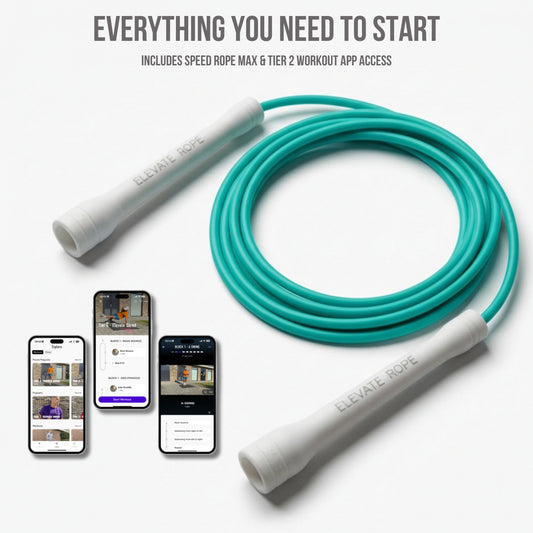
→The freeElevate Appincludes 100+ guided workouts and the Elevate26 challenge — a structured 26-day programme that works just as well as a family challenge as it does for solo training. No subscription required (Crossrope charges €150/year for equivalent functionality).
Answer Block
Short answer: Family fitness habits survive long-term when they're time-anchored, progress is measured collectively, and at least one activity is genuinely play-like rather than structured exercise.
Why it matters: The families who report active children in adolescence didn't run boot camps. They ran consistent, low-pressure routines that made movement feel normal rather than exceptional. Normal is the goal. Normal lasts.
Best next step: Choose a fixed weekly time slot. Start with 15 minutes of jump rope games. Add one other activity from this list in week three. Keep it short enough that everyone finishes wanting more.

Where Jump Rope Fits Into the Bigger Picture
Of the seven activities listed here, jump rope is the only one that is simultaneously a legitimate adult cardio workout and a natural children's playground game. A 10-minute jump rope session burns the caloric equivalent of an 8-kilometre run (Arizona State University). For a parent squeezing fitness into a busy household, that efficiency matters enormously.
The key is having a rope that bridges ages. A child-sized rope with fixed handles is useless to an adult. An adult speed rope is frustrating for a child still learning basic rhythm. The solution is a single adjustable rope with enough length to accommodate both — shortened for children, extended for adults, without needing to buy separate equipment for every family member.
For families genuinely committed to making movement a shared ritual, the jump rope mat is worth considering for indoor sessions. It cushions impact for younger joints, protects flooring, and creates a defined space that signals "this is where we work out" — a small environmental cue that supports habit formation.
→TheTITAN 7MM Weighted Speed Rope (€34,95) is built for adults who want real training intensity while the children use the beaded rope beside them. Both ropes in the same session, two very different workouts happening simultaneously.

Frequently Asked Questions
What are the best family fitness activities for mixed ages at home?
Jump rope games, backyard circuits, and obstacle courses are the highest-performing options for mixed-age families at home. All three require minimal or no equipment, take no time to set up, and naturally scale to individual ability levels. Jump rope in particular works from age 4 through adulthood without needing to modify the activity for different participants.
How do you get kids to actually enjoy exercise?
Remove the word "exercise" from the framing entirely. Children engage with challenges, games, and competitions — not workouts. Frame the activity as a challenge ("can you beat your own record?"), a game (obstacle course racing, jump rope challenges), or family time rather than fitness time. The physical benefits happen regardless of how it's framed. The engagement is determined entirely by the frame.
Is jump rope a good activity for kids and parents to do together?
Jump rope is one of the best shared activities available for families precisely because it scales naturally by ability. A beginner child and an advanced adult can train simultaneously — each working at their own ceiling — without either person needing to wait for the other or modify what they're doing. The Dignity Beaded Rope adjusts to fit both children and adults from a single purchase, which removes the most common logistical barrier.
How often should a family do physical activity together?
WHO guidelines recommend children accumulate 60 minutes of moderate-to-vigorous physical activity daily, while adults need 150 minutes of moderate activity weekly. Family fitness sessions three to four times per week of 20–30 minutes each, supplemented by daily movement like walking or active play, satisfies guidelines for both age groups. Consistency matters more than duration — three 20-minute sessions weekly outperforms a single 90-minute Saturday session every time.
What exercise can a 6-year-old and an adult do together?
Jump rope games, dance workouts, obstacle courses, and simple backyard circuits all work well from age 6 upward. Jump rope is particularly effective at this age because the learning curve makes the activity genuinely challenging for a 6-year-old, which means they're working at near-maximum effort while an adult beside them working on speed drills is also challenged. The effort levels match even when the skills don't.
Can family fitness activities replace a regular workout?
Yes, for adults targeting general health and maintenance fitness. A 20-minute jump rope session with children present — switching between coaching and personal training intervals — is a legitimate workout that produces cardiovascular, coordination, and muscular benefits. For adults with specific performance goals (endurance events, strength sports), family fitness supplements but doesn't replace structured training. For the majority of parents simply trying to stay healthy, it's more than sufficient.
How do I start a family fitness routine that actually sticks?
Anchor it to an existing time slot rather than trying to create new time. Saturday morning after breakfast, Sunday afternoon before dinner, weekday evenings after school — whatever already has predictable family availability. Start smaller than feels necessary: 10 minutes of jump rope games is enough for the first two weeks. Once the habit exists, extending it is easy. Starting with an ambitious 45-minute programme is how routines die in week two.
What jump rope is best for a family with young children?
An adjustable beaded rope is the most practical option for households with children. The beaded design provides auditory feedback that helps children develop timing and rhythm faster than smooth ropes, the adjustable length means one rope serves children and adults, and the weighted beads move slowly enough for beginners to track while still moving quickly enough to give adults a genuine workout at higher cadence. The Dignity Beaded Rope adjusts from children's sizing to 3 metres for adult use.
Getting Started: Match the Activity to Your Family
The right starting point depends on where your family currently is. If your children have never shown interest in physical activity, begin with jump rope games framed as challenges rather than exercise. The immediate feedback loop — counting jumps, trying to beat a personal best, learning a new trick — provides the quick wins that build engagement before motivation has a chance to waver.
If your family already does occasional physical activity but struggles to stay consistent, the problem is usually friction rather than willingness. Pick the activity from this list with the lowest setup requirement and anchor it to a fixed weekly time. Everything else can be added once the baseline habit is running.
If you have teenagers who resist family activities, the informal approach matters. Don't call it a workout. Don't track performance comparatively. Put on music. Make it competitive in a way where they have a genuine chance of winning. And let them teach you something — skill transfer creates investment in a way that being a passive participant never does.
For families ready to build a proper structure, the → Ascent Bundle provides both the beaded rope for beginners and the tools to progress, while the free Elevate App turns 26 days of family challenge into something with a beginning, middle, and end — which is exactly the structure that makes a habit feel achievable rather than infinite. Families who keep promises to themselves raise children who do the same. That's the whole point.
Sources
- World Health Organization. Physical activity factsheet: Children and adolescents. who.int
- Loprinzi, P.D., et al. "Parents' and children's physical activity influences." Preventive Medicine, 2012. PubMed
- Bailey, R. et al. "The educational benefits claimed for physical education and school sport." Research Papers in Education, 2009. tandfonline.com
- Barton, J. & Pretty, J. "What is the best dose of nature and green exercise for improving mental health?" Environmental Science and Technology, 2010. PubMed
- Shephard, R.J. & Trudeau, F. "Legacy of physical education: influence on adult lifestyle." Pediatric Exercise Science, 2000. PubMed
- Arizona State University. Comparative caloric expenditure study: jump rope vs. jogging. ResearchGate reference
- Eime, R.M., et al. "A systematic review of the psychological and social benefits of participation in sport for children and adolescents." International Journal of Behavioral Nutrition and Physical Activity, 2013. PubMed