





Learning how to jump rope like Jake Gyllenhaal in Southpaw starts with two movements: the boxer step and the open sideswing. Connect them with the right timing, and you can recreate that smooth boxing-style jump rope routine.
You've probably seen the scene. Jake Gyllenhaal, playing boxer Billy Hope, moves effortlessly between relaxed footwork and controlled rope swings. The movements look simple, but there's more happening than you might notice.
The secret isn't jumping faster. It's learning how to control the rope while changing your footwork.
In this tutorial, I'll break down the Southpaw jump rope drill step by step. We'll cover the fundamentals, master the boxer step, and practise open sideswings. Then we'll add a double-under variation for an extra challenge.
By the end, you'll understand how to combine these movements into your own Southpaw-inspired jump rope routine.
What Is Jake Gyllenhaal's Southpaw Jump Rope Routine?
The Southpaw jump rope routine is a boxing-inspired combination built around two main movements:
-
The boxer step.
-
The open sideswing.
Once you've mastered both movements, you can introduce a double-under variation.
The routine became recognizable through Jake Gyllenhaal's performance in the 2015 boxing movie Southpaw. In the film, he plays Billy Hope, a professional boxer rebuilding his life and career.
Gyllenhaal also underwent extensive boxing training to prepare for the role.
According to an interview with his trainer Terry Claybon, jump rope formed part of his regular training. Their sessions included approximately 15 minutes of skipping alongside footwork, boxing drills, and other conditioning exercises.
Watch Jake Gyllenhaal Training for Southpaw
Before learning the drill, take a look at the actor's preparation for the movie.
This behind-the-scenes footage shows Jake Gyllenhaal training for Southpaw alongside director Antoine Fuqua. The video offers a look at the boxing preparation behind his performance.
Watch Jake Gyllenhaal's Southpaw Training Video
The Southpaw-inspired jump rope combination we're learning focuses on the boxer step and sideswing movements described in this tutorial.
Is Jake Gyllenhaal Actually Doing Double Unders?
One interesting detail is the timing of his sideswing combination.
At first glance, the movement looks like a double-under variation. However, his feet appear to pause briefly on the ground between parts of the sequence.
A true double under requires the rope to pass beneath your feet twice during one continuous jump.
Because the timing is difficult to judge from the scene alone, we'll learn both variations.
First, you'll practise the regular Southpaw sideswing. Then you'll learn how to add a double under.
This approach also makes the routine more accessible if you're still developing your jump rope skills.
Step 1: Learn the Jump Rope Fundamentals
Before attempting Jake Gyllenhaal's jump rope routine, make sure your basic technique is reliable.
Three things make a difference: rope length, landing technique, and wrist position.
Get these right before moving into more advanced combinations.
Find the Correct Jump Rope Length
An incorrectly sized jump rope makes it harder to maintain rhythm.
If your rope is too long, it may hit the ground too early. If it's too short, you might compensate by moving your hands away from your body.
Both problems make sideswings and boxer steps more difficult.
Here's a practical starting point for sizing your rope.
For beginners:
Stand on the middle of your rope with one foot.
Pull both handles upward until the cable is straight.
As a starting point, the tops of the handles should reach approximately your armpits.
For more experienced jumpers:
You may prefer a shorter rope.
Some advanced jumpers shorten their cable until the handles reach around chest height.
A shorter rope can support compact rotations when your technique is already consistent.
However, don't shorten your rope simply because you've seen someone else use that length.
Your ideal setup depends on your height, arm position, technique, and rope construction.
Read our complete jump rope sizing guide for more detailed instructions.
Keep Your Jumps Small and Controlled
You don't need to jump high during the boxer step.
In fact, unnecessary jumping height can interrupt the smooth rhythm you're trying to develop.
Aim to clear the rope with small, relaxed jumps.
Land softly through the front of your feet, allowing your knees and ankles to absorb the movement naturally.
Keep your torso upright and avoid looking down at your feet.
Think about maintaining a steady rhythm instead of forcing more speed.
Position Your Wrists Near Your Hips
Your hands play an important role in the Southpaw jump rope drill.
Keep your elbows relatively close to your body.
Position your hands near hip height and allow your wrists to control most of the rope's rotation.
Avoid making large circles with your arms.
Excessive arm movement can change the rope's path and make your timing less predictable.
This becomes especially important when transitioning into the open sideswing.
Step 2: Master the Boxer Step

Now that your fundamentals are in place, it's time to learn the first movement.
If you watch Jake Gyllenhaal's skipping style in Southpaw, you'll notice that he enters the combination through a relaxed boxer step.
The boxer step is a familiar jump rope technique used in boxing-style conditioning.
Instead of landing evenly on both feet during every jump, you gradually shift your weight from one foot to the other.
The movement looks relaxed because your feet are constantly sharing the work.
How to Perform the Boxer Step
Start with a regular basic bounce.
Once you've established a comfortable rhythm, shift more of your weight toward your left foot.
Allow your right foot to lift slightly.
During the next rotation, transfer your weight toward your right foot.
Let your left foot lift naturally.
Continue alternating sides while maintaining the rope's rhythm.
Your movements should remain small and controlled.
Avoid exaggerating the weight transfer or jumping too far sideways.
The Most Common Boxer Step Mistake
Many beginners try to turn the boxer step into a running movement.
They lift their knees too high or move their feet excessively.
This often causes the rope to catch their shoes.
Instead, imagine gently shifting your weight from one foot to the other.
Your feet should remain relatively close to the ground.
The smoother your boxer step becomes, the easier the Southpaw combination will feel.
Boxer Step Training Drill
Try this simple progression:
-
Complete five relaxed basic jumps.
-
Perform five boxer steps.
-
Return to five basic jumps.
-
Repeat the sequence.
Once the transitions feel comfortable, gradually increase the number of boxer steps.
For additional guidance, watch Geraldo Alken's boxer step tutorial:
Boxer Step Tutorial: How to Jump Rope Like a Boxer
You can also explore our jump rope guide for boxers.
Step 3: Learn the Open Sideswing

Now we're getting to the movement that makes Jake Gyllenhaal's Southpaw jump rope routine recognizable.
The open sideswing allows you to move the rope past your body instead of jumping through it.
During this movement, both handles travel toward the same side.
You then reopen your hands to return the rope to its normal jumping path.
The key is controlling which hand leads the movement.
Understand the Leading Hand
This is the most important part of the open sideswing.
When swinging the rope to your left, your right hand should be on top.
When swinging the rope to your right, your left hand should be on top.
Remember this simple rule:
-
Left sideswing: right hand leads.
-
Right sideswing: left hand leads.
Getting this hand position right helps you guide the rope around your body without crossing your arms excessively.
It also prepares you to reopen the rope smoothly.
How to Perform the Left Open Sideswing
Begin with your normal jump rope stance.
As the rope approaches, bring both hands toward the left side of your body.
Your right hand becomes the leading hand.
Point the leading handle slightly backward while directing the other handle outward.
Keep your wrists relatively close together.
Allow the rope to pass beside your body without jumping through it.
Then prepare to reopen your hands.
How to Perform the Right Open Sideswing
Repeat the same process on the opposite side.
Bring both hands toward your right hip.
This time, your left hand becomes the leading hand.
Guide the rope past your body while maintaining a controlled wrist movement.
Avoid throwing your arms across your torso.
The sideswing should feel like a compact movement controlled through your wrists.
How to Exit the Open Sideswing
The exit is where many jumpers lose their rhythm.
After completing the sideswing, flick your wrists outward to reopen the rope.
Pull your leading hand back toward its normal position near your hip.
This returns you to the standard jump rope stance.
From there, you can complete a regular jump or begin another sideswing.
The faster you try to perform the movement, the harder the transition may become.
Focus on opening the rope at the correct moment.
A clean exit is more important than an aggressive sideswing.
Open Sideswing Practice Drill
Start without jumping.
Perform one sideswing to the left.
Reopen your hands.
Then complete one sideswing to the right.
Continue alternating sides while maintaining a relaxed posture.
Once the movement feels comfortable, add a basic jump between sideswings.
Try this combination:
Left sideswing → Basic jump → Right sideswing → Basic jump
Repeat until you can perform the sequence without repeatedly catching the rope.
Step 4: Combine the Boxer Step and Southpaw Sideswing
Now it's time to connect the movements.
This is where the Southpaw jump rope drill starts to resemble the combination that inspired the tutorial.
You've already learned the boxer step.
You understand how to control the open sideswing.
The next challenge is transitioning between both movements without losing your rhythm.
Start With the Boxer Step
Begin with a relaxed boxer step.
Complete several rotations until your movement feels comfortable.
Keep your hands close to your hips and maintain a consistent pace.
Don't rush into the sideswing immediately.
Establish the rhythm first.
Introduce the Open Sideswing
After several boxer steps, guide the rope into a left sideswing.
Allow the cable to pass beside your body.
Reopen your hands and return to your regular jumping position.
Complete a few more boxer steps.
Then repeat the movement on the right side.
Put the Southpaw Jump Rope Drill Together
Your first complete combination should look like this:
Boxer step → Left sideswing → Boxer step → Right sideswing → Boxer step
Repeat the sequence at a pace you can control.
Once you're comfortable, gradually reduce the number of boxer steps between sideswings.
Your goal is to connect the movements without unnecessary pauses.
The combination should eventually feel like one continuous jump rope routine.
Step 5: Add the Southpaw Double Under
Ready for the bonus variation?
The double-under version adds another technical challenge to the Southpaw drill.
Instead of completing the normal sideswing and returning to basic jumps, you'll combine the movement with a double under.
This requires precise coordination between your jumping height, wrist rotation, and sideswing timing.
How to Perform the Southpaw Double Under
Start with a comfortable boxer step.
Prepare to enter an open sideswing.
As you begin the sideswing, jump slightly higher than normal.
Guide the rope beside your body during the first rotation.
Then quickly reopen your hands.
Allow the rope to pass beneath your feet before landing.
The goal is to complete the sideswing and the underfoot pass during one continuous jump.
The Most Important Timing Detail
Leave the ground as you initiate the sideswing.
Don't wait until the rope has completed the entire sideswing before jumping.
Your feet need to remain airborne long enough for the rope to complete the combination.
If you land before the underfoot pass, you've performed two separate movements rather than the intended double-under variation.
Start with one clean attempt.
Then return to your boxer step.
Southpaw Double-Under Progression
Try the following sequence:
-
Five relaxed boxer steps.
-
One open sideswing.
-
One Southpaw double-under attempt.
-
Reset with basic jumps.
Once you can complete the movement comfortably, try connecting additional repetitions.
Avoid forcing consecutive attempts before you understand the timing.
If you haven't learned double unders yet, practise them separately before returning to this routine.
Our jump rope tricks guide covers additional movements you can build into your training.
Common Mistakes When Learning Jake Gyllenhaal's Jump Rope Routine
The Southpaw jump rope drill can look complicated at first.
However, most difficulties come from a few common technique mistakes.
Understanding them makes it easier to identify what needs improvement.
1. Using Too Much Arm Movement
Many beginners throw their arms across their bodies during sideswings.
This makes the rope harder to control.
Keep your elbows relatively close and guide the movement through your wrists.
Your hands only need enough movement to direct the cable around your body.
2. Crossing the Wrong Hand During Sideswings
Remember the leading-hand rule.
When swinging left, your right hand should lead.
When swinging right, your left hand should lead.
Incorrect hand positioning can make the exit awkward and interrupt the following jump.
Practise slowly until the movement becomes familiar.
3. Jumping Too High During the Boxer Step
The boxer step should feel relaxed.
Excessive jumping height can make your footwork less efficient.
Save additional height for the Southpaw double-under variation.
4. Landing Before Completing the Double Under
This is one of the most common timing problems.
If your feet touch the floor before the final rope pass, the movement becomes two separate actions.
Practise coordinating the sideswing with your take-off.
Then reopen the rope while you're still airborne.
5. Trying to Learn Everything at Once
Don't attempt the complete Southpaw routine before mastering the individual movements.
Learn the boxer step first.
Then practise the open sideswing.
Finally, combine them and introduce the double-under variation.
Build the movement before increasing the difficulty.
Which Jump Rope Should You Use for the Southpaw Drill?
You don't need a specialized rope to begin learning this combination.
However, different rope designs provide different handling experiences.
PVC Speed Rope
A PVC speed rope supports smooth, responsive rotations.
It can be useful for boxer steps, basic sideswings, and double-under practice.
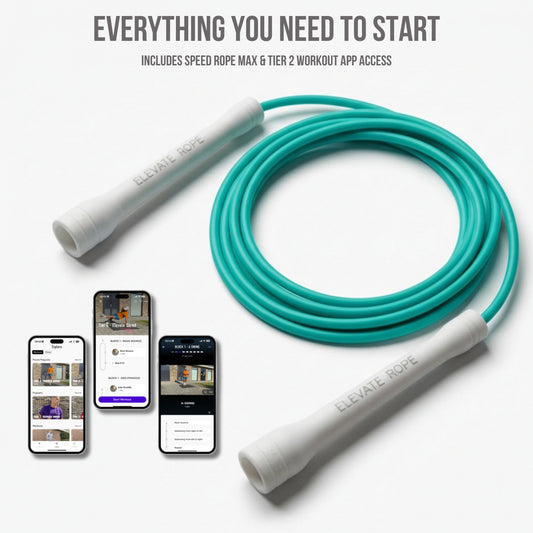
Elevate's Speed Rope MAX uses a flexible PVC cable with an internal nylon core.
This makes it a practical option for everyday boxing-style jump rope training.
Beaded Jump Rope
A beaded rope provides more noticeable feedback during rotation.
This can help when you're still developing your timing.
Some jumpers prefer beaded ropes while learning sideswings and freestyle combinations.
Long Handle Jump Rope
Longer handles can provide additional reach for crosses and advanced freestyle movements.
They may be worth considering once you're comfortable with basic sideswings.
However, you don't need to purchase another rope simply to attempt the Southpaw drill.
Start with equipment you can control.
Try This Southpaw Jump Rope Practice Routine
Once you've learned the individual techniques, combine them into a short training session.
Use this routine to practise the Southpaw jump rope drill without rushing your progress.
| Exercise | Duration | Focus |
| Basic jumps | 2 minutes | Warm-up and rhythm |
| Boxer step | 2 minutes | Footwork |
| Left and right sideswings | 2 minutes | Rope control |
| Boxer step and sideswing combination | 2 minutes | Transitions |
| Southpaw double-under practice | 1 minute | Timing |
| Easy basic jumps | 1 minute | Controlled finish |
Include recovery breaks whenever necessary.
Beginners can replace the double-under section with regular open sideswings.
More experienced jumpers can gradually connect longer combinations.
The goal is to improve control during each session.
Frequently Asked Questions About Jake Gyllenhaal's Jump Rope Routine
What jump rope technique does Jake Gyllenhaal use in Southpaw?
The Southpaw-inspired routine in this tutorial combines the boxer step with open sideswings. These movements create the relaxed boxing-style skipping pattern associated with the film. You can also add a double-under variation. Learn the individual movements first, then practise connecting them into a continuous combination.
Is Jake Gyllenhaal's Southpaw jump rope routine suitable for beginners?
The regular Southpaw jump rope drill can be adapted for beginners. Start with basic jumps and learn the boxer step before introducing sideswings. The double-under variation is more demanding and should come later. You don't need to complete every movement immediately to begin practising the routine.
How do you perform a Southpaw sideswing?
Bring both hands toward one side of your body while guiding the rope beside you. Your opposite hand leads the movement. For a left sideswing, your right hand should lead. Reopen your hands to return the rope to its normal jumping path. Practise both directions separately before connecting them.
What is the difference between a sideswing and a Southpaw double under?
A regular sideswing guides the rope beside your body without an underfoot pass during that swing. The Southpaw double-under variation combines a sideswing and an underfoot pass within one airborne jump. It requires quicker wrist rotation and more precise timing. Practise regular sideswings first.
What jump rope should I use to learn the Southpaw drill?
A PVC speed rope or beaded rope can work for learning the Southpaw drill. PVC ropes support responsive rotations, while beaded ropes provide noticeable feedback. Choose a rope that suits your experience and feels comfortable to control. Correct sizing and consistent technique matter more than purchasing specialized equipment.
Conclusion: Jump Rope Like Jake Gyllenhaal, One Movement at a Time
Learning how to jump rope like Jake Gyllenhaal in Southpaw isn't about copying the entire routine immediately.
It's about understanding the movements behind it.
Start with the fundamentals.
Master the boxer step.
Learn the open sideswing and practise transitioning between both sides.
Once those movements feel comfortable, introduce the Southpaw double-under variation.
Remember, the boxer step establishes your rhythm. The sideswing adds rope control. The double under introduces the final timing challenge.
One movement becomes two. Two movements become a combination. Eventually, you'll be connecting everything without having to think about every rotation.
That's how you develop a smoother, more confident jump rope style.
Ready to put your Southpaw skills into practice?
Explore Elevate Speed Ropes and find a rope that matches your training.