






Your knees hurt when you exercise and you want to know why. Maybe it started gradually, a dull ache that appeared after runs and lingered into the next day. Maybe it hit suddenly, sharp pain during a squat that made you stop mid-rep. Either way, you're now in that frustrating space where exercise, the thing that's supposed to make you healthier, seems to be breaking you down instead.
You're not alone. Knee pain is the most common musculoskeletal complaint among adults who exercise regularly. Studies suggest up to 25% of adults experience knee pain at any given time, with rates climbing higher among runners and those over 40.
But here's what most people get wrong: knee pain during exercise rarely means you should stop exercising entirely. More often, it means something about how, where, or how much you're exercising needs to change.
This article breaks down the five most common reasons your knees hurt when you exercise, explains what's actually happening in the joint, and outlines what to do about each cause.
What you'll learn:
- The five most common causes of exercise-related knee pain
- How to identify which cause applies to you
- What to do about each type of knee pain
- When knee pain requires professional attention
- Which exercises are gentler on knees while still delivering results
The Anatomy of Exercise-Related Knee Pain
Before diving into specific causes, understanding basic knee anatomy helps explain why your knees hurt when you exercise.
The knee joint connects your femur (thigh bone) to your tibia (shin bone), with your patella (kneecap) sitting in front. Cartilage cushions the bones. Ligaments hold everything together. Tendons connect muscles to bones. Fluid lubricates the joint.
When any of these structures experiences excessive stress, inflammation, or damage, pain results. The challenge is that knee pain often feels similar regardless of the underlying cause, which makes self-diagnosis tricky.
Exercise-related knee pain typically falls into one of five categories: surface impact, muscle imbalances, overuse, movement patterns, or underlying conditions. Most people experiencing pain have one primary cause, though combinations are common.

Answer Block: Why Do My Knees Hurt When I Exercise?
Short answer: Your knees hurt when you exercise due to one of five common causes: high-impact surfaces transmitting excessive force, muscle imbalances creating uneven joint loading, overuse without adequate recovery, poor movement patterns stressing the joint incorrectly, or underlying conditions like arthritis. Identifying the specific cause determines the solution.
Key insight: Most exercise-related knee pain doesn't require stopping exercise. It requires modifying how you exercise, what surfaces you use, or how much recovery you allow between sessions.
Next step: Work through the five causes below to identify which applies to your situation, then implement the corresponding solutions.
Cause 1: High-Impact Surfaces
The most overlooked reason your knees hurt when you exercise is the surface beneath your feet.
What's happening:
Every step, jump, or landing sends force through your joints. Hard surfaces like concrete, asphalt, and tile don't absorb any of this force. Your knees absorb it instead.
Running on concrete transmits approximately 2-3 times your body weight through your knees with each stride. Jumping activities can transmit 5-7 times your body weight on landing. Over hundreds or thousands of repetitions, this accumulated stress creates inflammation and pain.
Signs this is your cause:
Your knees hurt when you exercise on hard surfaces but feel better on softer ones. Pain increases with outdoor running or basement workouts on concrete. Cushioned shoes or mats provide noticeable relief.
What to do:
Switch to lower-impact surfaces when possible. Grass, rubber gym flooring, and cushioned mats dramatically reduce force transmission. If outdoor running on pavement is unavoidable, invest in quality cushioned shoes and limit weekly mileage.
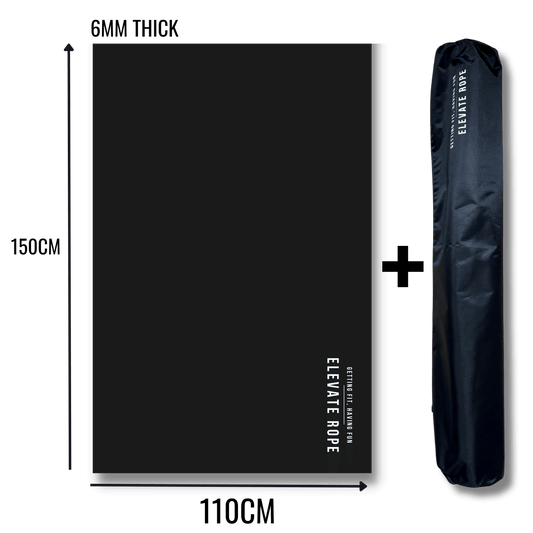
For home workouts, a dedicated exercise mat creates consistent cushioning regardless of floor type. This simple change eliminates surface impact as a variable and often resolves knee pain without any other modifications.
Research published in Gait & Posture found that proper landing technique combined with appropriate surfaces can reduce joint loading significantly compared to hard-surface exercise.
Cause 2: Muscle Imbalances
When certain muscles are weak or tight relative to others, your knees hurt when you exercise because the joint doesn't track properly.
What's happening:
Your knee is controlled by muscles above (quadriceps, hamstrings, glutes, hip flexors) and below (calves, tibialis anterior). When these muscles are imbalanced, the kneecap doesn't glide smoothly in its groove. Instead, it pulls to one side, creating friction, inflammation, and pain.
The most common imbalance: weak glutes combined with tight hip flexors. This pattern is epidemic among people who sit for extended periods. The glutes essentially "fall asleep," forcing the quadriceps to overcompensate. The quads then pull the kneecap upward and outward, creating patellofemoral pain, the technical term for pain around and behind the kneecap.
Signs this is your cause:
Pain is located around or behind the kneecap rather than on the sides or back of the knee. Pain worsens during squats, lunges, stairs, or sitting for extended periods. Your hips feel tight and your glutes feel weak.
What to do:
Address the imbalance directly. Strengthen your glutes with bridges, clamshells, and single-leg exercises. Stretch your hip flexors daily, holding each stretch for 60 seconds or longer. Foam roll your quadriceps and IT band to release tension.
This process takes weeks to months, not days. But correcting muscle imbalances provides lasting relief rather than temporary fixes.
Many people find that their knees hurt when they exercise intensely but feel fine during lower-intensity movement. This indicates the muscles can't handle the load, not that the knee itself is damaged.
Cause 3: Overuse Without Recovery
Training too much without adequate rest causes cumulative damage that makes your knees hurt when you exercise.
What's happening:
Every workout creates microscopic stress on tissues. Given adequate recovery, these tissues rebuild stronger. Without adequate recovery, damage accumulates faster than repair, leading to inflammation and pain.
Overuse injuries develop gradually. The first week feels fine. Week three has mild discomfort. Week six has persistent pain. By the time most people take action, they've been training through warning signs for months.
Signs this is your cause:
Pain developed gradually over weeks or months rather than suddenly. You've recently increased training volume, frequency, or intensity. Rest provides temporary relief but pain returns when training resumes. You train the same movements repeatedly without variety.
What to do:
Reduce training volume by 40-50% for two weeks. This doesn't mean stopping entirely. It means giving tissues time to catch up with repairs while maintaining fitness.
After the reduction period, increase training gradually, no more than 10% per week. Build in dedicated rest days. Vary your training to avoid repetitive stress on the same structures.
Many people discover their knees hurt when they exercise daily but feel fine with every-other-day training. The tissues simply need more recovery time than they're getting.
Cause 4: Poor Movement Patterns
How you move determines how force distributes through your joints. Faulty patterns cause your knees hurt when you exercise even if everything else is optimised.
What's happening:
The knee is a hinge joint. It's designed to bend and straighten, not rotate or move side to side. When the knee collapses inward during squats (valgus), twists during lunges, or hyperextends during landing, structures experience stress they weren't designed to handle.
Poor movement patterns often develop unconsciously as compensations for weakness, tightness, or previous injuries. You might not notice your knees collapsing inward during squats because it's become your normal.
Signs this is your cause:
Pain occurs during specific movements rather than generally. Video analysis reveals knee collapse, rotation, or hyperextension. Pain is worse on one side despite balanced training. You've had previous injuries that might have created compensatory patterns.
What to do:
Film yourself performing the movements that cause pain. Watch for knees collapsing inward, knees shooting forward past toes, or asymmetrical movement between sides.
Correct patterns through conscious practice at lighter loads. Use cues like "push knees out" during squats or "land softly" during jumps. Consider working with a coach or physical therapist who can identify patterns you can't see yourself.
Many people find their knees hurt when they exercise with heavy loads but feel fine with bodyweight movements. This often indicates technique breakdown under load rather than a structural problem.
Cause 5: Underlying Conditions
Sometimes your knees hurt when you exercise because of conditions that exist independently of your training.
What's happening:
Conditions like osteoarthritis, rheumatoid arthritis, meniscus tears, ligament damage, and patellofemoral syndrome can cause or exacerbate exercise-related knee pain. These conditions don't necessarily prohibit exercise but they do require modified approaches.
Osteoarthritis deserves special mention because it's extremely common among adults over 40 and is often assumed to mean exercise should stop. The opposite is true. Research consistently shows that appropriate exercise reduces arthritis symptoms and slows progression. But the type and intensity of exercise matters significantly.
Signs this is your cause:
Pain exists even at rest, not just during exercise. Swelling, warmth, or stiffness accompanies the pain. Pain has persisted for months despite rest and modification. You have a family history of arthritis or previous joint injuries.
What to do:
See a healthcare provider for proper diagnosis. Imaging may be necessary to identify structural issues. A diagnosis allows targeted treatment rather than guesswork.
Once diagnosed, work with professionals to develop an appropriate exercise programme. Most conditions allow continued exercise with modifications. The goal is finding what your knees can handle, not avoiding exercise entirely.
Research shows that people with knee osteoarthritis who exercise appropriately experience less pain and better function than those who avoid exercise. Movement is medicine, even for damaged joints.

Which Exercises Are Gentlest on Knees?
If your knees hurt when you exercise, switching to lower-impact options often provides immediate relief while you address underlying causes.
Swimming and water aerobics: Water supports body weight, virtually eliminating impact while providing resistance for cardiovascular training.
Cycling: Non-impact and low-stress when properly fitted. Keep resistance moderate and cadence high rather than grinding heavy gears.
Elliptical: Mimics running motion without the impact. Useful transition for runners experiencing knee pain.
Rowing: Full-body cardiovascular training with no impact. Requires proper technique to avoid knee hyperflexion at the catch.
Jump rope (with proper technique): Counterintuitively, research shows jump rope produces lower peak joint forces than running when performed correctly. The key is soft landings, minimal jump height, and cushioned surfaces. A study in Gait & Posture found that skipping was "hip and knee protective" compared to running at similar intensity levels.
The jump rope finding surprises many people whose knees hurt when they exercise with high-impact activities. The difference is technique. Running involves heel striking with extended legs, transmitting maximum force. Proper jump rope technique involves landing on the balls of the feet with soft knees, absorbing and distributing force efficiently.
When to See a Professional
While most exercise-related knee pain responds to the modifications above, certain signs warrant professional evaluation.
See a doctor if:
Pain is severe or sudden rather than gradual. The knee locks, gives way, or feels unstable. Significant swelling develops within hours of injury. You cannot bear weight on the leg. Pain persists despite 2-3 weeks of rest and modification.
What to expect:
A physical examination to assess range of motion, stability, and pain location. Possibly imaging (X-ray, MRI) to visualise internal structures. A diagnosis that guides treatment. Potentially physical therapy referral for guided rehabilitation.
Most people don't need surgery or extended rest. They need accurate diagnosis and targeted modification. Continuing to exercise through pain without understanding the cause often makes things worse.

Building a Knee-Friendly Exercise Routine
Once you understand why your knees hurt when you exercise, you can build a routine that provides cardiovascular benefits without accumulating damage.
Principles for knee-friendly training:
Start with lower-impact options and progress gradually. Prioritise surfaces that absorb force. Include strength training for muscles that support the knee. Allow adequate recovery between sessions. Monitor symptoms and adjust accordingly.
Sample weekly structure:
Monday: Lower-body strength (glutes, hamstrings, quads) with controlled movements Tuesday: Low-impact cardio (swimming, cycling, or jump rope with mat) Wednesday: Upper body and core Thursday: Low-impact cardio Friday: Full-body strength with knee-friendly modifications Saturday: Active recovery (walking, gentle stretching) Sunday: Rest
This structure provides five training days with built-in recovery and variety that prevents overuse. Adjust based on how your knees respond.
Frequently Asked Questions
Should I stop exercising if my knees hurt?
Rarely. Most knee pain improves with modification rather than cessation. Complete rest often leads to deconditioning, which makes the problem worse long-term. Continue moving within pain-free ranges while addressing the underlying cause.
Will my knee pain go away on its own?
Depends on the cause. Overuse pain often resolves with reduced training volume. Muscle imbalances and movement patterns require active correction. Underlying conditions need diagnosis and management. Pain that persists beyond 2-3 weeks despite modification warrants professional evaluation.
Is it normal for knees to hurt as I get older?
Common, but not inevitable. Age-related changes do occur, but many people maintain pain-free knees throughout life with appropriate exercise, strength maintenance, and healthy body weight. Don't accept knee pain as an unavoidable part of aging.
Can I run with knee pain?
Possibly, but not without modification. Reduce mileage, switch to softer surfaces, ensure proper footwear, and address any underlying causes. If pain worsens with running despite modifications, switch to lower-impact cardio temporarily.
Does being overweight cause knee pain during exercise?
Excess weight increases joint stress, but weight alone doesn't determine knee pain. Many overweight individuals exercise without knee pain, while many normal-weight individuals experience significant pain. Focus on controllable factors like surface, technique, and muscle balance rather than assuming weight is the sole cause.
Will knee sleeves or braces help?
They can provide compression and warmth that reduces discomfort during exercise, but they don't address underlying causes. Use them as a temporary tool while implementing real solutions, not as a permanent fix.
Moving Forward Without Pain
Your knees hurt when you exercise, but that doesn't mean exercise is the enemy. It means something about your current approach needs adjustment.
Work through the five causes systematically. Test different surfaces. Address muscle imbalances. Allow adequate recovery. Examine your movement patterns. Rule out underlying conditions if pain persists.
Most people find their pain resolves or dramatically improves with targeted modifications. The goal isn't to stop moving. It's to move in ways your joints can handle while still achieving your fitness goals.
For a comprehensive approach to joint-friendly cardio, read our complete guide to low-impact cardio for bad knees, hips, and joints. If you're considering jump rope as a lower-impact option, the Elevate Dignity Beaded Rope paired with our cushioned Jump Rope Mat provides the surface absorption and technique feedback that protects joints during training.
Your knees don't have to hurt when you exercise. Find the cause. Make the change. Keep moving.
Sources
Joint loading research references biomechanical analysis published in Gait & Posture comparing impact forces across different exercise modalities. Skipping versus running comparison draws from research demonstrating lower peak joint forces during rope jumping compared to running at equivalent intensity. Knee pain prevalence statistics reference epidemiological studies on musculoskeletal complaints among active adults. Arthritis and exercise recommendations align with guidelines from the Arthritis Foundation and American College of Sports Medicine.