





A speed rope workout can do more than get your heart rate up. It can build coordination, footwork, and muscular endurance. But faster turns do not automatically mean better training. Real progress comes from controlling each rotation, connecting movements, and keeping your technique when you get tired.
You do not need five advanced tricks to get started. Learn one movement, make it consistent, and build from there. This guide explains five techniques and shows how to combine them into a structured cardio workout.
The goal is not to jump as fast as possible. Build the control that lets speed develop naturally.
What Is a Speed Rope?
A speed rope is a jump rope designed for responsive, efficient rotation. It helps you repeat basic jumps, increase your pace, and practise more demanding skills. Different cable designs create different training experiences.
Some models use thin steel cables and bearing systems for fast double unders. Other models use flexible PVC cables, balancing rotation speed with noticeable feedback.
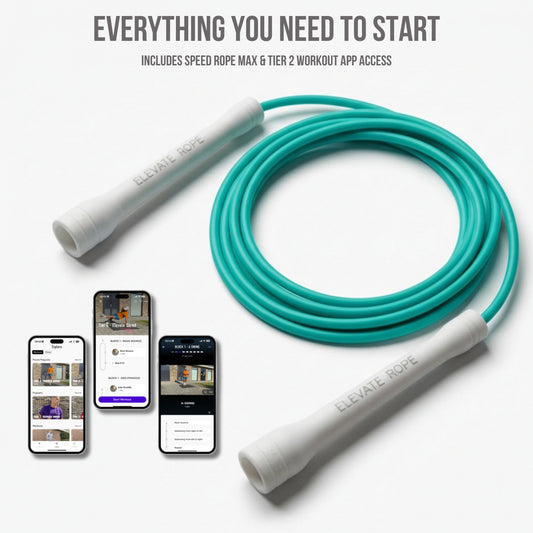
Elevate's Speed Rope MAX uses a flexible 5 mm PVC cable with a nylon core. It offers responsive rotation without a metal wire cable or swivel bearings. Its design suits everyday cardio, footwork, and skill practice.
Speed Rope vs Regular Jump Rope: What Changes?
The name matters less than the construction. A beaded jump rope uses plastic segments threaded onto a flexible cord. The beads make the rope's movement easier to feel.
A PVC speed rope has one continuous, flexible cable. It allows smooth rotations for repeated basic jumps and faster combinations. A thin wire model focuses more heavily on speed, often for experienced athletes practising double unders.
Choose according to your current skill, not the most advanced-looking jump rope equipment. Beads may help when you cannot yet feel the rotation. PVC makes sense when you have basic timing and want more pace.
A jump rope should help you feel each turn, not force you into an unfamiliar pace. Read our speed rope vs beaded rope comparison for a deeper breakdown.
What Can a Speed Rope Workout Improve?
A speed rope workout challenges several abilities at once. Your legs produce repeated jumps, your wrists turn the cable, and your core stabilises your body. Your heart and lungs support the effort throughout the session.
Intensity depends on your pace, working intervals, recovery periods, and fitness level. The CDC lists jumping rope as a vigorous-intensity activity. The same movement can still feel different for different people. That is why your jump rope session should match your own effort.
Cardiovascular Endurance
Repeated jumps raise your heart rate and challenge your breathing. Over time, consistent cardio practice can support overall cardiovascular fitness. Longer intervals are one way to progress. Shorter rest periods are another.
Change one variable at a time. More speed, more duration, and less rest can be too much together. A controlled cardio workout beats a frantic session that ends after repeated trips.
Muscular Endurance, Not Maximum Strength
Your calves work repeatedly during take-off and landing. Forearms and shoulders help maintain rope control, while your core supports posture. Training can improve your tolerance for repeated effort.
However, jumping is not a full substitute for progressive resistance training. If muscle growth or maximal strength matters most, include exercises that provide increasing resistance. The WHO recommends muscle-strengthening activity on at least two days weekly for adults.
Coordination, Timing, and Footwork
Every clean jump requires your hands and feet to work together. High knees change your leg pattern. Double unders change your timing. Crossovers introduce a different arm position.
Learning these movements keeps a cardio workout mentally engaging. Each successful transition gives you a clear sign of progress. That is a reason to practise, even before you can jump faster.
5 Speed Rope Techniques to Add to Your Workout

These movements challenge different skills. You can use all five in one speed rope workout, but mastery is not required. Begin with the exercises you can perform without losing your rhythm. A good jump rope session gives each movement a clear purpose.
1. High Knee Steps
High knee steps turn alternating-foot jumps into a more demanding cardio exercise. Instead of keeping your knees low, you lift them higher while maintaining a steady rope rhythm.
The movement increases the demand on your hips and legs. It also gives you a simple way to challenge balance without learning a complex arm pattern.
How to Perform High Knee Steps
-
Begin with comfortable basic jumps.
-
Change to alternating-foot steps, lifting one foot per rope turn.
-
Raise each knee gradually once your timing feels reliable.
-
Keep your torso upright and your hands near your hips.
-
Rotate from your wrists and land softly on the supporting foot.
Avoid leaning backward or pulling your knees too high. Both can disrupt rope control. A controlled knee lift matters more than reaching your waist on every repetition.
Why Include High Knees?
High knees increase the cardio challenge while strengthening your movement vocabulary. They also give you a useful transition between basic jumps and faster footwork.
Training tip: Practise 20 seconds of high knees, then recover for 40 seconds. Slow down whenever your alternating steps become uneven.
2. Double Unders
Double unders send the rope beneath your feet twice during one jump. They require a quicker rotation and enough jump height to clear both passes. Speed alone does not solve the timing.
Trying to whip the rope faster often creates tense shoulders and messy landings. Build the movement in small, repeatable steps instead.
How to Perform Double Unders
-
Start with basic jumps at an easy, consistent pace.
-
Practise slightly higher jumps without kicking your feet backward.
-
Keep your torso upright and your hands close to your hips.
-
Use your wrists to accelerate the rotation during one jump.
-
Return to comfortable singles after each successful attempt.
Begin with single jump → single jump → double under → reset. Repeat until the sequence becomes predictable. Then try connecting two double unders without forcing your speed.
Why Practise Double Unders?
Double unders challenge rope control, coordination, and cardiovascular endurance. They provide a clear technical target when regular jumps no longer feel demanding.
Training tip: Use short sets for double unders. Stop when your form deteriorates. Several clean attempts teach more than a long sequence of frustrated catches.
For the full progression, read our double-under tutorial for beginners.
3. Jump Rope Criss-Cross
The criss-cross changes the arm pattern while the rope keeps moving forward. You cross your forearms before the cable passes under your feet. Then you reopen your arms for a regular jump.
This exercise challenges upper-body timing and creates opportunities for freestyle combinations. A crossover only works when your crossed arms leave enough room for your feet.
How to Perform the Criss-Cross
-
Start with relaxed basic jumps.
-
As the cable travels upward, prepare to cross your forearms.
-
Bring your hands across your body, keeping them low enough for a wide loop.
-
Jump through the crossed opening without tucking your knees excessively.
-
Open your arms after the cable passes beneath your feet.
-
Complete a few regular jumps before attempting another crossover.
If the loop feels too narrow, practise the crossing motion without jumping. Avoid speeding up your arms to compensate for poor hand placement.
Why Practise the Criss-Cross?
Crossovers build coordination and rope control. They also connect well with side swings, alternating-foot steps, and basic jumps.
Some jumpers prefer beads or longer handles for advanced freestyle. A PVC speed rope can still work when it gives you the space and control you need.
Training tip: Alternate one criss-cross with three basic jumps. Keep the sequence relaxed before reducing the number of recovery jumps.
Explore our jump rope crossover tutorial for more technique guidance.
4. Lateral Jumps
Lateral jumps add side-to-side movement to a speed rope workout. Instead of landing in the same place, you shift both feet a small distance left and right.
The rope still turns forward. Your challenge is moving sideways without letting your hands drift or your rhythm collapse.
How to Perform Lateral Jumps
-
Begin with basic jumps, keeping your feet close together.
-
Move slightly left during one rotation.
-
Move slightly right during the next rotation.
-
Keep your upper body relaxed and your hands in position.
-
Land quietly and reduce the distance if your timing breaks.
Small movements are enough. You do not need wide jumps to practise controlled lateral footwork. Lateral jumps become smoother through repetition, not distance.
Why Practise Lateral Jumps?
The exercise makes a cardio workout more varied and introduces a different balance challenge. Lateral jumps can complement athletic training, although they do not replace sport-specific agility drills. Keep lateral jumps controlled before increasing distance.
Training tip: Perform 20 seconds of small lateral jumps. Prioritise quiet landings and an even rope arc.
5. Alternating Lateral Jumps
Alternating lateral jumps build on the previous movement. This time, you shift your weight between your feet while moving sideways. The combination challenges balance and timing without demanding maximum rotation speed.
How to Perform Alternating Lateral Jumps
-
Establish a steady alternating-foot rhythm.
-
Introduce a small sideways shift after a few clean turns.
-
Land on your left foot while the right lifts naturally.
-
Shift toward your right foot during the next rotation.
-
Repeat at a manageable pace, keeping your torso upright.
Do not force your knees inward or travel too far sideways. The change of foot and direction should feel connected, not rushed.
Why Practise Alternating Lateral Jumps?
This technique combines lateral footwork with one-foot balance. It creates another layer of coordination without needing double unders or an aggressive pace.
Training tip: Begin with five controlled repetitions on each side. Return to basic jumps before repeating the pattern. Alternating lateral jumps should still feel like a controlled rhythm exercise.
How to Combine These Techniques Into a Speed Rope Workout
You do not need five separate sessions. Once basic jumps feel comfortable, these skills can become one structured cardio workout.
Your 12-Minute Speed Rope Workout
| Time | Exercise | Main focus |
| 0:00–2:00 | Easy basic jumps and marching | Warm-up |
| 2:00–3:00 | High knee steps | Cardio and rhythm |
| 3:00–4:00 | Lateral jumps | Side-to-side control |
| 4:00–5:00 | Alternating lateral jumps | Balance and footwork |
| 5:00–6:00 | Criss-cross practice | Upper-body coordination |
| 6:00–7:00 | Double-under practice | Timing and rope control |
| 7:00–9:00 | Repeat comfortable techniques | Controlled conditioning |
| 9:00–10:00 | Easy basic jumps | Lower the intensity |
| 10:00–12:00 | Walking and gentle movement | Cool-down |
During each working minute, try 20 seconds of movement and 40 seconds of recovery. Use recovery time to reset your breathing and technique.
Treat the double-under and crossover minutes as skill practice. Replace either one with basic jumps when necessary. The goal is a controlled speed rope workout, not a perfect trick checklist.
Our jump rope workout plans offer more ways to structure your training.
How to Progress Without Losing Your Rhythm
Repeat the same workout until the movements become more reliable. Then extend a working interval or shorten one recovery period. Change only one variable during a session.
On another day, focus on a single skill. For example, practise double unders separately instead of attempting them while exhausted. That keeps technique work purposeful and cardio training manageable. Save demanding combinations for a separate speed rope session when needed.
A speed rope workout should challenge your current ability while leaving room for your next session. Consistency matters more than exhausting yourself once.
How to Adapt the Workout to Your Current Level
The 12-minute routine is a starting point, not a test. Adjust the skill minutes to make the speed rope workout useful for your current experience.
If You Are Still Learning the Basics
Practise basic jumps during most working intervals. March in place when you need a break from repeated landings. Keep high knees low and lateral jumps small. Replace both advanced technique minutes with relaxed jumping or no-rope arm drills.
Your first goal is a repeatable rhythm. Count clean turns instead of chasing speed. When you can recover calmly after a catch, resume the same pattern. Your cardio workout can improve without a single crossover or double under.
If You Already Have a Reliable Bounce
Use the full exercise sequence. Keep double unders separate from the rest of the routine when they still demand concentration. Practise crossovers between familiar jumps rather than attempting a long combination.
Try using lateral jumps as a transition between high knees and basic jumps. This changes your footwork without changing the cable's direction. Notice whether your shoulders stay relaxed as the movements change.
If You Want a Greater Conditioning Challenge
Keep the movement sequence and adjust one interval at a time. You might extend the working portion once technique remains stable. Alternatively, connect two comfortable movements without stopping between them.
Do not increase speed simply to make the speed rope workout feel harder. Longer controlled sets also challenge cardio endurance. Advanced jumpers still benefit from basic jumps that stay smooth under fatigue.
Common Speed Rope Mistakes and Their Fixes
The Rope Keeps Catching Your Feet
First, check whether the cable strikes the ground too early or barely clears your shoes. The problem may be length, hand placement, or timing. Test a slower rhythm before changing several things at once.
Return to basic jumps and watch one rotation at a time. A speed rope workout becomes frustrating when every catch triggers a completely different correction. Make one adjustment, then test it across several attempts.
Your Shoulders Tire Before Your Legs
Look at your arm position. Wide elbows and big arm circles increase unnecessary movement. Bring your hands closer to your hips and allow the wrists to do more work.
Relax your grip between sets. The goal is reliable rope control, not squeezing the handles as tightly as possible. Use recovery periods to check whether your upper body feels less tense.
You Lose Rhythm When Changing Techniques
Slow the transition. Move from high knees to basic jumps before switching to crossovers. Use two or three easy turns to re-establish your timing. Add the next movement only when the rope arc settles.
You can also practise the foot pattern without a jump rope. That separates a new movement from the challenge of rotating the cable. Bring them together after both actions feel familiar.
Every Session Feels Like Maximum Effort
A useful cardio workout does not have to become an all-out test. Shorten work intervals or choose simpler movements. If your calves remain unusually sore, allow more recovery before the next impact-heavy session.
Your speed rope practice should be something you can return to. Completing controlled work regularly makes more sense than forcing an advanced routine every time.
How to Use a Speed Rope Effectively
Even a well-designed speed rope cannot compensate for an awkward setup. Rope length, wrist position, landing control, and recovery all affect your experience.
Check Your Jump Rope Length
A rope that is too long can strike the floor too early. One that is too short may force your hands outward. Either problem can interrupt timing.
Stand on the cable's midpoint and lift the handles to assess your starting length. Adjust gradually according to your height, technique, and rope type. Avoid cutting too much cord before testing your setup.
Our jump rope sizing guide explains the process in detail.
Rotate With Your Wrists
Keep your elbows fairly close and allow your wrists to drive most rotations. Large arm circles change the cable's path. They can make double unders, crossovers, and fast basic jumps harder to time.
Relax your shoulders. Keep enough space beside your hips for a smooth arc. A steady rotation supports better rope control than constant adjustments.
Keep Jumps Small and Controlled
During basic jumps, lift only high enough to clear the rope. Reserve extra height for techniques that need it, such as double unders.
Land with control rather than stiff knees. Let your ankles and knees respond naturally to each jump. If landing becomes loud or uncomfortable, reduce the pace and check your technique. A jump rope should support a manageable rhythm.
Increase Intensity Gradually
Repeated jumping loads your calves, feet, and ankles. Begin with manageable sessions and allow time for recovery. Add more jumping only when you can maintain technique without pain.
Jumping is not suitable for every person or every situation. Stop when it hurts. Consider lower-impact movement or professional guidance if joint symptoms persist.
Speed Rope vs Heavy Rope: Which Fits Your Goal?

Speed ropes support responsive rotations and cardio training, while heavy ropes add resistance for controlled conditioning intervals.
A speed rope and a heavy rope create different training demands. PVC speed ropes suit repeated turns, footwork, and cardio intervals. Heavy ropes use thicker cables that add resistance during rotation.
That resistance can increase upper-body effort. It does not make a heavy rope automatically better for every strength goal. Choose your equipment according to the session you want to perform.
| Training goal | Rope to consider |
| General cardio workout | PVC speed rope |
| Basic footwork and coordination | Speed or beaded rope |
| Double unders | PVC or specialist wire speed rope |
| Additional rope resistance | Heavy rope |
| Advanced freestyle combinations | Beaded or long-handle rope |
You do not need every rope type. Start with equipment that supports your current training. Add something different when you know which new challenge you want.
Build Speed Through Control
The best speed rope techniques are not necessarily the fastest. They are the ones you can practise with reliable timing and controlled movement.
High knees add cardio intensity. Double unders demand precise timing. Crossovers develop upper-body coordination. Lateral movements introduce balance and more varied footwork. Together, these skills keep training interesting while supporting endurance.
You do not need to master them today. Choose one movement and practise until it feels familiar. One clean repetition becomes five. Five become ten. With time, your speed rope workout starts to feel more natural.
Ready to develop your next skill? Explore Elevate Speed Ropes and find a setup that matches your training.
For a visual demonstration, watch Geraldo Alken's double-under tutorial and practise the timing progression at your own pace.
Frequently Asked Questions
Is a speed rope good for beginners?
Yes. A speed rope can suit beginners who practise short intervals and start with basic jumps. A flexible PVC cable may offer useful feedback during early practice. If you struggle to feel the rotation, try beads instead. Learning a consistent rhythm matters more than buying the fastest cable.
Can a speed rope workout help with weight loss?
A speed rope workout contributes to physical activity and energy expenditure. It can support weight management alongside appropriate nutrition and sustainable habits. Results depend on total activity, food intake, fitness, and consistency. No single cardio workout guarantees a specific change in body weight, regardless of how intense it feels.
Does a speed rope workout build muscle?
A speed rope workout can develop muscular endurance through repeated jumps and controlled rotations. Your calves, shoulders, forearms, and core all contribute. However, jumping is not a replacement for progressive strength training. Combine both methods if increasing muscle size or maximal strength is a major goal.
How long should a speed rope workout last?
Start with a duration you can complete using comfortable technique. Beginners may need only a few minutes of actual jumping, separated by generous rest. More experienced athletes can extend intervals or add challenging movements. This guide's 12-minute plan offers one option, not a universal requirement for every fitness level.
Do I need double unders for an effective cardio workout?
No. Basic jumps, high knees, and lateral movements can already challenge your breathing and coordination. Double unders are an optional skill, not an entry requirement. Practise them separately when needed. A controlled cardio workout with regular jumps is still worthwhile when advanced techniques are not ready.