Vous avez un compte ?
Se connecter pour passer à la caisse plus rapidement.
It's not a warm-up. It's not a kids' toy. It's the most underutilized performance tool in training — and elite athletes have known it for decades.
Boxers have sworn by it for a century. CrossFitters built it into their WODs. Elite footballers use it for conditioning. MMA fighters rely on it for footwork.
So why does jump rope feel like an afterthought for most athletes? Here are 7 reasons to move it to the top of your training stack.
In 10 minutes of moderate jump rope, the average person burns between 100–130 calories. Push the intensity and you're looking at 800+ calories per hour — more than cycling, rowing, or most gym classes.
Jump rope is high-effort, full-body output. Your calves, shoulders, core, and coordination all fire at once. There's nowhere to hide.
When you're short on time and need a serious metabolic hit, no piece of equipment delivers more output per minute than a jump rope. Not the treadmill. Not the assault bike. This.
Muhammad Ali didn't jump rope for cardio alone. It was footwork. Rhythm. The ability to move his feet independently of his upper body — automatically, without thinking.
Football players, basketball athletes, martial artists — they all use jump rope to train fast-twitch muscle response, lateral quickness, and the coordination between brain and body that makes elite movement possible.
No cone drill, no ladder drill teaches your feet to respond automatically under pressure the way jump rope does. 15 minutes of rope work three times per week visibly changes how athletes move within 4–6 weeks.
A full-sized treadmill weighs 100kg and costs €2,000+. A quality jump rope weighs under 200 grams and costs less than €35. Both deliver elite cardio. One fits in your gym bag.
Training camp in another city. Hotel room workouts. Outdoor sessions. Backpacking through a tournament schedule. Jump rope is the only serious training tool that goes anywhere you go without friction.
The athletes who stay consistent don't let travel break their routine. Two ropes — one for home, one for the bag — means you're never more than 10 minutes from a real conditioning session, no matter where you are.
Ankles. Knees. Hips. The kinetic chain that absorbs force every time your foot hits the ground. Most athletes neglect it until something breaks.
Jump rope builds the stabilizer muscles and connective tissue around vulnerable joints — especially ankles and knees — through thousands of low-intensity repetitive impacts. It reduces ankle injury risk and improves landing mechanics across every sport.
The athletes who stay healthy aren't just stronger — they're better at absorbing force. Jump rope teaches your body to land quietly, efficiently, and safely. It's the cheap injury insurance most athletes never buy.
Jump rope isn't just physical. It's a coordination challenge that requires your brain to sync rhythm, timing, and movement simultaneously — and maintain that sync as fatigue sets in.
That's exactly what sports demand. The ability to execute technical movement precisely when you're tired is the thing that separates good athletes from great ones.
When you can hit clean double-unders at the end of a brutal session — hands still finding the grip, feet still finding the rhythm — that's the real adaptation. Mental clarity and motor precision under pressure.
Research consistently shows that 10 minutes of moderate-to-high intensity jump rope produces similar cardiovascular benefits to 30 minutes of running — with less joint impact than pavement pounding.
For athletes already carrying heavy training loads, the math matters. Less time. Comparable conditioning. Lower injury risk. Better footwork as a side effect.
Every serious athlete is managing their training load. Jump rope lets you get your conditioning in without adding a 45-minute run on top of an already full week. Same stimulus. A third of the time.
Most athletes warm up with 5 minutes of static stretches that do almost nothing for performance. Jump rope replaces that with a full-body dynamic warm-up that raises heart rate, activates fast-twitch fibers, and primes your joints for real output.
5–8 minutes of rope work before a session means your first heavy set isn't also your warm-up set. You arrive ready.
Stop walking on a treadmill for 10 minutes and calling it a warm-up. 8 minutes of jump rope activates more muscle, primes more of your nervous system, and raises your heart rate faster than anything else you could do before a session.
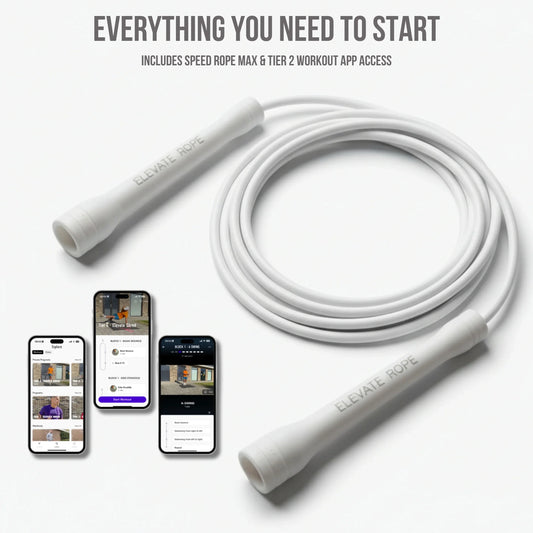
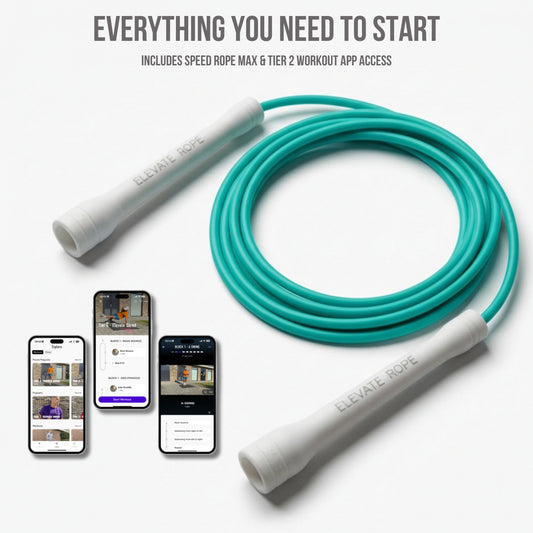
Two ropes. One for training. One for travel. Pay for one. Never have an excuse to skip a session again.
Ali used it. UFC fighters live by it. CrossFit athletes built their conditioning on it. The question was never whether jump rope works — it was whether you had the right one.