






When the final whistle blows, the lights fade, and the season ends for good — something changes for some athletes. But if you’ve ever been an athlete, you know it’s not just about the sport. It’s about who you became through it.
You can retire from competition.
But you can’t retire from that mindset.
That part of you — the drive, the discipline, the way your body remembers movement — is still there, waiting to be reactivated. The challenge is learning how to train for life, not a trophy.

The Identity Shift: From Athlete to “Normal”
Ask any former athlete what they miss most, and the answers sound familiar:
The structure. The camaraderie. The rush of pushing your limits and knowing exactly what you’re working toward.
When that structure disappears, so does a big part of your identity. Suddenly, “working out” feels… different.
You used to train — with purpose, focus, and goals.
Now, you’re just exercising — and that word alone feels empty.
The result? You start chasing that old feeling again — through random workouts, extreme challenges, or periods of total inactivity.
The truth is, it’s not your motivation that’s gone.
It’s your context.
When that structure disappears, so does a big part of your identity. Research shows that many former athletes struggle with identity loss and motivation after retirement — even at the elite level.” American Psychological Association
The same competitive mindset that once drove you to peak performance can now work against you if you’re not careful. You might feel guilty for not being “as fit as you were,” or frustrated that your body doesn’t recover like it used to.
But here’s the truth:
You don’t need to train like you used to.
You just need to train like you.
Reframing What Training Means Now
Training after your athletic career shouldn’t be about chasing old records.
It should be about redefining performance — on your own terms.
That shift begins with a simple mindset change:
Train for longevity, not competition.
You already know what consistency, intensity, and focus look like. But now, the goal isn’t medals — it’s momentum. It’s staying strong, coordinated, and confident through every phase of life.
And here’s the good news:
You already have the blueprint.
The new rules of post-competition training:
-
Replace “more” with “better.”
You don’t need to train harder — just smarter. Choose exercises that deliver high return with minimal joint stress. -
Reignite rhythm before resistance.
Coordination and movement quality matter more than load. Find exercises that make you move, not just lift. -
Redefine recovery as part of progress.
Training sustainably means respecting your body’s feedback — not fighting it. -
Set goals that evolve with you.
Your “wins” now come in minutes moved, not medals earned.
The Mindset Never Left — It Just Needed a New Arena
Most ex-athletes don’t lose their drive — they lose their framework.
Once you find something that reintroduces rhythm, flow, and measurable progress… the switch flips back on.
That’s why so many former athletes are rediscovering movement through jump rope training.
It’s not the same as running laps or doing heavy squats — but it feels like training.
The timing. The focus. The precision.
Every jump demands presence, and every rhythm brings back that sense of flow you thought you’d lost.
With just a rope, you’re training coordination, endurance, and explosiveness — all in one movement.
And more importantly, it reconnects you with that part of yourself that loves to move.

Why Jump Rope Training Works So Well for Former Athletes
Let’s break it down practically.
You’ve spent years developing body awareness, footwork, and timing — jump rope training reawakens all of that.
Here’s what makes it a perfect fit post-career:
-
Low-impact, high-performance:
Unlike running or plyometrics, jump rope builds power and conditioning without punishing your joints. -
Neuromuscular reactivation:
The rhythm and timing challenge your coordination in ways that mimic athletic training. -
Compact and efficient:
You don’t need an hour or a gym — just a rope, space, and your focus. -
Competitive satisfaction:
You can track your progress in skills, time, or jump count — it scratches that “performance itch” without pressure.
But what makes it truly special for former athletes is how mentally engaging it is.
You’re not zoning out.
You’re locked in.
Every session feels like practice — not punishment.
From Competition to Creation: The Ascent MAX Approach
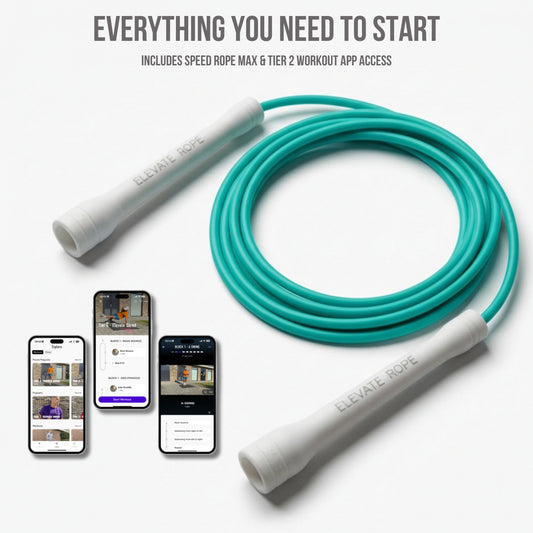
The Ascent MAX Bundle was built with this exact transition in mind — for athletes who still crave intensity, but want it on their own terms.
The weighted handles, adjustable cables, and smooth bearing system make it easy to rebuild your rhythm while safely increasing difficulty.
It’s not just a rope — it’s a modular performance tool that grows with you.
Want more burn? Add the heavy cable.
Want to work speed and control? Switch to the beaded rope.
It turns your living room, backyard, or garage into your new training ground — where consistency beats nostalgia, and purpose replaces pressure.
When you train with tools that feel right, staying consistent becomes second nature.

The Emotional Edge: Rediscovering Flow
Every athlete knows what flow feels like — that deep, almost meditative state where body and mind move as one.
You don’t need a team, a coach, or a scoreboard to feel it again.
You just need rhythm as athletes.
Jump rope training taps into that flow faster than almost any other workout. The repetition, timing, and feedback loop between your hands, feet, and breath — it all syncs up.
That’s why ex-athletes often describe their sessions as energizing instead of exhausting.
Because it’s not just cardio — it’s connection.
How to Reignite Your Athletic Rhythm
If you’re ready to train again, but not sure where to start, here’s a simple framework to get you moving:
1. Start with rhythm.
Grab a rope and jump for 2 minutes at a comfortable pace. Focus only on timing and breathing.
2. Add purpose.
Set a 10-minute goal: alternate between 30 seconds of jump and 30 seconds of rest.
Track your rounds — your new “score.”
3. Refine technique.
Practice variations — boxer step, high knees, double unders — to build coordination.
4. Level up intentionally.
Use weighted cables or resistance ropes to increase challenge once rhythm feels natural.
5. Stay consistent, not extreme.
Even 10–15 minutes a day is enough to feel sharper, stronger, and more alive again.
Real Stories from Former Athletes
“Jump rope gave me back that fire I thought I’d lost. It’s the first time since college football that I’ve felt truly athletic again.” one of the athletes.
— Marco, 38, ex-football player
“After years of lifting and feeling heavy, the rope brought lightness and fun back into my routine. It’s meditative and powerful.” one of the athletes.
— Lina, 31, former dancer
“I don’t train for games anymore — I train for me. Elevate Rope helped me find that balance.” one of the athletes.
— Jordan, 42, ex-sprinter
🚀 The Takeaway: You Don’t Retire From Movement
Leaving competition doesn’t mean leaving behind what made you an athlete.
It means redefining what “winning” looks like.
You’ve spent years learning how to listen to your body, push through limits, and build discipline.
Now it’s time to use those same tools to train for life.
Start small.
Find your rhythm.
And remember — the athlete’s mindset never retires. It just evolves.
Ready to Reignite Your Athletic Rhythm?
Rediscover your edge with the Ascent MAX Bundle — the all-in-one training system designed to help ex-athletes rebuild coordination, endurance, and confidence through movement that feels natural again.
👉 Reignite your rhythm. Train with purpose. Train with Ascent MAX.