





By Geraldo Alken, founder and CEO of Elevate Rope. Published 1 September 2026.
Jumping rope goes wrong for six common reasons: your wrists take a beating, your ankles get sore, the rope keeps hitting you, you cannot hold a rhythm, the noise is a problem where you live, or you trip every ten turns. Almost every message we get about a rope that "does not work" lands on one of those six, and five of them are fixable in an afternoon.
I have been building ropes and answering those messages for years. What follows is the order I would check things in, with the honest version of what causes each problem. Some of it is technique. Some of it is the rope. A fair bit of it is neither, and it is just doing too much too soon.
1. Your wrists hurt after jumping rope
Sore wrists almost always mean your arms are turning the rope instead of your wrists. Big circles from the shoulder feel powerful and they wear you out. The rope should turn from a small flick of the wrist, with your elbows tucked in near your ribs and your hands sitting about a fist away from your hips.
The rope makes this better or worse. Heavy handles ask more of your forearms every single turn. Long handles give you more reach for tricks and cost you a bit of feel. Our speed ropes use light handles on purpose, because a balanced handle lets the wrist do the work instead of the elbow. On the heavy ropes we shaped the handles differently again, since a 10mm cable puts real pressure on the wrist and the grip has to take some of that off.
The full breakdown is in why jumping rope hurts your wrists.
2. Your ankles get sore
Ankle soreness is usually a load problem rather than a form problem. You added minutes faster than your calves and ankles adapted to them, and the surface you jump on decided how much of that landed in your joints. A hard floor with no give sends more back up your leg than a mat does.
The technique part is short. Land on the front of your foot, keep the knee soft, and keep the hop small. Most people jump three or four times higher than the rope needs. The rope is about five millimetres thick, so a low hop clears it.
What to change and in what order is in how to jump rope without hurting your ankles.
3. The rope keeps hitting you
Getting caught on the shins, the back of the head or the top of the ear is a sizing and hand-position problem far more often than a skill problem. A rope that is too long has to go somewhere, and it drags on the floor or wraps around you. Hands that drift wide shorten the arc on one side and the rope arrives early.
A kink in the cable does the same thing. A rope stored folded in a gym bag holds that fold, and a folded cable does not travel in a clean circle. Our cables are PVC over a nylon core, which is there to stop the cable taking a set, but nothing survives being knotted in a bag for a month.

Fixes are in why your jump rope keeps hitting you.
4. You cannot find a rhythm
Rhythm is a feedback problem. If you cannot tell where the rope is without looking at it, you are jumping on a guess, and a guess is late or early every few turns. That is why beginners often learn faster on a beaded rope than on a thin speed cable. The beads catch air, hold their shape through the turn, and make a sound you can time against.
That is also the reason we build without swivel bearings. Bearings let the cable spin faster than your hands are actually moving, so what you feel and what the rope does drift apart. Our beaded ropes go the other way and give you more information, not less.
More on that in why you cannot find a rhythm with your jump rope.
5. It is too loud for where you live
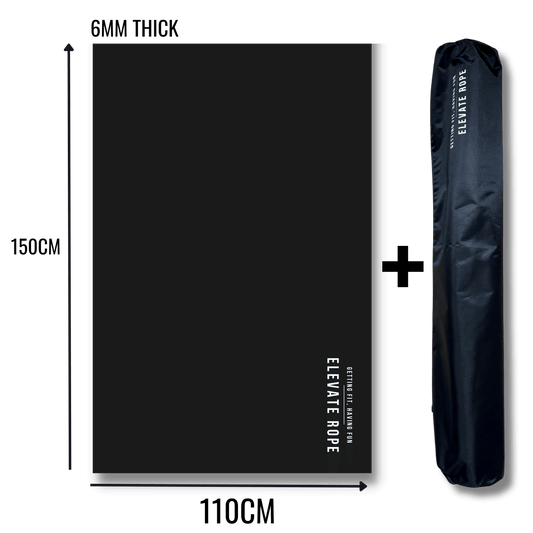
Noise complaints are about the landing, not the rope. The thud that reaches the flat below you travels through the floor, and it comes from heels and from hopping higher than you need to. A mat takes the edge off both the sound and the wear on your cable, which is why we sell them in accessories rather than treating them as an afterthought.
The rope adds its own noise on top. Beads on a hard floor are loud by design. A 5mm PVC cable is quieter. See how to jump rope quietly in an apartment.
6. You keep tripping
Tripping has its own article, because the causes are different from everything above. It is usually rope length, arm position, or a cable that moves faster than you do. We wrote that one up in why you keep tripping on your jump rope.
The order I would check things in
If you have more than one of these problems at once, start at the top of this list. It is ordered by how often the fix turns out to be the answer.
- Rope length. Stand on the middle of the cable. The handles should reach somewhere between your armpit and the top of your shoulder. Longer than that and the rope drags. Shorter and you have to jump higher to clear it.
- Hand position. Elbows near your ribs, hands slightly in front of your hips, thumbs pointing roughly forward.
- Hop height. Low enough that a five millimetre cable passes under you and no higher.
- Surface. Something with a little give. Concrete is hard on you and hard on the rope.
- Volume. Short sets with real rest between them for the first few weeks.
- The rope itself. Kinks, worn beads, a cable that is too light or too heavy for what you are trying to do.
Where the rope actually matters
I want to be straight about this, because it would be easy to sell you a rope as the answer to all six. It is not. Length and hop height fix more problems than any purchase does.
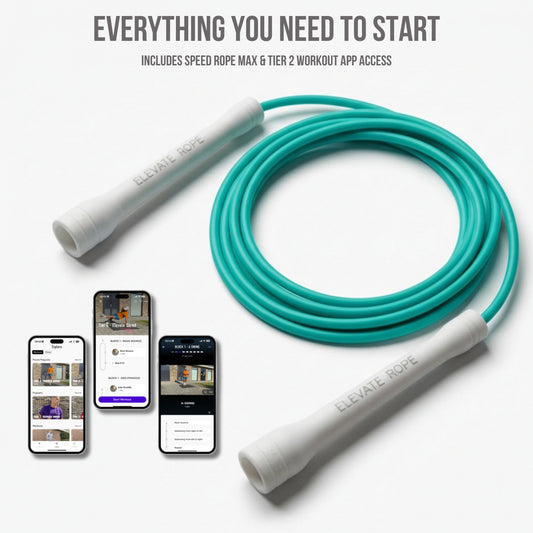
What the rope decides is how much information you get back. Our speed cable is 5mm PVC over a nylon core, and we chose that over steel wire because a thin wire snaps through the air faster than most people can react to. The beaded ropes run 2.5cm PVC beads on 3.5mm polycord, which is thicker than the 3mm most of the market uses, and the extra thickness is there for sturdiness and for what you feel mid-air. There is no metal in either, which means you can size them with household scissors and it means a stray hit stings less than a cable would.
If you already own a rope you like, fix the length first. If you are choosing one, the full range is split by what you are trying to do rather than by price.
When to stop and get it looked at
Everything here is about equipment and technique. If pain is sharp rather than sore, if it is on one side only, or if it is still there after a week of rest, that is a conversation with a physiotherapist or a doctor and not something to solve with a different rope. The same goes for any pain that wakes you up at night.
For the things that are technique, common jump rope mistakes covers the basics, and a proper warm up before you skip solves a surprising amount on its own.
About the author
Geraldo Alken is the founder and CEO of Elevate Rope. He designs jump ropes and works with jumpers every day, from people picking up a rope for the first time to professionals.
Frequently asked questions
Why does jumping rope hurt?
Most jump rope pain comes from three places: turning the rope with your arms instead of your wrists, landing on your heels on a hard floor, and adding volume faster than your body adapts to it. Fix rope length and hop height first, because those two solve more problems than anything else.
Is my jump rope the wrong length?
Stand with one foot on the middle of the cable and pull the handles up. They should reach between your armpit and the top of your shoulder. Higher than that means the rope is too long, which makes it drag, hit you, and force a higher hop.
Should I stop jumping rope if something hurts?
Soreness that eases as you warm up and settles within a day or two is normal training soreness. Sharp pain, pain on one side only, or soreness that is still there after a week of rest is worth showing to a physiotherapist or a doctor.