





Looking for jump rope mat alternatives that actually work? You don't necessarily need a dedicated exercise mat.
A horse stall mat, dense rubber sheet, or sealed plywood can provide a practical jumping surface. Even a low-pile rug can work in certain situations.
But not every soft surface is a good choice.
Interlocking foam tiles and doubled yoga mats often create more problems than they solve. They can compress underfoot, move during exercise, or leave too much of your rope hitting the surrounding floor.
The best jump rope mat alternatives share three qualities: adequate space, stable footing, and a surface that allows smooth rope rotation.
We sell a jump rope mat ourselves, so you should question our recommendations. But we're not going to pretend our product is the only answer.
Some alternatives work perfectly well.
Here's what to choose, what to avoid, and why.
What Makes Jump Rope Mat Alternatives Worth Using?
Before comparing materials, understand what a jumping surface needs to accomplish.
Two rules matter most.
1. Width Matters More Than You Think
Your feet don't need much space to land.
Your rope does.
The cable travels around your body and can strike the floor well beyond your shoes.
As explained in our jump rope surface guide, surface width affects where your cable makes contact.
A narrow mat may protect your landing area while leaving the cable exposed to concrete.
That defeats much of the purpose.
Aim for a surface wide enough to accommodate your natural rope path.
2. Firmness Matters More Than Thickness
A thicker mat isn't automatically better.
When you jump, your feet push against the surface.
An excessively soft material can compress and make your bounce feel less responsive.
That can interfere with timing, especially during faster skipping.
A firm, stable surface generally feels more predictable.
The goal isn't maximum cushioning.
It's controlled movement.
3. Stability and Surface Texture Matter Too
A jumping surface should stay in place.
Loose edges, raised seams, and sliding materials create avoidable obstacles.
The surface should also be smooth enough for the cable to travel without repeated snagging.
These factors matter whether you're practicing basic jumps or more advanced footwork.
6 Jump Rope Mat Alternatives Compared
Here are six realistic options, including one that doesn't involve buying a mat at all.
| Alternative | Best for | Main advantage | Main drawback |
| Horse stall mat | Permanent garage setup | Dense, stable rubber | Heavy and difficult to move |
| Sealed plywood | Budget garage training | Firm, smooth surface | Limited noise reduction |
| Interlocking foam tiles | Protecting floors beneath equipment | Affordable coverage | Softness and raised seams |
| Doubled yoga mat | Small landing-area protection | Easy to find | Too narrow and compressible |
| Low-pile rug | Indoor home training | Accessible and quieter | Can move or slow the rope |
| Bare floor with spare cables | Occasional outdoor training | No mat purchase | Cable wear and hard landings |
The best choice depends on where you train and what you're trying to protect.
1. Horse Stall Mat: Best Overall Jump Rope Mat Alternative
A horse stall mat is one of the strongest jump rope mat alternatives for a permanent training space.
These mats are typically made from dense rubber and sold in large sheets.
They are designed for demanding environments, which makes them worth considering for garage training.
Why It Works
Dense rubber provides a relatively firm surface.
A sufficiently large sheet can cover your landing area and much of the rope's contact path.
Its weight can also help it stay in place.
Unlike lightweight foam, a dense rubber mat usually compresses less under normal skipping movements.
That makes the surface feel more predictable.
What to Watch Out For
Horse stall mats are heavy.
Moving one between rooms can become inconvenient.
Some rubber products also have a noticeable smell when new.
That may matter in a bedroom or enclosed home gym.
Check the surface texture before buying.
Deep grooves or pronounced patterns can interfere with smooth cable movement.
Our Verdict
For a garage or shed with a permanent workout area, a horse stall mat is a strong choice.
Choose a flat, appropriately sized sheet rather than the thickest option available.
2. Plywood Over Concrete: Best Budget Garage Option
Plywood sounds like an unusual exercise surface.
But it can be a practical alternative when used correctly.
A smooth sheet of approximately 18 mm plywood provides a defined training area over concrete.
Why It Works
Plywood creates a smoother contact surface than rough concrete.
That can reduce abrasion on your jump rope cable.
It also provides a firm platform that doesn't compress like soft foam.
Depending on its support and installation, plywood may have some flexibility.
However, don't assume a loose sheet provides meaningful shock absorption.
What to Watch Out For
Unfinished plywood edges can splinter.
A rough edge can catch or damage your rope.
Seal or tape exposed edges.
Make sure the sheet cannot slide, rock, or lift during training.
Avoid placing an unstable board over an uneven floor.
Plywood also offers limited noise reduction.
Your neighbours may still hear repeated impacts.
Our Verdict
Sealed plywood is a reasonable budget solution for a stable garage setup.
It's less suitable for apartments where impact noise is the main concern.
3. Interlocking Foam Tiles: The Most Common Mistake
Interlocking foam tiles look appealing.
They're affordable, easy to install, and available in large packs.
But they're often poor jump rope mat alternatives when used as the actual jumping surface.
Why They Struggle
Many foam tiles compress noticeably underfoot.
That can make repeated jumping feel less responsive.
Their interlocking edges create another problem.
If a seam separates or lifts, the rope can catch it.

Repeated cable contact may also wear down exposed edges.
When Foam Tiles Can Still Work
Foam tiles can protect the floor beneath other equipment.
They may also provide a base layer under a more suitable, stable surface.
But that doesn't automatically make them appropriate for skipping.
Their suitability depends on density, installation, and surface stability.
Our Verdict
Avoid soft interlocking foam as your primary jump rope surface.
If you already own tiles, check every seam before training.
A lifted edge is a practical problem, not just a cosmetic one.
4. Doubled Yoga Mat: Too Narrow and Too Soft
A yoga mat is probably the first alternative many people consider.
You already own one.
It's easy to roll up.
And it looks like it should provide cushioning.
Unfortunately, most yoga mats weren't designed for repeated rope skipping.
Why It Struggles
A typical yoga mat is much narrower than the area your rope may contact.
It can protect the floor directly beneath your shoes.
But the cable may still strike the surrounding surface.
Folding a yoga mat in half increases thickness without increasing width.
That can make the landing area feel even softer.
When It Might Be Useful
A yoga mat may help protect a small section of flooring from light contact.
But it shouldn't be treated as a full replacement for a stable jumping surface.
Make sure it doesn't bunch, curl, or move.
Our Verdict
A doubled yoga mat is one of the least practical jump rope mat alternatives.
If your goal is protecting both your feet and rope, choose something wider and firmer.
5. Low-Pile Rug or Carpet Offcut: Best Home Compromise
A dense, low-pile rug can be a reasonable compromise for home workouts.
It isn't perfect.
But it may already be available.
Why It Works
A low-pile rug creates a layer between your rope and hard flooring.
It can reduce some of the sound from cable contact.
A sufficiently wide rug may also protect a larger floor area than a yoga mat.
However, actual noise reduction depends on the rug, floor, and building.
What to Watch Out For
Thick carpet can slow the rope.
The cable may drag across the fibres rather than moving smoothly.
Loose rugs can also slide or bunch underfoot.
Use a suitable non-slip backing.
Secure the edges without creating raised obstacles.
Our guide to jumping rope on carpet explains the trade-offs in more detail.
Our Verdict
A dense low-pile rug is worth considering for occasional home training.
Choose a large, stable rug with minimal surface texture.
Avoid thick, fluffy carpet.
6. No Mat and a Spare Cable: Best for Occasional Jumpers
Here's an option that doesn't get mentioned enough.
You might not need a mat at all.
If you jump occasionally, replacing a worn cable may cost less than buying additional equipment.
But there are important trade-offs.
Why It Can Make Sense
Hard outdoor surfaces can accelerate cable wear.
A spare cable gives you a replacement when the original becomes worn.
If your training sessions are short and infrequent, that may be acceptable.
You can explore replacement ropes and accessories when considering maintenance costs.
What It Doesn't Solve
A spare cable doesn't make hard ground more comfortable.
It doesn't reduce impact noise.
And it doesn't prevent the rope from striking rough concrete.
The American Academy of Orthopaedic Surgeons recommends progressing exercise gradually and paying attention to your body's response.
If hard-surface jumping causes discomfort, don't simply ignore it.
Our Verdict
Skipping without a mat can be reasonable for occasional training.
Inspect your cable regularly.
Replace it when damage becomes significant.
And reconsider your surface if noise, slipping, or discomfort becomes a problem.
Jump Rope Mat Alternatives vs a Dedicated Jump Rope Mat
So what does a dedicated mat actually offer?
The main advantage is convenience.
A purpose-built jump rope mat combines surface coverage, portability, and cable protection in one product.
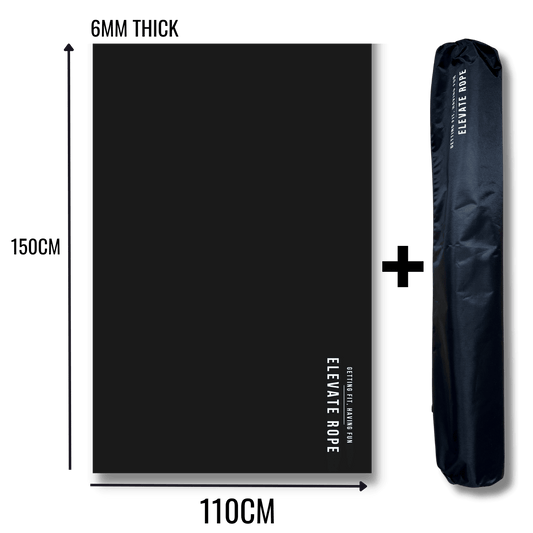
Our Elevate Jump Rope Mat measures 150 × 110 cm.
We chose those dimensions to accommodate a wider jumping area rather than just the space beneath your feet.
That matters because your cable contacts the floor outside your landing position.
A dedicated mat should also provide:
- Enough surface area for normal rope rotation.
- A stable, non-slip training surface.
- A relatively firm feel underfoot.
- A texture that allows the rope to travel smoothly.
- Practical storage between workouts.
That doesn't mean every dedicated mat is better than every alternative.
A large horse stall mat may be better for a permanent garage gym.
Sealed plywood may be more economical.
A low-pile rug may already meet your needs.
The right decision depends on your training environment.
Which Jump Rope Mat Alternative Protects Your Rope Best?
Surface texture matters as much as material.
A rough floor repeatedly rubs against the cable.
Over time, that contact can contribute to visible wear.
A smoother surface generally creates less abrasive contact.
But no surface makes a cable immune to wear.
Inspect the cable along its entire length.
Look for flattening, cracks, exposed core material, or unusual damage.
Our guide on straightening and maintaining PVC jump rope cables explains additional maintenance considerations.
The goal is simple.
Protect the rope where practical.
Replace damaged equipment before it fails.
Which Jump Rope Mat Alternatives Are Best for Apartments?
Apartment training adds another consideration.
Noise.
A surface can feel comfortable while still transmitting repeated impacts through the floor.
Dense rubber or a stable low-pile rug may help with some noise.
But neither guarantees that neighbours won't hear you.
Building construction, floor structure, training intensity, and footwear all affect the result.

Consider the following:
- Choose a stable, sufficiently wide surface.
- Avoid loose edges or sliding materials.
- Practice low, controlled jumps.
- Train during reasonable hours.
- Test whether noise travels into nearby rooms.
If noise remains a problem, changing your training location may be more effective than adding softer flooring.
For additional equipment ideas, explore our jump rope mat and mobility guide.
How to Choose the Best Jump Rope Mat Alternatives
Before buying anything, answer four questions.
Where Will You Train?
A permanent garage setup can accommodate heavy rubber.
A small apartment may require something portable.
How Often Will You Jump?
Frequent sessions make durability and convenience more important.
Occasional training may not justify a dedicated purchase.
What Surface Are You Covering?
Rough concrete creates different problems from smooth indoor flooring.
Consider both rope abrasion and stability.
What Is Your Biggest Concern?
If your priority is cable protection, look for a smooth surface.
If your priority is noise, consider the complete floor setup.
If your priority is portability, avoid extremely heavy materials.
The best jump rope mat alternatives solve your actual problem without introducing another one.
The Short Version: Which Alternative Should You Choose?
Here's how we'd make the decision.
- Garage with a permanent setup: Choose a dense horse stall mat.
- Garage with a limited budget: Consider sealed plywood on a stable base.
- Apartment with neighbours: Try a stable low-pile rug or a suitable dedicated mat.
- Occasional outdoor training: Consider no mat, with regular cable inspections.
- Thinking about foam tiles: Avoid soft tiles with raised or unstable seams.
- Considering a doubled yoga mat: Choose a wider, firmer surface instead.
Don't buy a mat simply because somebody tells you that you need one.
Choose a surface that fits how and where you actually train.
Conclusion: The Best Jump Rope Mat Alternative Depends on Your Setup
The best jump rope mat alternatives aren't necessarily the most expensive.
For a garage, a horse stall mat is difficult to beat.
For a tight budget, sealed plywood can work.
For indoor training, a stable low-pile rug may be enough.
And for occasional jumping, you may decide that no mat is necessary.
Whatever you choose, remember the essentials.
Wide enough for the rope. Firm enough for your feet. Stable enough to stay in place.
That's what matters.
Your equipment should make consistency easier, not more complicated.
Together We Elevate.
Watch Geraldo Alken demonstrate jump rope technique and rope control before choosing a surface for your next workout.
Frequently Asked Questions
What are the best jump rope mat alternatives?
The best jump rope mat alternatives include horse stall mats, dense rubber sheets, sealed plywood, and stable low-pile rugs. Horse stall mats suit permanent garage setups. Plywood offers a budget option. Low-pile rugs can work indoors. Choose a surface that's wide, firm, and stable enough for repeated jumping.
Can I use a yoga mat instead of a jump rope mat?
You can use a yoga mat for limited floor protection, but it isn't an ideal replacement. Most yoga mats are relatively narrow and compress underfoot. Folding one makes it thicker without increasing its width. A wider, firmer surface is usually more practical for regular rope skipping.
Are rubber stall mats good jump rope mat alternatives?
Yes, rubber stall mats can be effective jump rope mat alternatives for permanent training spaces. Their density and weight help provide a stable surface. However, some are difficult to move or have a strong rubber smell. Choose a flat texture and suitable dimensions before buying.
Can I jump rope on plywood over concrete?
Yes, plywood can provide a smoother surface than bare concrete when installed securely. Seal the edges to prevent splinters and check that the sheet doesn't slide or rock. It offers limited noise reduction and shouldn't be assumed to provide substantial cushioning. It's most practical in garages.
Do jump rope mat alternatives protect your knees?
A suitable surface may make jumping feel more comfortable, but no mat guarantees protection from knee injuries. Technique, training volume, footwear, and individual circumstances also matter. Choose a stable surface and increase your workload gradually. Stop if you develop persistent pain and seek appropriate medical advice.
Do I really need a jump rope mat?
Not necessarily. Many people jump rope without a dedicated mat. However, rough surfaces can increase cable wear, while hard floors may create noise or discomfort. A mat becomes more useful when you train frequently or need to protect your flooring. Consider your environment before buying additional equipment.
About Elevate Rope
Geraldo Alken is the founder and CEO of Elevate Rope. He designs jump ropes and works daily with jumpers, from beginners to professionals.
Elevate Rope helps people build lasting fitness habits through jump rope training, practical education, and community.
Our goal is to make movement more accessible and consistent.
Together We Elevate.