





The best jump ropes for HIIT and CrossFit depend on your experience, training intensity, and goals.
Speed ropes suit fast intervals and double-under practice. Beaded ropes provide more feedback for learning rhythm. Heavy ropes add resistance to demanding conditioning sessions.
You don't need the heaviest or fastest rope to get an effective workout.
You need one that matches what you're trying to improve.
Jump rope training is an accessible way to build cardiovascular fitness and coordination. It requires little space and can fit into short workouts.
But choosing the wrong equipment can make training unnecessarily frustrating.
This guide compares 15 jump ropes and training bundles from Elevate Rope, including speed, beaded, and heavy options.
You'll learn which equipment works best for beginners, HIIT intervals, CrossFit, endurance, and resistance training.
Some options are different designs or bundles rather than entirely different rope technologies. We'll explain those distinctions so you can choose confidently.
Why Jump Ropes Work Well for HIIT and CrossFit
High-intensity interval training, or HIIT, alternates demanding exercise with recovery periods.
Jumping rope fits naturally into this structure.
You can adjust your pace, change techniques, and alternate work intervals with rest.
For example, you might perform 30 seconds of jumping followed by 30 seconds of recovery.
As your fitness improves, you can modify the intensity or duration.
Cardiovascular Conditioning
Jumping rope can be vigorous aerobic exercise.
The CDC's physical activity guidance identifies jumping rope as an example of vigorous-intensity activity.
During vigorous exercise, speaking more than a few words without pausing for breath becomes difficult.
Research on HIIT and cardiovascular fitness also supports interval training as a way to improve cardiorespiratory fitness.
However, results depend on exercise intensity, training consistency, and individual fitness.
Coordination and Agility
Each rotation requires your hands and feet to work together.
This challenges timing, rhythm, and movement control.
Different jump ropes create different training demands.
A beaded design provides noticeable feedback.
A speed rope allows quicker rotations.
A heavy rope adds resistance to every turn.
CrossFit and Double Unders
CrossFit workouts frequently include jump rope movements.
Double unders require the cable to pass beneath your feet twice during one jump.
The CrossFit double-under technique guide explains the importance of timing, hand position, and consistent movement.
The best CrossFit jump rope is not necessarily the fastest available.
A rope with predictable handling may be more useful while developing technique.
What About Calorie Burning?
Jumping rope can contribute to energy expenditure and weight management.
However, claims about burning a fixed number of calories per hour need context.
Actual energy expenditure depends on body size, intensity, fitness, technique, and rest periods.
A HIIT workout also includes recovery intervals.
Avoid choosing jump ropes based on unrealistic calorie-burning promises.
Choose equipment that helps you train consistently.
How to Choose Jump Ropes for HIIT and CrossFit
Before comparing individual products, understand the main rope categories.

| Rope type | Best use | Main advantage | Main limitation |
| Beaded rope | Beginners, rhythm, freestyle | Noticeable tactile and audible feedback | More drag during fast rotations |
| PVC speed rope | HIIT, cardio, double unders | Faster, smoother rotations | Less feedback for beginners |
| Weighted speed rope | Conditioning with added cable resistance | Greater resistance while maintaining rope flow | More demanding than a standard speed rope |
| Heavy rope | Short resistance-focused intervals | Stronger upper-body loading | Harder to sustain for longer periods |
| Double Dutch ropes | Group coordination and conditioning | Shared rhythm and teamwork | Requires multiple participants |
Speed Ropes for HIIT
Speed ropes are a practical choice when you already have consistent jumping technique.
Their relatively light cables allow quick rotations.
That makes them suitable for fast intervals, conditioning, and double-under practice.
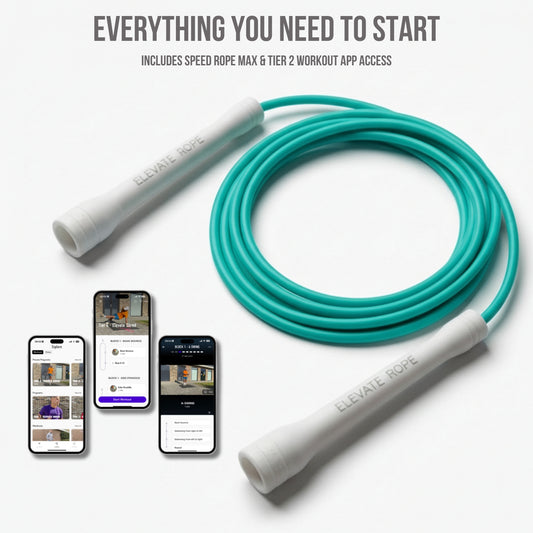
The Elevate Speed Rope MAX uses a PVC cable with a nylon core.
Its bearing-free design provides rotation controlled by your wrists.
You can explore the Speed Rope collection to compare available models.
Beaded Jump Ropes for Beginners
Beaded ropes provide feedback through their segmented construction.
The beads create noticeable resistance during rotation.
This helps some beginners understand the rope's position.
Beaded jump ropes are useful for basic jumps, footwork, freestyle practice, and controlled intervals.
They remain a practical training option even after you learn the basics.
Heavy Jump Ropes for Resistance
Heavy ropes use thicker, more demanding cables.
They require greater effort to rotate compared with standard speed ropes.
This can increase the challenge for your shoulders, forearms, and grip.
However, heavier doesn't automatically mean better.
These ropes generally suit shorter conditioning intervals rather than prolonged speed practice.
15 Best Jump Ropes for HIIT and CrossFit Workouts
The following selection preserves the 15 options from the original Elevate Rope comparison.
It includes individual jump ropes, colour variations, and multi-rope bundles.
Some older names now appear differently in the current collection.
Where a previous model cannot be confirmed as a current standalone product, we've identified the closest relevant range.
These are recommendations by training purpose, not laboratory-tested performance rankings.
1. Elegance Beaded Jump Rope: Best for Beginner Rhythm
The Elegance Beaded Jump Rope is a practical starting point for new jumpers.
Its adjustable beaded construction provides audible and tactile feedback.
That helps you recognize the rope's rhythm during basic jumps.
Best for: Beginners, footwork, freestyle, and controlled cardio intervals.
Why choose it: The beads make rotation easier to feel than a thin cable.
Consider first: The added drag makes it less suited to maximum-speed double unders.
If you're new to jump rope workouts, prioritize clean technique before increasing intensity.
2. Elevate Speed Rope MAX Confidence: Best for Fast Cardio
The Speed Rope MAX Confidence belongs to Elevate's speed-focused range.
Its cable construction is designed for smooth, controlled rotations.
This makes it a practical option for athletes building faster skipping intervals.
Best for: HIIT cardio, quicker single unders, and double-under practice.
Why choose it: A speed-focused rope supports faster rotations without the bulk of beaded designs.
Consider first: Beginners may need more time to develop timing with a faster cable.
The older Confidence listing may not always be available. Check the current speed range before purchasing.
3. Ascent Bundle: Best Beginner-to-Intermediate Progression
The Ascent Bundle combines beaded and speed jump ropes.
This gives you two different training styles.
Start with the beaded rope to develop consistent rhythm.
Then introduce the speed rope for faster cardio intervals.
Best for: Beginners planning to progress toward HIIT and CrossFit.
Why choose it: You can change rope types as your technique improves.
Consider first: A bundle costs more than buying one rope.
However, it may be practical if you already intend to train with both styles.
4. Elevate Maestro PVC Jump Rope: Classic Speed-Rope Option
The Elevate Maestro appeared in the original comparison as a PVC speed rope.
Its appeal was straightforward: a flexible cable suitable for general cardio and technique practice.
The former Maestro product listing belongs to an older product range.
Best for: Athletes looking for the handling characteristics of a traditional PVC speed rope.
Why consider it: PVC cables can provide a useful balance between rotation speed and feedback.
Consider first: The Maestro's current standalone availability has not been confirmed.
For a currently documented alternative, browse Elevate's Speed Ropes.
Avoid assuming an older model has the same specifications as its replacement.
5. Elevate Gravity Heavy Rope Optimism: Resistance-Focused Training
The original Optimism model was part of Elevate's heavy-rope selection.
Heavy jump ropes are designed to make each rotation more physically demanding.
This makes them relevant for resistance-focused conditioning.
Best for: Short, demanding intervals and experienced jumpers.
Why consider it: Additional cable resistance changes the effort required during each turn.
Consider first: Heavy ropes can tire your upper body before your cardiovascular capacity becomes the limiting factor.
The original Optimism model's current availability is unconfirmed.
Compare the current Heavy Rope collection for available options.
6. Pink Demon Beaded Jump Rope: Beginner Control With Personality
The Pink Demon Beaded Jump Rope combines a distinctive colour design with beaded-rope handling.
Its segmented construction gives you feedback during rotation.
That makes it suitable for coordination drills and freestyle combinations.
Best for: Beginners, rhythmic HIIT intervals, and jump rope tricks.
Why choose it: The rope provides the same general feedback advantages associated with beaded designs.
Consider first: Colour doesn't make one beaded rope inherently faster or more effective than another.
Choose the style you enjoy using.
7. Rainbow Beaded Jump Rope: Best for Freestyle Variety
The Rainbow Beaded Jump Rope offers another beaded option.
Its visible segments help you follow the rope's movement.
This can be useful when learning footwork, crosses, or combinations.
Best for: Freestyle practice, coordination, and controlled conditioning.
Why choose it: Beaded feedback helps maintain rhythm while learning new skills.
Consider first: It's not necessarily a better HIIT rope than Elegance or Pink Demon.
The primary differences are appearance and personal preference.
8. Elevate Speed Rope MAX Tranquility: Best for Repeatable Speed Intervals
The Speed Rope MAX Tranquility uses a 5 mm PVC cable with a nylon core.
Its bearing-free construction is designed for controlled rotation.
The rope can be adjusted to fit the user.
Best for: HIIT intervals, sustained cardio, and double-under development.
Why choose it: Its cable provides more physical feedback than many very thin wire ropes.
Consider first: You still need consistent timing and appropriate rope length.
A faster rope cannot compensate for poor technique.
9. Sweet Harmony Beaded Jump Rope: Best for Skill-Based Cardio
The Sweet Harmony Beaded Jump Rope is another option for rhythmic jumping.
Its segmented cable provides feedback through the hands and arms.
This helps when practicing controlled changes in footwork.
Best for: Beginners, freestyle, and varied cardio sessions.
Why choose it: Its beaded construction is helpful for learning movement patterns.
Consider first: Beaded ropes are not the most efficient choice for maximum-speed rotations.
They prioritize feedback rather than pure speed.
10. Double Dutch Rope: Best for Group Training
The Elevate Unity Double Dutch Rope Set includes two matched ropes.
Each rope measures approximately 14 feet.
The set is designed for coordinated turning and group skipping.
Best for: Team conditioning, school programmes, clubs, and community workouts.
Why choose it: Double Dutch challenges rhythm, communication, and coordination.
Consider first: This is not a normal solo HIIT rope.
Double Dutch requires turners and a jumper.
Choose it for group sessions rather than individual CrossFit workouts.
11. Unicorn Beaded Jump Rope: Best for Enjoyable Beginner Training
The Unicorn Beaded Jump Rope brings another visual option to the beaded range.
The construction supports controlled rotations and basic skill development.
Like other beaded designs, it can work well for beginner intervals.
Best for: Recreational skipping, beginner cardio, and freestyle practice.
Why choose it: A rope you enjoy using can make your routine easier to repeat.
Consider first: There is no established performance advantage from the Unicorn colourway alone.
Availability may vary.
12. Ascent MAX Bundle: Best All-Round Training Selection
The Ascent MAX Bundle combines three complementary rope types.
It includes beaded, speed, and heavy-rope training options.
This covers several stages of development.
Use the beaded rope for timing.
Switch to the speed rope for fast intervals.
Introduce the heavy rope when you want additional resistance.
Best for: Athletes combining cardio, technique, and strength-focused conditioning.
Why choose it: Different ropes let you change the workout demand without abandoning jumping.
Consider first: You may not need three ropes when starting out.
Build a consistent routine before trying every variation.
13. Athlete Bundle: Best for Multiple Training Goals
The Athlete Bundle provides four ropes within one training system.
It is designed for people who want more options for skill and conditioning work.
Different cable types can support different training sessions.
Best for: Regular jumpers, mixed conditioning, and skill development.
Why choose it: It provides a broader selection for athletes who frequently change their training focus.
Consider first: A larger bundle does not automatically improve results.
Choose it when you know you'll use the variety.
14. Elevate Speed Rope MAX Power: Fast-Rotation Alternative
The Speed Rope MAX Power was included in the original selection as a performance-focused model.
Its role was similar to the other speed ropes: quicker rotations for cardio and technical practice.
The older MAX Power product URL now presents the current bearing-free speed-rope design.
Best for: Speed intervals, agility training, and CrossFit practice.
Why consider it: A controlled PVC cable is useful for repeatable fast rotations.
Consider first: Confirm the colour and exact model before ordering.
Do not assume the current listing retains every specification from the original Power version.
15. Elevate Gravity Heavy Rope Aspiration: Best for Short Resistance Intervals
The Gravity Heavy Rope Aspiration adds substantial resistance to the skipping movement.
Its documented construction includes a 10 mm PVC cable with a nylon core.
The heavier cable demands more effort from your arms and shoulders.
Best for: Short conditioning intervals and experienced jumpers seeking greater resistance.
Why choose it: It changes the training stimulus without requiring a separate resistance exercise.
Consider first: It isn't intended to replace a speed rope for double-under practice.
Start with manageable intervals and progress carefully.
Best Jump Ropes Compared: Which Should You Choose?
The 15 options serve different purposes.
Some are colour variations. Others combine multiple rope types.
The most useful comparison is based on training goals.
| Training goal | Recommended option | Main reason |
| First jump rope workout | Elegance Beaded Rope | Noticeable rotation feedback |
| Beginner rhythm and freestyle | Pink Demon, Rainbow, Sweet Harmony, or Unicorn | Beaded construction |
| Fast HIIT intervals | Speed Rope MAX Confidence or Tranquility | Controlled, faster rotation |
| CrossFit double unders | Speed Rope MAX | Speed-focused cable |
| Adding resistance | Gravity Heavy Rope Aspiration | Heavier cable |
| Learning and progressing | Ascent Bundle | Beaded and speed combination |
| Mixed cardio and resistance | Ascent MAX | Three different rope types |
| Broader training variety | Athlete Bundle | Four-rope selection |
| Group coordination | Unity Double Dutch | Two matched group ropes |
For many people, the decision comes down to three questions.
Are you still learning timing?
Do you want faster rotations?
Or do you want more resistance?
Answer those first.
How to Use Jump Ropes in HIIT Intervals
Choosing equipment is only the first step.
Your workout structure determines how challenging the session becomes.

The best HIIT jump ropes should help you maintain controlled movement throughout your intervals.
Beginner HIIT Workout
Start with a beaded rope.
Try the following routine:
| Interval | Activity |
| 20 seconds | Basic jumps |
| 40 seconds | Rest |
| 20 seconds | Basic jumps or boxer step |
| 40 seconds | Rest |
Repeat for 5 rounds after warming up.
This provides 10 minutes of interval practice.
Keep the effort manageable rather than forcing maximum speed.
Intermediate HIIT Workout
Use a speed rope when your basic jumping is consistent.
| Interval | Activity |
| 30 seconds | Fast basic bounce |
| 30 seconds | Recovery |
| 30 seconds | Boxer step |
| 30 seconds | Recovery |
Repeat the sequence 5 times.
Increase speed only while maintaining technique.
Advanced Resistance Intervals
Experienced jumpers can use a heavy rope for shorter efforts.
Try:
- 20 seconds of controlled heavy-rope jumping
- 40 seconds of recovery
- Repeat for 5 rounds
Adjust the work and recovery periods to match your conditioning.
Do not sacrifice technique simply to complete the interval.
Heavy-rope fatigue can affect your shoulders, grip, and timing.
Stop if control deteriorates.
Which Jump Rope Is Best for CrossFit Double Unders?
For CrossFit athletes, rope length and consistent rotation are essential.
A speed rope is generally the most practical choice for double-under practice.
But not everyone needs the thinnest possible cable.
A PVC speed rope may offer more feedback while you're learning.
A thinner wire cable may suit advanced speed-focused training.
Neither design automatically guarantees successful repetitions.
Three Things to Check
1. Rope length
An excessively long rope can strike the ground too early.
A rope that's too short reduces clearance.
Adjust in small steps.
2. Hand position
Keep your hands reasonably close to your hips.
Large outward arm movements can change the cable's path.
3. Timing
A double under requires controlled jump height and quick rotation.
Focus on repeatable movements before increasing speed.
If you're still struggling with basic rotations, spend time with a beaded rope first.
Mastering the foundation makes faster training more manageable.
Are Heavy Jump Ropes Better for Strength and Endurance?
Heavy jump ropes create greater resistance than standard speed ropes.
This can make short sets more demanding for the upper body.
But added resistance doesn't guarantee superior fitness results.
The training effect depends on how you structure your sessions.
For long, continuous cardio, a speed rope may be more practical.
For short resistance-focused intervals, a heavy rope can provide useful variety.
For skill development, beaded ropes remain valuable.
Don't assume one rope must accomplish every goal.
Using different equipment can make sense when each option has a clear purpose.
How to Maintain Your HIIT Jump Rope
A reliable training setup needs more than the right rope.
Regular equipment checks help you spot damage before your next workout.
Inspect the cable or beads after training on rough surfaces.
Look for deep cuts, splitting, exposed material, and loose handle connections.
Wipe away dirt and moisture.
Store the rope without sharp bends or tight knots.
Choose a stable surface and enough surrounding space.
Cable wear is normal over time, especially with frequent outdoor use.
Replace damaged components rather than continuing with unreliable equipment.
Good maintenance supports consistent training.
It cannot guarantee that a rope will last forever.
Common Mistakes When Choosing Jump Ropes for HIIT
Buying the Fastest Rope as a Beginner
Fast rotation isn't helpful if you cannot control it.
A beaded rope may provide the feedback you need first.
Choosing Heavy Ropes for Every Workout
Heavy ropes are useful for resistance-focused intervals.
They are less practical for every type of cardio or technical practice.
Ignoring Rope Length
Incorrect length can disrupt timing regardless of the rope's quality.
Check sizing before judging a product.
Assuming Every Product Is Technically Different
Many beaded products share similar construction.
Colour may be the main difference.
Similarly, bundles combine existing rope types.
Compare what you're actually getting before purchasing.
Training Without a Progression Plan
Jump ropes are tools.
They don't replace a consistent routine.
Start with manageable sessions and increase demands gradually.
The right rope helps. The habit is what moves you forward.
Conclusion: Choose the Best Jump Rope for Your HIIT Goals
The best jump ropes for HIIT and CrossFit aren't necessarily the fastest, heaviest, or most expensive.
They are the ones that suit your current training needs.
Choose a beaded rope when learning rhythm and coordination.
Choose a speed rope for fast intervals and double-under practice.
Choose a heavy rope for additional resistance during shorter sessions.
If you want to switch between these styles, a bundle may be practical.
You don't need to buy all 15 options.
You need equipment that helps you train consistently.
Start with the rope that matches your goal. Build your technique. Then progress with purpose.
Together We Elevate.
Watch Geraldo Alken demonstrate a 30-minute jump rope HIIT workout featuring footwork, speed intervals, and recovery.
Frequently Asked Questions
What are the best jump ropes for HIIT beginners?
The best jump ropes for HIIT beginners usually provide enough feedback to develop timing. A beaded rope can help you feel each rotation and establish rhythm. Once you can jump consistently, a speed rope becomes useful for faster intervals. Prioritize appropriate length and controlled technique over maximum rotation speed.
Are speed jump ropes better for CrossFit?
Speed jump ropes are useful for CrossFit workouts involving quick singles and double unders. Their lighter cables support faster rotation, provided you already have sufficient timing and wrist control. However, beginners may benefit from practicing with a beaded rope first. Consistent technique matters more than selecting the fastest available model.
Can heavy jump ropes improve HIIT workouts?
Heavy jump ropes add resistance during each rotation, making intervals more demanding for the shoulders, arms, and grip. They can provide useful variety for experienced jumpers. However, they are not automatically better for every workout. Use manageable intervals and avoid replacing all cardio sessions with heavy-rope training.
Are beaded jump ropes suitable for high-intensity training?
Yes, beaded jump ropes can be used for HIIT workouts, particularly when control and coordination are priorities. The beads create noticeable feedback during rotation, helping you maintain rhythm. However, their additional drag limits maximum turning speed compared with many speed ropes. Choose them for skill-focused intervals rather than maximum-speed double unders.
Should I buy one jump rope or a bundle?
One properly sized rope can be enough for an effective workout routine. Beginners may prefer starting with a single beaded rope. A bundle becomes useful when you regularly switch between technique, speed, and resistance sessions. Choose based on the types you'll actually use, rather than assuming more equipment means better results.
How often should I use jump ropes for HIIT?
Training frequency depends on your fitness, recovery, and other exercise commitments. Beginners should start with manageable sessions and allow time to adapt. Experienced jumpers can incorporate intervals into a broader fitness programme. Monitor fatigue, maintain technique, and increase training demands gradually. Consistency matters more than completing intense sessions every day.
About Elevate Rope
Elevate Rope is a jump rope fitness brand founded by Geraldo Alken.
We help people build consistent fitness habits through equipment, training guidance, and community.
Our approach focuses on making movement more accessible, enjoyable, and sustainable.
Whether you're learning your first basic jump or training for demanding intervals, progress begins with repeated action.
Together We Elevate.